Sales Strategy
Revenue Forecasting: Enhancing Accuracy in B2B Sales
The Sales Coach Network8 min read


For many British B2B IT firms, what looks like a robust sales pipeline often results in lacklustre win rates and unpredictable quarters. With long buying cycles and complex deals, relying on surface-level projections can seriously hinder revenue planning. Nearly two thirds of all B2B sales forecasts miss their targets, highlighting why strategic revenue forecasting is now mission-critical for senior revenue leaders. Discover how mastering this discipline can transform chaotic estimates into data-driven confidence for your next growth phase.
Table of Contents
Key Takeaways
Point | Details |
Revenue Forecasting is Collaborative | Successful forecasting requires input from Sales, Marketing, Customer Success, and Finance to enhance accuracy and incorporate diverse insights. |
Utilise Multiple Forecasting Models | Implement a hybrid forecasting approach combining different models to improve reliability and mitigate individual methodology biases. |
Leverage Technology and Advanced Analytics | Incorporate sophisticated techniques such as machine learning to adapt forecasts based on real-time data and emerging market signals. |
Continuous Improvement and Validation | Establish regular cross-functional reviews and validation processes to refine forecasting methodologies and detect discrepancies. |
What Revenue Forecasting Really Means
Revenue forecasting is a sophisticated strategic process that goes far beyond simple number-crunching. At its core, revenue forecasting represents a structured method of estimating future sales by integrating historical performance data, current pipeline insights, and nuanced business assumptions.
In the complex world of business-to-business sales, this practice involves meticulously analysing multiple data streams to construct predictive financial models. Key components typically include tracking historical revenue trends, assessing current sales pipeline dynamics, evaluating potential conversion rates, and understanding potential market disruptions. Senior revenue leaders rely on these forecasts to make critical strategic decisions about resource allocation, hiring, investment, and growth trajectory.
Successful revenue forecasting is not a solitary finance function but a collaborative endeavour involving multiple departments. Sales, Marketing, Customer Success, and Finance must collectively own and contribute to the forecasting process. This cross-functional approach ensures a more holistic and accurate prediction by incorporating diverse perspectives and data points. Modern forecasting approaches leverage advanced analytics, predictive modelling techniques, and increasingly sophisticated software platforms to enhance accuracy and provide real-time insights.
Pro Tip: Quarterly Review Strategy: Conduct monthly forecast reviews with cross-functional teams, comparing initial projections against actual performance and immediately adjusting your predictive models to improve future accuracy.
Types of Revenue Forecasting Models
Revenue forecasting encompasses a diverse range of sophisticated models designed to predict future financial performance. Test-market analysis represents one approach, where organisations launch products in controlled environments to assess potential performance before full-scale deployment.
The landscape of revenue forecasting models is rich and multifaceted. Key methodologies include moving averages, which analyse historical data trends, exponential smoothing for weighted recent performance analysis, and advanced regression models that incorporate complex economic variables. Advanced techniques now leverage artificial intelligence and machine learning algorithms capable of detecting intricate patterns and dynamically adapting predictive models as new data becomes available.
Moreover, contemporary revenue forecasting strategies often blend multiple approaches to enhance accuracy. Sophisticated models like weighted pipeline forecasting analyse potential deal conversions, while scenario-based forecasting allows organisations to model potential outcomes under varying economic conditions. Some advanced techniques even incorporate machine learning algorithms that continuously refine predictive capabilities by learning from historical performance data and emerging market signals.
To better understand the strengths and limitations of common revenue forecasting models, consider the following comparison:
Model Type | Key Strength | Limitation | Best Use Case |
Moving Average | Smooths short-term noise | Lags behind rapid changes | Stable, seasonal businesses |
Exponential Smoothing | Weights recent trends | Can overreact to anomalies | Markets with shifting patterns |
Regression Analysis | Incorporates multiple variables | Requires significant data | Complex, multivariate contexts |
Weighted Pipeline | Reflects current pipeline health | Depends on accurate inputs | B2B sales with tracked stages |
AI/ML Algorithms | Learns from patterns | Needs ongoing data training | Fast-changing, data-rich firms |
Pro Tip: Model Diversification Strategy: Implement a hybrid forecasting approach that combines at least three different predictive models to reduce individual methodology bias and improve overall forecast reliability.
How Forecasting Works in B2B Sales
Sales forecasting in B2B environments represents a comprehensive process of estimating future revenue by synthesising multiple data streams and strategic insights. This intricate methodology goes beyond simple number-crunching, requiring a holistic approach that integrates quantitative analysis with nuanced business intelligence.
The forecasting process typically involves several critical components. First, organisations systematically analyse historical sales performance, examining patterns, trends, and seasonal variations. Next, current pipeline activity is meticulously evaluated to translate potential sales opportunities into projected revenue outcomes. This involves assessing factors such as lead quality, opportunity stage, deal size, and estimated probability of closure. Advanced forecasting models incorporate both quantitative metrics and qualitative insights, allowing revenue leaders to create more robust predictive frameworks.

Successful B2B sales forecasting demands a multidimensional approach that transcends traditional linear predictions. Modern organisations utilise sophisticated techniques that blend statistical modelling, machine learning algorithms, and contextual business intelligence. Key considerations include market dynamics, competitive landscape, economic indicators, and internal performance metrics. By integrating these diverse data points, revenue teams can develop more nuanced and adaptive forecasting models that provide meaningful strategic guidance.
Pro Tip: Forecasting Precision Strategy: Implement a quarterly validation process where actual performance is rigorously compared against initial forecasts, systematically identifying and addressing predictive discrepancies to continually refine your forecasting methodology.
Common Mistakes and Major Pitfalls
A staggering proportion of B2B sales organisations continue to rely on intuitive guesswork rather than rigorous data analytics when forecasting revenue, creating substantial risks for strategic planning and business performance. This persistent dependence on gut feeling undermines the fundamental principles of accurate revenue prediction.
Several critical mistakes consistently emerge in B2B revenue forecasting. Overreliance on historical data without contextual interpretation can lead to myopic predictions that fail to account for market shifts. Equally problematic is the tendency to underestimate pipeline complexity, where sales teams neglect to thoroughly assess the nuanced probability of deal closure across different opportunity stages. Many organisations also struggle with siloed forecasting, where individual departments operate without comprehensive cross-functional communication, resulting in fragmented and potentially misleading projections.
Moreover, technological limitations and cultural resistance frequently impede sophisticated forecasting approaches. Sales teams often lack the advanced analytical tools and machine learning capabilities required to develop truly predictive models. Cultural barriers, such as entrenched intuition-based decision-making and resistance to data-driven methodologies, further complicate the implementation of robust forecasting strategies. The most successful organisations recognise that effective revenue forecasting demands a holistic approach that combines sophisticated technological infrastructure, cross-functional collaboration, and a commitment to continuous methodology refinement.
Pro Tip: Forecast Validation Protocol: Implement a monthly cross-departmental review process where actual performance metrics are rigorously compared against initial forecasts, systematically identifying and documenting predictive discrepancies to drive continuous improvement.
Improving Forecast Accuracy and Reliability
Enhancing revenue forecasting precision demands a strategic, multifaceted approach that transcends traditional predictive methodologies. Advanced organisations are increasingly adopting sophisticated simulation techniques like Monte Carlo analysis to dramatically reduce forecast error margins, providing more robust and nuanced revenue projections.
Key strategies for improving forecast reliability include implementing granular data collection processes, developing comprehensive probabilistic models, and fostering a culture of continuous forecast refinement. Critical components involve breaking down complex sales pipelines into measurable, discrete stages, assigning precise probability weightings to each opportunity, and continuously calibrating predictive algorithms based on real-world performance data. Organisations must invest in advanced analytical capabilities that can dynamically adjust forecasts in response to emerging market signals, competitive dynamics, and internal performance metrics.
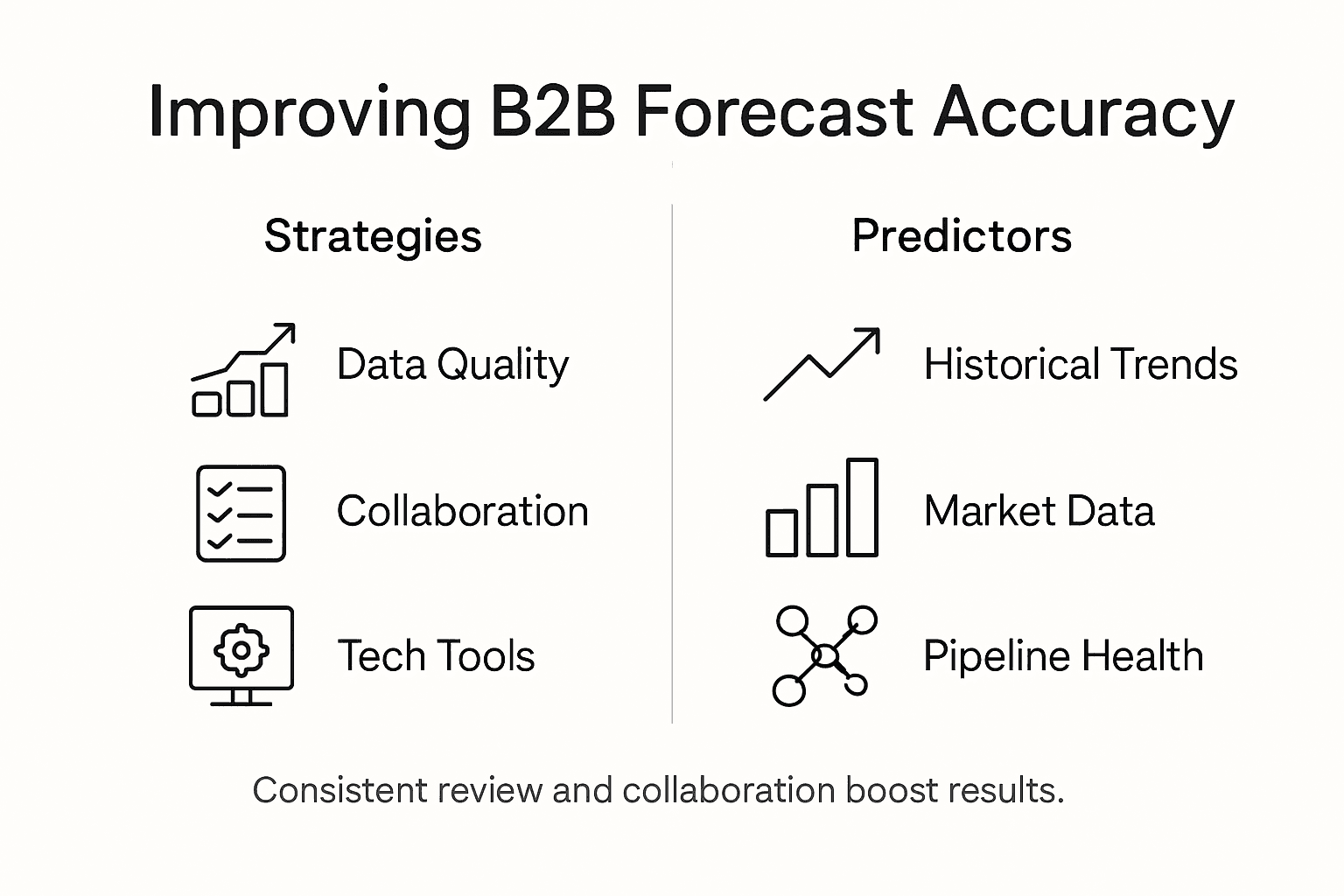
Successful forecast improvement requires a holistic approach that integrates technological infrastructure, cross-functional collaboration, and organisational commitment to data-driven decision-making. This means developing sophisticated machine learning models capable of detecting subtle patterns, creating transparent forecasting methodologies that encourage accountability, and establishing rigorous validation mechanisms that systematically compare projected outcomes against actual performance. By treating forecasting as a continuous improvement process rather than a static annual exercise, revenue leaders can progressively enhance their predictive capabilities and strategic planning effectiveness.
Below is a summary of effective strategies to improve forecast accuracy and reliability:
Enhancement Strategy | Expected Result | Organisational Prerequisite |
Granular opportunity analysis | Finer resolution, better predictions | Detailed pipeline tracking |
Scenario simulation (e.g., Monte Carlo) | Reduced forecast error margins | Advanced analytics capability |
Continuous cross-functional review | Early error detection and model refinement | Strong collaborative culture |
Ongoing machine learning calibration | Adaptive forecasts responding to change | Accessible historical datasets |
Pro Tip: Forecast Precision Protocol: Implement a quarterly cross-functional forecast review process where predictive models are systematically stress-tested against multiple scenario simulations, ensuring robust and adaptable revenue projection strategies.
Drive Predictable Revenue with Expert Sales Coaching
The challenges outlined in the article highlight how complex B2B sales environments struggle with revenue forecasting accuracy due to fragmented data, siloed teams, and unreliable pipeline insights. If your organisation is facing unpredictable revenue, stalled deals, or inconsistent sales performance it is essential to adopt a holistic approach that aligns strategy, enablement, and disciplined execution.
At The Sales Coach Network we specialise in partnering with senior revenue leaders to embed scalable sales operating systems that transform forecasting reliability and sales velocity. Our proven frameworks such as the Sales Ecosystem Framework and the VALID Differentiation Framework equip your teams to improve pipeline quality, increase win rates and shorten sales cycles. By combining leadership training with ongoing coaching we ensure that new behaviours stick and forecasting accuracy improves sustainably.
Ready to move beyond guesswork and build a revenue forecasting process driven by collaboration and data-driven discipline? Discover how our tailored sales training and coaching solutions can help you adapt to market changes and accelerate revenue growth today. Visit The Sales Coach Network to unlock your team’s full potential.
Frequently Asked Questions
What is revenue forecasting in B2B sales?
Revenue forecasting in B2B sales is a strategic process that estimates future sales by analysing historical performance data, current sales pipelines, and business assumptions. It helps businesses make informed decisions about resource allocation and growth strategies.
What are the types of revenue forecasting models?
There are several revenue forecasting models, including moving averages, exponential smoothing, regression analysis, weighted pipeline forecasting, and advanced AI/ML algorithms. Each model has its strengths and limitations, making them suitable for different business contexts.
How can businesses improve the accuracy of their revenue forecasts?
Businesses can enhance forecast accuracy by implementing granular data collection, developing probabilistic models, and fostering a culture of continuous improvement through regular cross-functional reviews and stress-testing predictive models against various scenarios.
What common mistakes should be avoided in revenue forecasting?
Common mistakes include over-reliance on historical data without context, underestimating pipeline complexity, siloed forecasting practices, and insufficient analytical tools. These issues can lead to inaccurate predictions and impact strategic planning.
Recommended