Sales Strategy
What Is Account Management – Impact on B2B Sales
The Sales Coach Network8 min read


More than 60 percent of British B2B IT leaders report that ineffective account management holds back pipeline quality and extends sales cycles. For CROs and VPs of Sales, the complexity of client ecosystems disrupts predictable growth and profitability. With mounting pressure for smarter strategy, understanding the core principles behind modern account management shines a spotlight on new approaches that shape loyalty, expand revenue, and streamline operations.
Table of Contents
Key Takeaways
Point | Details |
Strategic Focus | Effective account management emphasises relationship-building over transactional interactions, requiring organisations to understand their clients’ unique dynamics. |
Types of Management | B2B account management can be categorised into three types: Traditional, Key, and Global, each tailored to different client complexities and engagement needs. |
Role of Account Managers | Account managers act as strategic partners, fostering deep client relationships and coordinating cross-functional efforts to enhance service delivery and value. |
Revenue Growth Mechanism | Strong account management practices lead to increased customer retention and create opportunities for upselling, ultimately driving sustainable revenue growth. |
Account Management Defined – Core Principles
Account management represents a sophisticated strategic approach to nurturing and developing business relationships, moving far beyond traditional sales transactions. At its core, account management is about creating sustained value through deliberate, relationship-focused interactions with key clients.
The fundamental principles of account management centre on understanding that client relationships are complex ecosystems requiring nuanced, strategic engagement. Strategic collaboration and customer orientation emerge as critical elements, demanding a holistic approach that transcends simple transactional interactions. Organisations must develop adaptive strategies that recognise each client’s unique organisational dynamics, challenges, and growth potential.
Effective account management demands comprehensive cross-functional commitment. Research indicates that successful programmes integrate insights from multiple departments, ensuring a cohesive approach to client relationship development. This means sales professionals must collaborate closely with marketing, customer service, product development, and strategic planning teams to create genuinely integrated client experiences.
Pro Tip - Strategic Relationship Building: Develop a systematic approach to understanding each client’s business ecosystem, mapping their organisational structure, key decision-makers, and long-term strategic objectives to create tailored engagement strategies.
Types of Account Management in B2B Context
B2B account management encompasses several sophisticated approaches, each designed to address different organisational complexities and client relationship dynamics. Comprehensive taxonomies of account management reveal distinct strategic categories that organisations can deploy based on their specific business requirements and market positioning.
Three primary types of account management emerge as critical in the B2B landscape: traditional account management, key account management, and global account management. Traditional approaches focus on transactional relationships and standard sales processes, typically managing smaller or less strategically significant clients. Key account management, by contrast, represents a more sophisticated model targeting high-value, strategically important clients that require personalised, in-depth engagement strategies.
Global account management represents the most complex and advanced form of B2B relationship management. This approach involves creating dedicated teams that can navigate multinational client structures, understanding intricate organisational landscapes across different geographic and cultural contexts. Such programmes demand exceptional cross-functional coordination, enabling businesses to deliver consistent, integrated experiences for large, geographically dispersed clients.
The table below distinguishes the main B2B account management types and highlights key attributes for each:
Approach | Focus Area | Organisational Complexity | Client Engagement Style |
Traditional Account Mgt | Standard sales transactions | Low to moderate | Reactive, transactional |
Key Account Mgt | High-value strategic clients | Moderate to high | Proactive, tailored strategies |
Global Account Mgt | Multinational client networks | Very high | Integrated, cross-border teams |
Pro Tip - Strategic Account Classification: Develop a rigorous scoring mechanism to categorise client accounts based on potential revenue, strategic alignment, and complexity, enabling targeted resource allocation and relationship management strategies.
Key Roles and Responsibilities Explained
Account managers in B2B contexts occupy a complex strategic role that transcends traditional sales responsibilities. Their core responsibilities involve sophisticated relationship management and value co-creation, requiring a multifaceted approach to client engagement and organisational alignment.

The primary responsibilities of account managers can be categorised into several critical domains. Strategic relationship development demands continuous engagement, requiring professionals to understand client business ecosystems, anticipate needs, and proactively design solutions. This involves deep research, regular communication, and the ability to translate client challenges into tailored strategic interventions. Account managers must also serve as internal advocates, coordinating across multiple departments to ensure comprehensive client support and seamless service delivery.
Communication and stakeholder management represent another crucial dimension of account management responsibilities. Professionals must navigate complex organisational hierarchies, building relationships with decision-makers at multiple levels while maintaining a holistic view of the client’s strategic objectives. This requires exceptional interpersonal skills, strategic thinking, and the ability to translate technical capabilities into compelling business value propositions that resonate with executive leadership.
The following table summarises core account manager responsibilities and their business contribution:
Responsibility | Description | Business Impact |
Strategic Relationship Dev. | Build trust and anticipate needs | Stronger loyalty and retention |
Cross-functional Coordination | Align departments for client support | Improved service delivery |
Stakeholder Management | Engage all relevant decision-makers | More effective client influence |
Value Proposition Delivery | Align solutions with client strategy | Upselling and revenue growth |
Pro Tip - Relationship Mapping: Develop a comprehensive stakeholder relationship matrix that tracks key contacts, their influence levels, communication preferences, and strategic priorities to enable more targeted and effective engagement strategies.
How Account Management Drives Revenue Growth
Account management represents a strategic lever for sustainable revenue generation in B2B environments, transforming traditional sales approaches into sophisticated value-creation mechanisms. Empirical research demonstrates a direct correlation between sophisticated account management practices and enhanced profitability, revealing how systematic relationship management can substantially impact organisational financial performance.
The revenue growth mechanism of account management operates through multiple interconnected pathways. Customer retention emerges as a primary driver, with well-managed accounts demonstrating significantly higher loyalty and lifetime value. By developing deep understanding of client ecosystems, account managers can identify expansion opportunities, design targeted upselling strategies, and create tailored value propositions that extend beyond initial contract parameters. This approach enables organisations to incrementally increase revenue from existing client relationships while reducing customer acquisition costs.
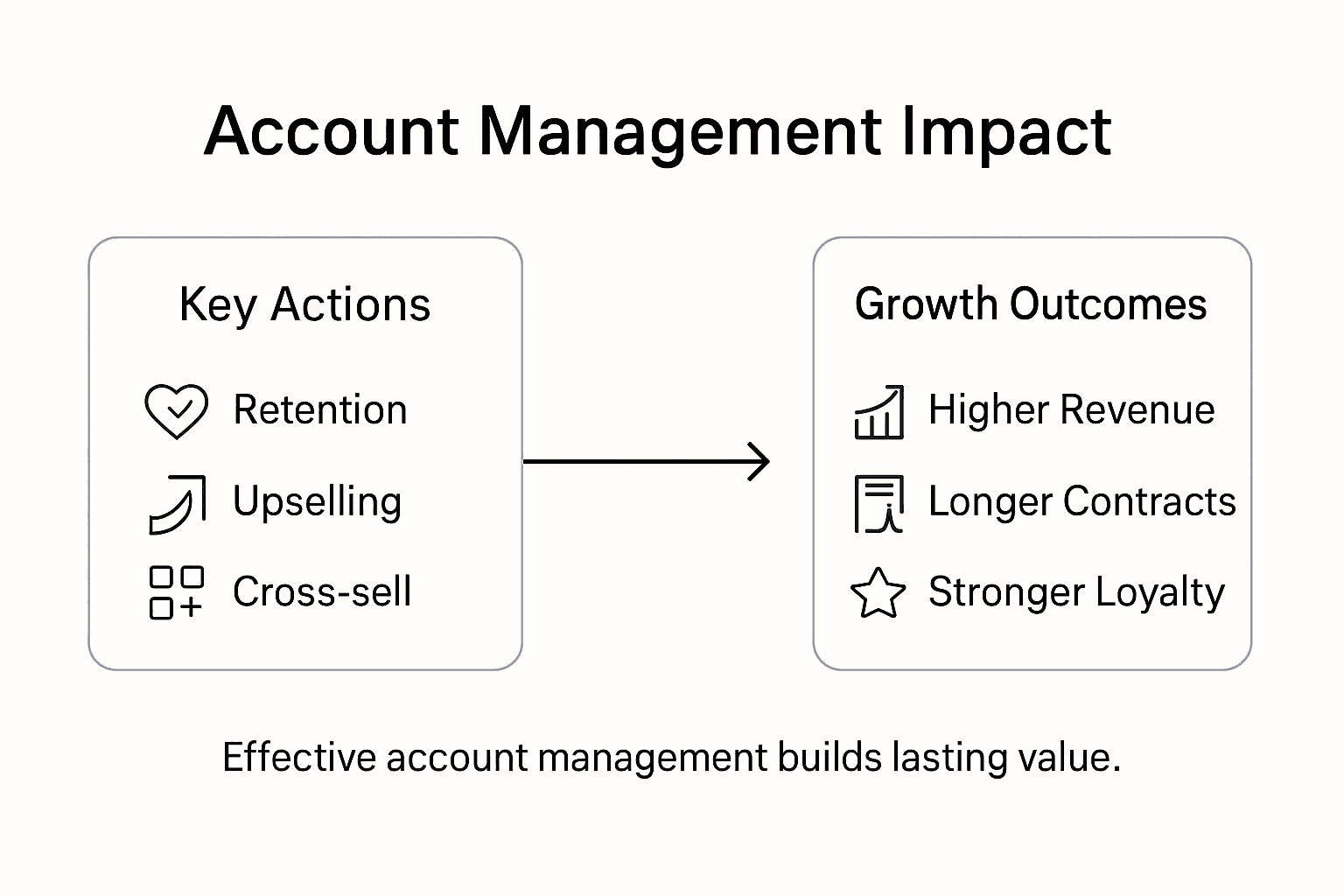
Strategic account management also generates revenue growth by facilitating more complex, multi-dimensional engagement models. Professionals who understand client strategic objectives can position themselves as trusted advisors, moving beyond transactional interactions to become integral partners in their clients’ success. This elevated relationship status allows for more comprehensive service offerings, higher-value contracts, and sustainable long-term revenue streams that are less susceptible to market fluctuations.
Pro Tip - Revenue Mapping: Develop a comprehensive client value potential matrix that systematically tracks current revenue, potential expansion opportunities, and strategic alignment to prioritise account management resources effectively.
Common Challenges and Pitfalls to Avoid
B2B account management is fraught with complex challenges that can undermine organisational performance and client relationships. Research systematically identifies critical pitfalls that compromise effective account management strategies, highlighting the intricate nature of maintaining successful client interactions.
One primary challenge lies in internal misalignment, where sales teams operate in isolation from delivery and support functions. This disconnection creates significant friction, leading to inconsistent client experiences and potential value erosion. Account managers frequently struggle with fragmented communication channels, resulting in missed opportunities, diluted value propositions, and reduced client confidence. Strategic coordination across departments becomes crucial to mitigate these systemic challenges, requiring robust cross-functional collaboration mechanisms.
External challenges equally threaten account management effectiveness. Organisations often underestimate the complexity of client ecosystems, failing to adapt to changing stakeholder dynamics and evolving business requirements. Rigid, one-size-fits-all approaches prevent account managers from developing nuanced, contextually appropriate engagement strategies. Successful account management demands exceptional adaptability, deep contextual understanding, and the capability to recalibrate relationship strategies in response to shifting client priorities and market conditions.
Pro Tip - Relationship Complexity Management: Implement a dynamic stakeholder mapping process that continuously tracks organisational changes, key decision-makers’ evolving roles, and strategic shifts within client businesses to maintain proactive, responsive account management strategies.
Enhance Your B2B Account Management for Predictable Revenue Growth
The insights from “” highlight the complex challenges of strategic relationship building, cross-functional coordination, and maintaining alignment with high-value clients. Many senior sales leaders struggle with unpredictable revenue, fractured internal collaboration, and missed growth opportunities due to inconsistent account management approaches. If you recognise the need to move beyond transactional sales and embed sophisticated, tailored strategies that reflect client ecosystems and strategic priorities then you are not alone.
At The Sales Coach Network, we specialise in partnering with senior revenue leaders to solve these very challenges. Our practical, holistic sales training programmes and bespoke sales coaching services are designed to embed scalable account management systems that address pipeline growth, increase win rates and accelerate sales velocity. By applying proven frameworks such as the Sales Ecosystem Framework and the Sales Accelerator Method, we help your teams deliver measurable and sustainable revenue growth.
Do not let fragmented account management strategies stall your growth any longer. Discover how to embed disciplined execution and value-focused client engagement by partnering with expert practitioners who understand complex B2B environments. Explore our expert solutions today at The Sales Coach Network and take the next step towards predictable, scalable revenue.
Frequently Asked Questions
What is account management in B2B?
Account management in B2B refers to a strategic approach focused on nurturing and developing long-term relationships with clients, going beyond mere sales transactions to create sustained value through tailored engagement.
What are the main types of account management?
The three primary types of account management in B2B are traditional account management, key account management, and global account management. Each type varies in focus and complexity, catering to different client needs and organisational structures.
How does account management drive revenue growth?
Account management drives revenue growth through enhanced customer retention, identifying expansion opportunities, and positioning account managers as trusted advisors, which leads to higher-value contracts and long-term revenue streams.
What are common challenges in account management?
Common challenges in account management include internal misalignment across departments, fragmented communication, and an inability to adapt to the complexities of client ecosystems, all of which can hinder effective relationship management.
Recommended