Sales Management
Manager-Led Sales Training Steps for Consistent Revenue Growth
The Sales Coach Network9 min read


Most british sales teams face a surprising challenge: nearly 60 percent of training initiatives never deliver clear business results. Without defined commercial goals and tailored strategies, companies struggle to turn learning into true revenue growth. Building an effective sales training programme means each step must align with measurable outcomes, real behavioural change, and leadership commitment. This guide takes you through every stage so your british sales team can achieve stronger results and lasting improvements.
Table of Contents
Quick Summary
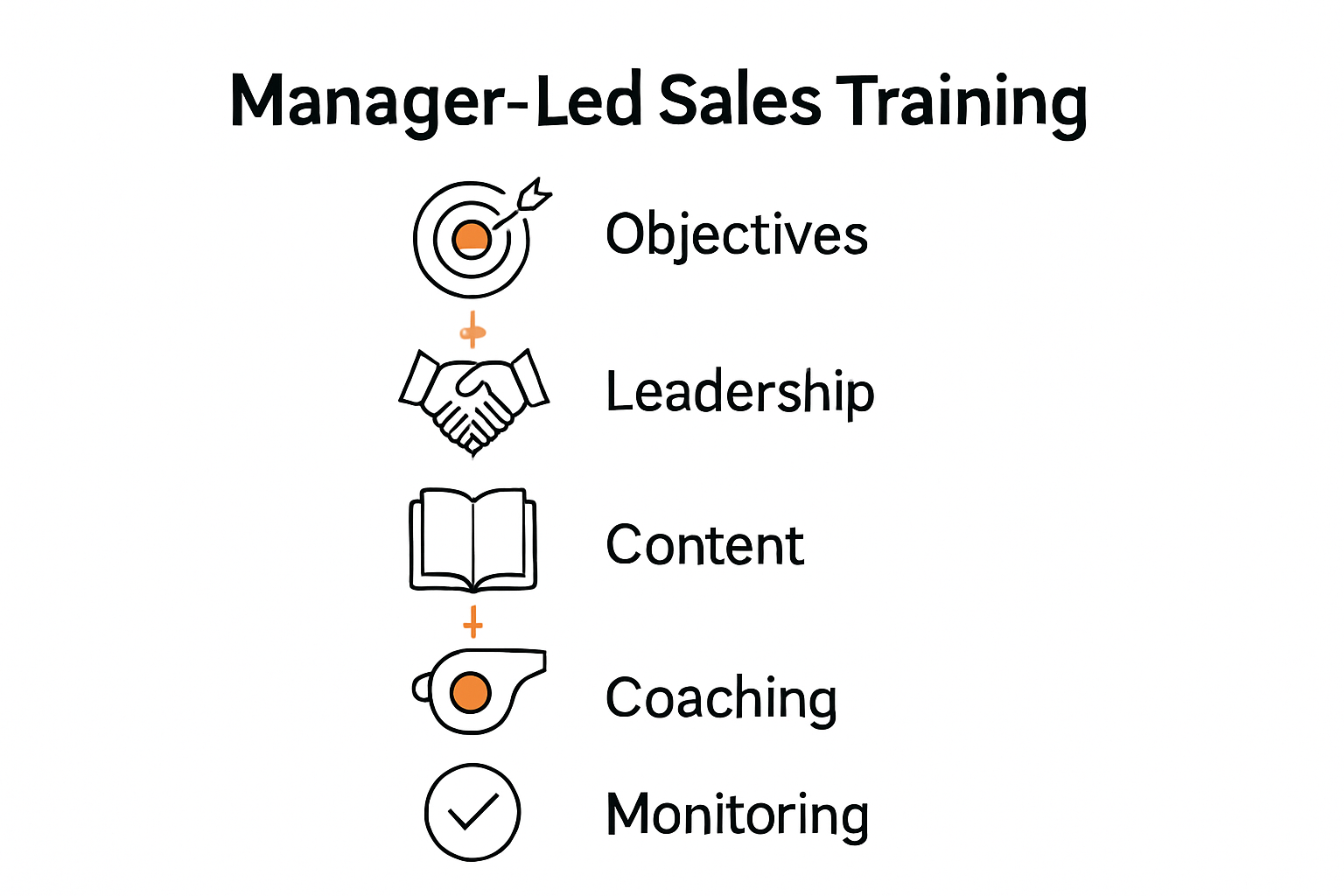
Key Insight | Explanation |
1. Define precise commercial objectives | Establish specific, quantifiable outcomes to guide training and align sales efforts towards measurable growth. |
2. Secure leadership commitment | Engage senior leaders actively to ensure they champion the sales training initiative and understand their roles in the transformation. |
3. Create tailored training content | Develop customised training that directly addresses specific skill gaps and organisational challenges, moving beyond generic approaches. |
4. Implement manager-led coaching | Foster practical, routine coaching sessions that focus on real-world applications and skill improvements within the sales team. |
5. Monitor and verify behavioural change | Employ robust tracking mechanisms to assess the impact of training on both sales performance and desired behavioural shifts. |
Step 1: Define commercial objectives and training outcomes
Defining clear commercial objectives and training outcomes transforms sporadic sales efforts into strategic revenue generation. This critical first stage establishes precise targets that align your entire sales organisation towards measurable growth.
To craft effective objectives, start by understanding your current sales performance landscape. Comprehensive enterprise sales training requires a systematic approach that begins with forensic analysis of existing revenue streams. Examine your historical sales data to identify performance gaps, market opportunities, and specific skill deficiencies within your team. These insights will form the foundation of targeted training interventions.
Your commercial objectives should articulate specific, quantifiable outcomes. Rather than vague statements like “increase sales”, define precise metrics: “Increase average deal value by 23% in financial services sector” or “Reduce sales cycle time from 98 to 62 days for enterprise technology deals”. Each objective must connect directly to financial impact, ensuring that training programmes are not abstract exercises but pragmatic pathways to revenue acceleration. Precise goal setting transforms sales training from a theoretical exercise into a strategic business investment.
Warning: Avoid generic, one-size-fits-all training approaches. Your objectives must reflect your unique market position, customer segments, and organisational capabilities.
Next, you will map specific skills and behaviours required to achieve these commercial objectives.
Step 2: Align leadership buy-in and sales management roles
Gaining committed leadership support transforms sales training from a theoretical exercise into a strategic organisational initiative. This critical step ensures your entire leadership team understands and actively champions the training transformation.
Successful alignment begins with comprehensive engagement. Targeted sales leadership training provides a structured approach to uniting management perspectives and creating a cohesive vision. Senior leaders must understand their pivotal role in driving performance change. This means moving beyond passive approval to active participation research shows that sales managers are instrumental in translating training insights into practical workplace behaviours.
To achieve meaningful buy-in, design a collaborative approach that connects training objectives directly to organisational strategic goals. Schedule dedicated leadership workshops where executives can critically examine current sales performance challenges, understand proposed training methodologies, and co-create implementation strategies. Each leadership team member should clearly understand their specific accountability in supporting and reinforcing new sales approaches.
Warning: Superficial leadership endorsement will undermine your entire training programme. Genuine commitment requires visible, sustained engagement from top management.
Next, you will design a comprehensive communication strategy to cascade training objectives across your sales organisation.
Step 3: Develop tailored training content and frameworks
Developing customised training content represents the strategic blueprint for transforming your sales team’s performance. This critical step moves beyond generic training approaches to create precise, targeted learning experiences that directly address your organisation’s unique sales challenges.

Essential sales team training requires a forensic approach to content design. Begin by conducting a comprehensive skills gap analysis that maps existing team capabilities against your desired commercial outcomes. This diagnostic process should include behavioural assessments, performance data reviews, and direct input from sales managers about real world challenges encountered during client interactions.
Structuring your training framework demands meticulous alignment with strategic objectives. Drawing from advanced sales leadership methodologies, create modular content that addresses specific competency areas such as consultative selling techniques, executive communication skills, complex deal negotiation, and strategic account management. Each training module should incorporate practical scenarios that mirror your specific industry context, enabling participants to develop muscle memory for handling nuanced sales interactions. The goal is not theoretical knowledge but pragmatic skill transformation that translates directly into improved sales performance.
Warning: Generic, off the shelf training programmes will produce mediocre results. Your content must be as unique as your sales ecosystem.
Next, you will design an implementation strategy that ensures systematic knowledge transfer and skill embedding across your sales organisation.
Step 4: Deploy practical, manager-led coaching sessions
Deploying effective manager-led coaching sessions transforms theoretical training into tangible performance improvement. This critical step bridges the gap between learning and consistent sales execution by embedding practical skill development directly within your team’s workflow.
Sales coaching for managers requires a structured yet dynamic approach that goes beyond traditional performance reviews. Successful coaching sessions demand managers become active skill architects who diagnose individual performance gaps and design targeted interventions. This means moving beyond generic feedback to provide granular, actionable guidance that helps each sales professional incrementally improve their capabilities. Implement a recurring coaching rhythm where managers conduct weekly or bi-weekly one-on-one sessions focused on specific skill development, deal strategy, and performance refinement.
The most powerful coaching sessions integrate real world scenario analysis and skills practice. Create coaching frameworks that require sales professionals to deconstruct actual sales interactions, analyse communication strategies, and rehearse advanced negotiation techniques. Encourage managers to use role playing exercises, deal review workshops, and collaborative problem solving methods that transform coaching from a passive review into an active skill development experience. Each session should produce clear, measurable actions that sellers can immediately implement in their sales approach.
Warning: Sporadic or superficial coaching will produce minimal results. Consistent, structured, and skill focused coaching is the cornerstone of sustainable sales performance improvement.
Next, you will establish robust tracking mechanisms to measure the impact of your coaching interventions.
Step 5: Monitor adoption and verify behavioural change
Monitoring training adoption and verifying behavioural transformation represent the critical validation stage of your sales performance improvement strategy. This step moves beyond theoretical training measurement to understanding genuine skill integration and performance impact.
Essential training for sales teams requires sophisticated tracking mechanisms that go beyond traditional metrics. Develop a comprehensive monitoring framework that captures both quantitative performance indicators and qualitative behavioural evidence. This means creating multidimensional assessment tools that track not just sales outcomes but actual behavioural shifts such as communication techniques, negotiation approaches, and strategic thinking patterns. Implement periodic skill assessments, peer reviews, and customer interaction analyses that provide granular insights into how training interventions translate into real world sales capabilities.
The most effective verification processes combine data driven evaluation with direct observation. Establish a robust feedback loop where managers conduct structured performance reviews that examine specific behavioural modifications learned during training. Use a combination of performance metrics sales pipeline progression, win rates, deal sizes and direct behavioural observation to create a holistic view of skill transformation. Encourage sales professionals to document their learning journey, reflecting on how new techniques have changed their approach to client interactions and deal progression.
Warning: Superficial measurement will provide misleading insights. True behavioural change requires deep, nuanced evaluation that goes beyond surface level performance indicators.
Next, you will design systematic reinforcement strategies to sustain and amplify the newly acquired sales capabilities.
Transform Your Sales Team Through Manager-Led Training for Lasting Growth
If you are striving to move beyond inconsistent sales results and fragile revenue streams, the steps outlined in “” speak directly to your challenges. Managers who take the lead in coaching and embedding new sales behaviours create stronger, more disciplined teams. However, achieving this needs more than one-off training sessions or generic programmes. It demands a holistic, tailored approach that aligns leadership commitment, practical coaching, and rigorous performance tracking.
At The Sales Coach Network, we specialise in partnering with senior sales leaders to embed scalable sales operating systems that solve systemic issues such as stalled deals and unpredictable revenue. Our proven frameworks focus on practical manager-led coaching and transforming commercial objectives into measurable growth. Explore our offerings like sales training for managers and targeted leadership development to empower your sales managers as effective coaches and change agents.
Do not let superficial training hold your sales team back. Discover how a strategic, hands-on approach can accelerate your team’s performance and secure consistent revenue growth. Take the next step now by visiting The Sales Coach Network to learn more about our customised sales training and coaching solutions.
Frequently Asked Questions
What are the key steps in manager-led sales training for consistent revenue growth?
The key steps include defining commercial objectives, aligning leadership buy-in, developing tailored training content, deploying manager-led coaching sessions, and monitoring adoption to verify behavioural change. Start by setting precise targets for your sales team and ensure all leadership supports the training initiatives.
How can I ensure leadership buy-in for sales training initiatives?
To ensure leadership buy-in, engage them in collaborative workshops that connect training objectives to organisational goals. Schedule these sessions to discuss current sales challenges and strategies, which will foster a sense of ownership and commitment from the leadership team.
What type of training content should I develop for my sales team?
You should develop customised training content that addresses specific skill gaps identified in your team. Conduct a skills gap analysis and create modular training focused on areas like consultative selling and negotiation techniques that directly correspond to your organisational goals.
How can I effectively monitor the impact of sales coaching sessions?
To effectively monitor the impact, implement a comprehensive tracking framework that assesses both quantitative sales metrics and qualitative behavioural changes. Conduct regular performance reviews and collect feedback on skill application from the sales team to ensure that new techniques are being integrated into daily practices.
What are the best practices for conducting manager-led coaching sessions?
Hold recurring one-on-one coaching sessions that focus on specific skills, deal strategies, and performance refinement. Use real-world scenarios and role-playing exercises in these sessions to enhance practical skill development, enabling immediate application in sales interactions.
How can I sustain the behavioural changes achieved through sales training?
Establish systematic reinforcement strategies such as continuous feedback mechanisms and follow-up coaching sessions to maintain behavioural changes. Aim for ongoing evaluations every 30 days to ensure that new skills are being regularly practised and integrated into the sales process.
Recommended