
Sales Velocity: Driving Predictable Revenue Growth
- The Sales Coach Network
- Dec 13, 2025
- 7 min read


Most advice about sales velocity overlooks how even small improvements can spark real change. For many British companies, understanding this critical metric can mean the difference between stalled growth and sustainable success. With over 60 percent of revenue leaders relying on sales velocity to guide their strategies, knowing exactly how it works—and how to optimise it—can help organisations identify bottlenecks, drive better results, and stay ahead of the competition.
Table of Contents
Key Takeaways
Point | Details |
Sales Velocity is a Comprehensive Metric | It quantifies sales performance by measuring the speed at which opportunities generate revenue through four key drivers: number of opportunities, average deal value, win rate, and sales cycle length. |
Holistic Strategy is Essential | Improving sales velocity requires a balanced approach that integrates lead generation, sales processes, and client engagement rather than focusing on isolated improvements. |
Awareness of Challenges is Crucial | Misconceptions like prioritising quantity over quality can obstruct effective sales velocity analysis; organisations should understand contextual factors influencing performance. |
Continuous Measurement and Adaptation | Successful teams must regularly compute and analyse sales velocity to identify trends and refine strategies for sustainable revenue growth. |
Defining Sales Velocity and Core Concepts
Sales velocity is a powerful metric that provides revenue leaders with a comprehensive understanding of their sales performance and growth potential. At its core, sales velocity measures how quickly opportunities move through the sales pipeline and generate revenue. This metric combines multiple critical components: the number of sales opportunities, average deal value, win rate, and length of sales cycle.
Understanding sales velocity requires examining its fundamental elements. Sales performance metrics from entrepreneurial research highlight four key dimensions that drive this calculation:
Number of Opportunities: Total qualified leads entering the sales pipeline
Average Deal Value: Monetary worth of potential sales transactions
Win Rate: Percentage of opportunities successfully converted to sales
Sales Cycle Length: Average time required to close a deal
The significance of sales velocity extends beyond simple mathematical calculation. It provides strategic insights into organisational sales performance, enabling leaders to identify bottlenecks, optimise processes, and predict revenue generation more accurately. By tracking these interconnected metrics, sales teams can develop targeted strategies to accelerate growth and improve overall commercial effectiveness.
The Four Drivers of Sales Velocity
Sales velocity represents a critical framework for understanding and accelerating revenue generation. Entrepreneurial sales research from MIT highlights four fundamental drivers that collectively determine an organisation’s sales performance and growth potential.
The four interconnected drivers of sales velocity are:
Number of Opportunities: The total volume of qualified leads entering the sales pipeline. This metric reflects the effectiveness of lead generation strategies and prospecting efforts. More high-quality opportunities typically translate to increased potential revenue.
Average Deal Value: The monetary worth of potential sales transactions. This driver focuses on the financial potential of each opportunity, emphasising the importance of targeting larger, more strategic deals that can significantly impact overall revenue.
Win Rate: The percentage of opportunities successfully converted into actual sales. A higher win rate indicates more efficient sales processes, better qualification strategies, and stronger value propositions that resonate with potential clients.
Sales Cycle Length: The average time required to progress a lead from initial contact to closed sale. Shorter sales cycles indicate more streamlined processes, faster decision-making, and potentially more agile organisational approaches to revenue generation.
These four drivers are not independent variables but intricate components of a complex sales ecosystem. Improving performance across these dimensions requires a holistic approach that balances strategic lead generation, compelling value propositions, efficient sales processes, and targeted relationship-building techniques. Sales leaders must continuously analyse and optimise these drivers to create predictable, scalable revenue growth strategies.
Calculating Sales Velocity: Method and Formula
Sales velocity is not just a conceptual framework, but a precise mathematical calculation that provides tangible insights into sales performance. Entrepreneurial sales research from MIT offers a structured approach to quantifying this critical business metric.

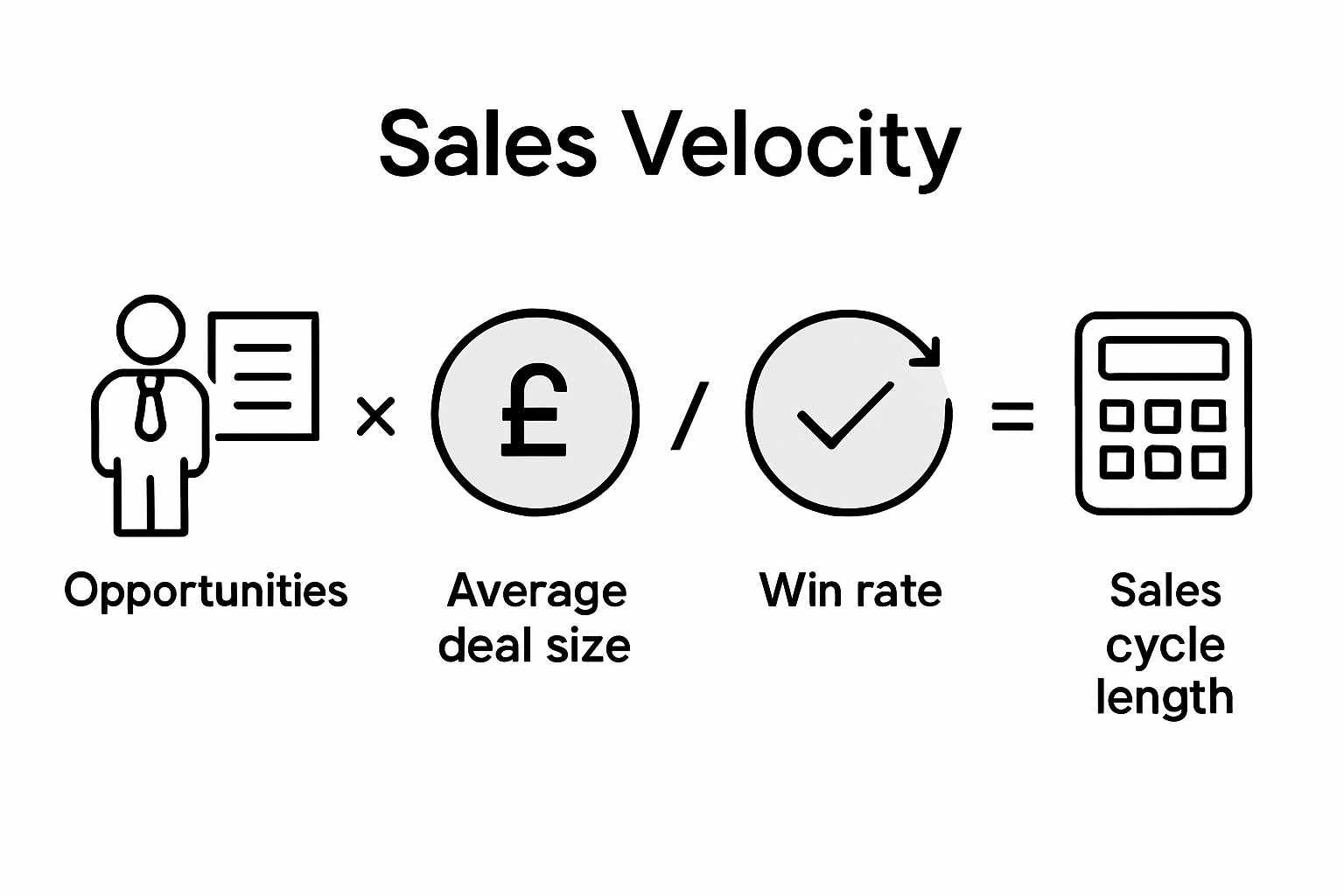
The standard sales velocity formula is elegantly simple yet powerful:
Sales Velocity = (Number of Opportunities × Average Deal Value × Win Rate) ÷ Sales Cycle Length
Let’s break down each component of this calculation:
Number of Opportunities: Count all qualified sales leads entering your pipeline during a specific period. This represents potential revenue generation capacity.
Average Deal Value: Calculate the monetary worth of typical sales transactions. This figure helps weight the financial potential of your opportunities.
Win Rate: Determine the percentage of opportunities that successfully convert to actual sales. A higher win rate indicates more effective sales strategies.
Sales Cycle Length: Measure the average time required to progress a lead from initial contact to closed transaction, typically calculated in days or weeks.
Practical implementation requires consistent tracking and precise measurement. Sales teams should establish standardised processes for capturing these metrics accurately, ensuring reliable calculations that reflect genuine performance. By regularly computing sales velocity, organisations can identify trends, diagnose bottlenecks, and develop targeted strategies for accelerating revenue growth.
Typical Challenges and Common Misconceptions
Sales velocity is a nuanced metric that requires sophisticated understanding, yet many organisations fall prey to fundamental misinterpretations. Entrepreneurial sales research from MIT highlights several critical challenges that can derail accurate assessment and improvement of sales performance.
Common misconceptions about sales velocity include:
Quantity Over Quality: Many sales teams mistakenly believe that increasing the number of opportunities automatically improves sales velocity. In reality, flooding the pipeline with low-quality leads can actually decrease velocity by diluting focus and reducing overall win rates.
Linear Performance Assumptions: Sales leaders often assume that performance improvements will be straightforward and predictable. However, sales velocity is a complex ecosystem where changes in one area can have unexpected ripple effects across other dimensions.
Overlooking Contextual Factors: Teams frequently calculate sales velocity without considering critical contextual elements such as market conditions, product maturity, and competitive landscape. These external factors can significantly impact the interpretation of velocity metrics.
Misinterpreting Activity as Progress: There’s a dangerous tendency to conflate sales activity with meaningful progress. Numerous meetings, emails, and proposals do not necessarily translate to increased sales velocity if they do not effectively move opportunities through the pipeline.
Addressing these challenges requires a holistic approach. Sales organisations must develop sophisticated tracking mechanisms, cultivate a deep understanding of their specific market dynamics, and focus on quality-driven strategies rather than simplistic numerical targets. The most successful teams view sales velocity as a dynamic, interconnected system requiring continuous refinement and nuanced interpretation.
Boosting Sales Velocity in B2B Teams
Sales velocity requires strategic, multifaceted approaches specifically tailored to complex B2B environments. Entrepreneurial sales research from MIT highlights critical strategies for systematically improving each velocity driver within organisational frameworks.
Effective strategies for boosting sales velocity include:
Strategic Opportunity Generation
Implement targeted account-based marketing approaches
Develop refined ideal customer profiles
Leverage advanced prospecting technologies
Create collaborative lead qualification processes
Deal Value Enhancement
Train sales teams in consultative selling techniques
Develop comprehensive value propositions
Align solutions more closely with client business outcomes
Create multi-tiered pricing strategies
Win Rate Optimisation
Implement rigorous qualification methodologies
Develop advanced sales enablement programmes
Create structured client engagement frameworks
Invest in continuous skills development
Sales Cycle Acceleration
Streamline internal approval processes
Implement customer relationship management technologies
Develop clear engagement playbooks
Create cross-functional collaboration mechanisms
Successful B2B teams recognise that improving sales velocity is not about isolated tactics, but creating an integrated, dynamic sales ecosystem. Continuous measurement, learning, and adaptive strategies are essential for sustainable performance improvements. Sales leaders must foster a culture of accountability, strategic thinking, and relentless performance optimisation to drive predictable revenue growth.
Accelerate Your Sales Velocity with Expert Sales Coaching
If your B2B sales teams struggle with generating consistent pipeline opportunities, improving win rates, or reducing long sales cycles then understanding and applying the principles of sales velocity is essential. This article highlights the crucial components that drive predictable revenue growth including optimising the number of opportunities, increasing average deal value, enhancing win rates, and accelerating sales cycles. These are exactly the challenges addressed by The Sales Coach Network, a specialist firm focused on embedding scalable sales operating systems for sustainable results.
Our practical, holistic approach aligns perfectly with the core concepts of sales velocity by providing sales training programmes designed for complex teams and targeted sales coaching services that improve qualification methods and shorten sales cycles. You can discover how our tailored programmes apply the proven Forty-20-40 Principle to build disciplined execution while improving strategy and enablement. To start transforming your revenue growth and confidently drive predictable results explore our tailored sales training programmes and learn how to embed consistent sales velocity within your organisation.
Don’t let unpredictable revenue hold your team back any longer. Take action today with expert guidance that links strategy to execution. Visit The Sales Coach Network now and empower your sales leaders to adapt, accelerate, and achieve measurable growth aligned with the framework of sales velocity.
Frequently Asked Questions
What is sales velocity?
Sales velocity is a metric that measures how quickly opportunities move through the sales pipeline and generate revenue. It combines the number of sales opportunities, average deal value, win rate, and length of sales cycle to provide insight into sales performance.
How do I calculate sales velocity?
The formula for sales velocity is: Sales Velocity = (Number of Opportunities × Average Deal Value × Win Rate) ÷ Sales Cycle Length. This requires tracking the qualified leads, average revenue per deal, the conversion rate of sales, and the time taken to close deals.
Why is sales velocity important for businesses?
Sales velocity is crucial as it provides strategic insights into an organisation’s sales performance. It helps identify bottlenecks, optimise processes, and predict revenue generation more accurately, allowing teams to develop targeted strategies for growth.
What are some strategies to improve sales velocity?
To improve sales velocity, businesses can focus on enhancing opportunity generation, increasing deal value, optimising win rates, and accelerating sales cycles. Strategies include targeted marketing, consultative selling techniques, structured engagement frameworks, and streamlined approval processes.
Recommended