Selling Skills
What Is Value Based Selling and Why It Matters
The Sales Coach Network9 min read


Traditional sales methods are losing traction as british companies realise that only about 30 percent of buyers see genuine value in standard pitches. With competition intensifying, understanding how to clearly demonstrate real business outcomes now sets leading sales teams apart. This introduction explores why value based selling matters in the british market and what separates true client-focused strategies from outdated product pushes, offering fresh clarity on a topic crowded with myths.
Table of Contents
Key Takeaways
Point | Details |
Focus on Client Needs | Value based selling prioritises understanding client challenges over product features, transforming salespeople into strategic advisors. |
Preparation is Essential | Successful value selling requires comprehensive research and engagement to tailor solutions to specific business needs. |
Measure Impact, Not Volume | Outcomes should focus on the value delivered to clients rather than merely closing deals. |
Avoid Traditional Pitfalls | Sales teams must resist reverting to transactional methods under pressure; training and organisational alignment are crucial for success. |
Value Based Selling Defined and Debunked
Value based selling represents a sophisticated sales strategy that fundamentally shifts from traditional product-centric approaches towards understanding and articulating genuine customer value. Unlike conventional selling methods that focus on features and pricing, this approach prioritises demonstrating how a solution directly addresses specific business challenges and delivers measurable economic outcomes.
At its core, value based selling requires sales professionals to deeply comprehend a client’s strategic objectives, financial metrics, and organisational pain points. This means moving beyond superficial conversations about product specifications and instead engaging in substantive dialogues that map solutions directly to the client’s most critical business needs. Understanding the nuanced approach to value selling becomes crucial for modern sales teams seeking to differentiate themselves in competitive markets.
The methodology demands comprehensive preparation and a consultative mindset. Successful practitioners invest significant time researching potential clients, understanding their industry dynamics, financial constraints, and strategic goals before initiating any sales conversation. This approach transforms salespeople from transactional vendors into strategic advisors who can articulate precise, quantifiable business value propositions that resonate at executive leadership levels.
Pro Sales Strategy Tip: Develop a comprehensive value assessment framework that allows you to systematically map your solution’s potential impact across financial, operational, and strategic dimensions before engaging with potential clients.
Core Principles of Value Led Conversations
Value led conversations represent a strategic approach to sales interactions that transcend traditional transactional exchanges. These dialogues are fundamentally anchored in understanding and articulating genuine customer value, requiring sales professionals to become true business consultants who can map solutions precisely to organisational challenges.
The core principles of value led conversations demand a multi-dimensional understanding of client needs. Developing a robust value-based sales pitch involves creating a comprehensive framework that explores four critical value dimensions: strategic value, financial value, operational value, and personal value. This holistic approach enables sales professionals to craft nuanced narratives that resonate deeply with decision makers across different organisational levels.
Successful value led conversations require meticulous preparation and active listening. Sales representatives must invest significant time researching potential clients, understanding their industry context, financial constraints, and strategic objectives. This preparation allows for dynamic, tailored discussions that demonstrate a profound understanding of the client’s unique business ecosystem. By positioning themselves as strategic advisors rather than mere product vendors, sales professionals can transform conventional pitch meetings into collaborative problem-solving sessions.
Pro Sales Strategy Tip: Create a systematic client value assessment template that enables you to methodically map potential solutions against each of the four value dimensions before engaging in substantive sales discussions.
This table summarises key value dimensions explored in effective value based sales conversations:
Value Dimension | Description | Example Impact |
Strategic Value | Alignment with long-term business goals | Improved market positioning |
Financial Value | Direct economic benefits and cost reductions | Increased profit margins |
Operational Value | Enhancements to day-to-day processes | Higher process efficiency |
Personal Value | Benefits to individual stakeholders | Career advancement support |
Comparing Value Based and Traditional Sales
Traditional sales approaches have long relied on product-centric strategies that emphasise features, pricing, and transactional interactions. These methods typically focus on pushing products through standardised pitches, treating each sales conversation as an opportunity to demonstrate technical specifications and competitive pricing, often with limited understanding of the client’s deeper business context.
In stark contrast, value based selling represents a transformative approach that fundamentally reimagines the sales engagement. Exploring comprehensive value selling techniques reveals a methodology centred on understanding the client’s strategic objectives, financial implications, and organisational challenges. Where traditional sales methods might present a generic product presentation, value based selling crafts a tailored narrative that demonstrates precisely how a solution will address specific business needs and generate measurable economic impact.
The key differentiators between these approaches are profound. Traditional sales models prioritise volume and speed, often treating prospects as potential transactions rather than strategic partners. Value based selling, conversely, demands a consultative approach that requires deeper research, more nuanced communication, and a genuine commitment to understanding the client’s unique business ecosystem. This shift transforms sales professionals from product vendors to strategic advisors who can articulate complex value propositions that resonate at executive leadership levels.
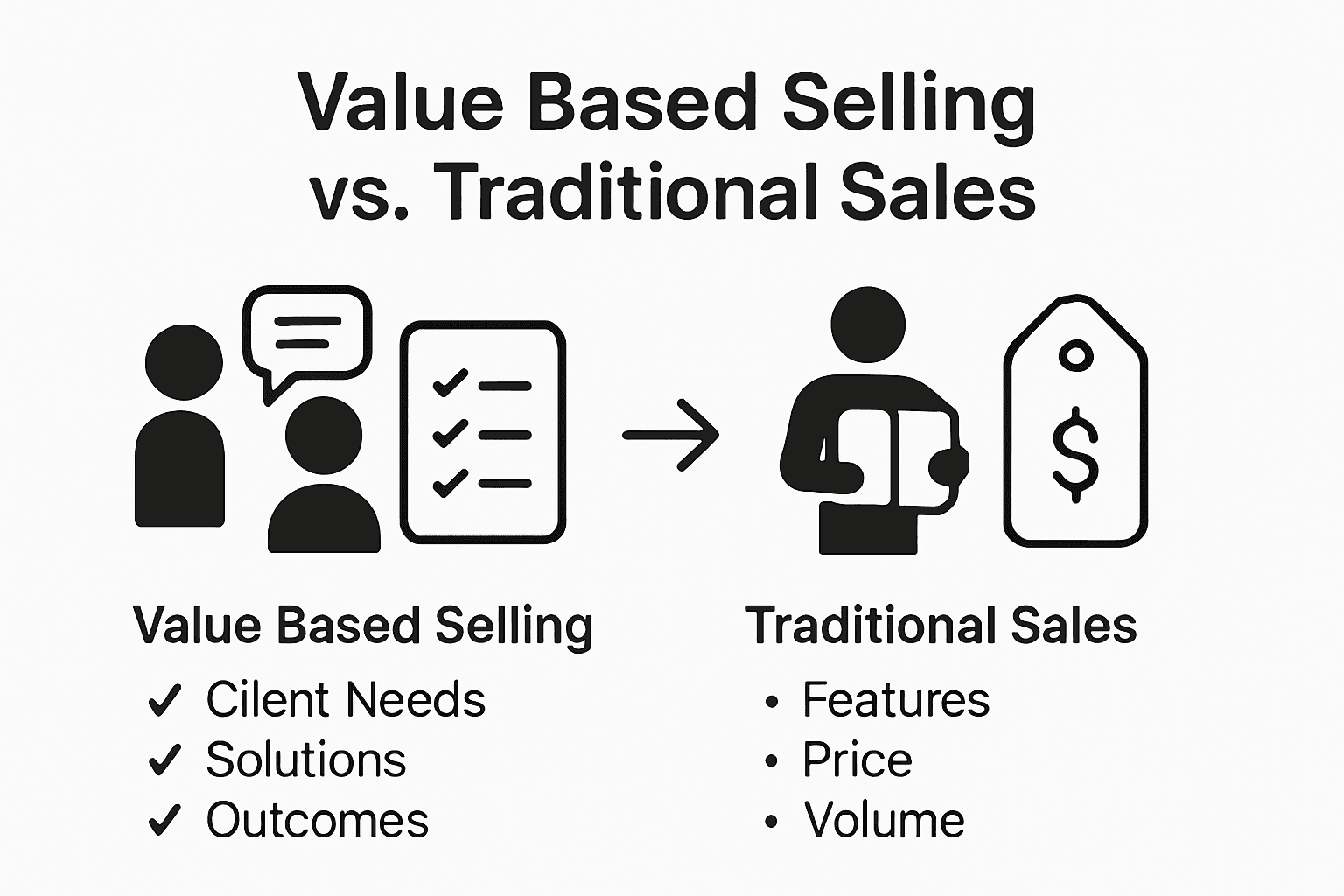
Here is a comparison of value based selling and traditional sales approaches to help clarify their differences:
Aspect | Value Based Selling | Traditional Sales |
Primary Focus | Addressing client challenges | Highlighting product features |
Salesperson’s Role | Strategic advisor | Product vendor |
Sales Conversation | Consultative and tailored | Standardised and transactional |
Outcome Measurement | Value and impact delivered | Volume and deal closure |
Client Relationship | Long-term partnership | One-off transaction |
Pro Sales Strategy Tip: Develop a comprehensive comparative assessment framework that allows you to systematically map the limitations of traditional sales approaches against the strategic advantages of value based selling methodologies.
Best Practices for B2B Implementation
Value based selling in business-to-business contexts demands a sophisticated, multifaceted approach that transcends traditional sales methodologies. Successful implementation requires a strategic framework that aligns sales processes with deep client understanding, organisational capabilities, and measurable value creation.

Implementing comprehensive sales training strategies represents a critical foundation for value based selling in B2B environments. This approach necessitates a holistic transformation that encompasses four key dimensions: organisational alignment, sales team enablement, robust qualification methodologies, and continuous performance measurement. Sales teams must develop sophisticated skills that allow them to conduct executive-level conversations, map solutions to complex business challenges, and articulate compelling economic value propositions.
The most effective B2B value selling implementations integrate several crucial elements. These include developing comprehensive client value assessment frameworks, training sales professionals in consultative communication techniques, creating rigorous opportunity qualification processes, and establishing clear metrics that track value realisation. Organisations must move beyond traditional sales training models, instead embedding a systematic approach that transforms sales interactions from transactional exchanges to strategic partnerships. This requires significant investment in capability development, management coaching, and creating a shared understanding of value across the entire revenue generation ecosystem.
Pro Sales Strategy Tip: Design a structured value assessment template that enables your sales team to systematically document and quantify potential client value across financial, operational, strategic, and individual impact dimensions before initiating substantive sales discussions.
Common Pitfalls and How to Avoid Them
Value based selling requires sophisticated execution, and organisations frequently encounter significant challenges that can derail their implementation efforts. Understanding these potential obstacles becomes crucial for maintaining the integrity and effectiveness of a value-driven sales approach.
Identifying and mitigating common sales mistakes reveals several critical pitfalls that can undermine value based selling strategies. One prominent challenge is the tendency of sales teams to revert to traditional transactional approaches when facing pressure to meet short-term targets. This regression often occurs when organisations fail to establish a comprehensive performance measurement system that rewards value creation rather than simply closing deals. Sales professionals might find themselves defaulting to familiar product-centric narratives, undermining the consultative philosophy central to value based selling.
Another significant pitfall emerges from inadequate organisational alignment and insufficient training. Many organisations attempt to implement value based selling without providing the necessary skills development, coaching frameworks, and cultural transformation required for success. This superficial approach leads to inconsistent execution, where individual sales representatives might understand the concept but lack the practical tools and organisational support to implement it effectively. Successful value based selling demands a holistic approach that integrates advanced qualification methodologies, robust client value assessment frameworks, and continuous capability development across the entire revenue generation ecosystem.
Pro Sales Strategy Tip: Develop a comprehensive diagnostic tool that allows your organisation to systematically assess and address potential implementation barriers in your value based selling approach, ensuring consistent and sustainable execution across your sales team.
Unlock Sustainable Growth with Value Based Selling
The article emphasises that understanding and communicating genuine customer value is the key to overcoming common B2B sales challenges such as unpredictable revenue, low win rates, and lengthy sales cycles. If your sales team struggles to move beyond transactional conversations or lacks a structured approach to engaging decision makers at executive levels, adopting a value based selling methodology could transform your results. Concepts like strategic alignment, consultative conversations and comprehensive client value assessment are not just theory — they are proven means to sustainably increase pipeline quality, deal sizes and close rates.
At The Sales Coach Network we specialise in embedding scalable, practical sales operating systems that drive measurable growth. Our tailored sales training programmes and expert sales coaching services empower complex B2B sales teams to confidently lead value driven conversations, qualify opportunities rigorously and reduce friction in the buying process. By focusing on consultative leadership and disciplined execution, you can achieve more predictable sales velocity and unlock higher revenue performance.
Discover how to move beyond generic training and build a value based sales culture that sticks. Visit The Sales Coach Network now and start transforming your sales outcomes with proven frameworks aligned precisely to your business challenges.
Frequently Asked Questions
What is value based selling?
Value based selling is a sales strategy that focuses on understanding and articulating a customer’s genuine value, shifting from product-centric approaches to demonstrating how solutions address specific business challenges and deliver measurable economic outcomes.
How does value based selling differ from traditional sales methods?
Unlike traditional sales methods that emphasize features and pricing, value based selling prioritises a consultative approach that aligns with the client’s strategic objectives and organisational challenges, transforming sales professionals into strategic advisors rather than mere product vendors.
What are the core principles of value led conversations?
The core principles include understanding the client’s strategic value, financial benefits, operational improvements, and personal advantages, allowing sales professionals to craft tailored narratives that resonate with decision-makers across various organisational levels.
What are common pitfalls to avoid when implementing value based selling?
Common pitfalls include reverting to traditional transactional approaches under pressure, inadequate organisational alignment, and insufficient training. Addressing these barriers is crucial for maintaining the effectiveness of a value-driven sales strategy.
Recommended