
Enterprise Sales: Driving Growth in Complex B2B Markets
- The Sales Coach Network
- Dec 20, 2025
- 7 min read


Securing high-value contracts has become the defining challenge for many British companies in a competitive global market. With complex deals often worth millions and involving negotiations that can stretch over a year, enterprise sales require a far more strategic and nuanced approach than traditional selling. Understanding what sets enterprise sales apart empowers businesses and professionals to tackle intricate organisational dynamics, build stronger relationships, and unlock the rewards of more sophisticated partnerships.
Table of Contents
Key Takeaways
Point | Details |
Enterprise Sales is Strategic | It requires deep understanding of organisational dynamics and building long-term relationships with multiple stakeholders. |
Tailored Solutions are Essential | Successful enterprise sales professionals provide customised solutions to meet specific corporate needs rather than focusing solely on product sales. |
Navigating Complex Sales Cycles | The sales process involves extended cycles of 6-18 months, necessitating structured stages from prospecting to implementation. |
Avoiding Common Pitfalls | Sales teams should be wary of misalignment in strategies and ineffective communication, ensuring they tailor their approaches to the unique context of each organisation. |
What Enterprise Sales Involves and Why It Matters
Enterprise sales represents a sophisticated approach to selling complex products or services to large organisations, characterised by intricate transactions and strategic relationship building. Unlike traditional sales models, enterprise sales demands nuanced understanding of organisational dynamics, deep market knowledge, and exceptional interpersonal skills.
The core essence of enterprise sales lies in addressing sophisticated business challenges through tailored solutions that meet specific corporate needs. These transactions typically involve multiple stakeholders, extended negotiation periods, and significant financial investments. Key characteristics include:
High-value deal sizes
Prolonged sales cycles (often 6-18 months)
Complex decision-making processes
Requirement for comprehensive solution design
Strategic long-term partnership potential
Successful enterprise sales professionals understand that their role transcends mere product selling. They function as strategic consultants, deeply understanding client organisations’ operational challenges, technological ecosystems, and strategic objectives. By providing comprehensive solutions rather than isolated products, these sales experts create transformative value that goes beyond transactional interactions.
Pro Tip for Enterprise Sales Success: Develop deep industry expertise and cultivate genuine relationships with key decision-makers, focusing on understanding their specific business challenges rather than pushing standard sales pitches.
Types of Enterprise Sales and Key Distinctions
Enterprise sales encompasses diverse approaches tailored to meet complex organisational needs, with distinct categories reflecting varying levels of strategic engagement. These sales models are fundamentally distinguished by their sophistication, deal complexity, and targeted organisational scope.
Typically, enterprise sales models can be classified into three primary categories:
Aspiring to Be Enterprise-Grade: Targeting smaller teams within large organisations
Smaller deal sizes
Initial entry point into larger corporate structures
Lower complexity and shorter sales cycles
Enterprise-First: Focusing on comprehensive solutions for large enterprises
Multi-million-pound deal potential
Highly complex technological or strategic implementations
Extensive stakeholder engagement
Traditional Enterprise Sales: Representing the most sophisticated sales approach
Consultative selling methodology
Extended negotiation and implementation periods
Comprehensive solution design and strategic partnership development
These sales approaches are characterised by intricate decision-making processes involving multiple stakeholders, with sales cycles potentially extending from 8 to 18 months. Success requires deep understanding of organisational ecosystems, technological requirements, and strategic objectives.
The following table compares different types of enterprise sales and highlights their primary business implications:
Sales Type | Organisational Focus | Deal Complexity | Strategic Outcome |
Aspiring to Be Enterprise-Grade | Entry into large organisations | Lower | Foundation for broader engagement |
Enterprise-First | Comprehensive enterprise-wide | Very high | Long-term partnership development |
Traditional Enterprise Sales | Whole-organisation consulting | Highest | Ongoing consultancy and integration |
Pro Tip for Enterprise Sales Navigation: Master the art of building consensus across different organisational levels by developing communication strategies that address diverse stakeholder perspectives and demonstrate tangible value proposition.
Essential Processes and Sales Cycle Stages
Enterprise sales demands a meticulously structured approach that transforms complex transactions into predictable revenue streams. The typical enterprise sales process comprises strategic stages designed to navigate intricate organisational landscapes and multiple stakeholder interactions.
The core stages of enterprise sales typically encompass:
Prospecting and Initial Engagement
Identifying potential high-value corporate clients
Conducting comprehensive market research
Developing initial relationship mapping
Discovery and Needs Assessment
Deep understanding of organisational challenges
Mapping stakeholder requirements
Preliminary solution conceptualisation
Solution Design and Proposal
Crafting tailored value propositions
Creating detailed implementation strategies
Demonstrating measurable business impact
Negotiation and Consensus Building
Managing complex buying committee dynamics
Addressing multiple stakeholder perspectives
Aligning solution with strategic organisational objectives
Closing and Implementation
Finalising contractual arrangements
Establishing implementation roadmaps
Transitioning from sales to delivery phases
Implementing a structured sales process enables organisations to focus precisely on key performance metrics, including opportunity monetary value, conversion rates, and deal closure timelines. This systematic approach transforms sales from an unpredictable art into a measurable, repeatable science.

This table summarises key stages of the enterprise sales cycle with the main goal and common challenges at each phase:
Sales Stage | Main Objective | Typical Challenge Encountered |
Prospecting | Identify and research target clients | Reaching relevant decision-makers |
Discovery | Uncover business needs | Gaining access to all stakeholders |
Solution Design | Present tailored value proposition | Aligning technical and strategic goals |
Negotiation | Build consensus and secure agreement | Resolving conflicting priorities |
Closing & Implementation | Finalise deal and plan delivery | Managing expectations and smooth rollout |
Pro Tip for Sales Process Optimisation: Develop a dynamic, data-driven sales workflow that continuously adapts based on performance insights, ensuring your approach remains responsive to evolving market dynamics and organisational needs.
Critical Skills and Success Factors for Teams
Enterprise sales teams operate in complex environments that demand exceptional collaborative capabilities and strategic thinking. Mastering enterprise sales requires a sophisticated approach involving nuanced relationship building, deep organisational understanding, and adaptive communication strategies.
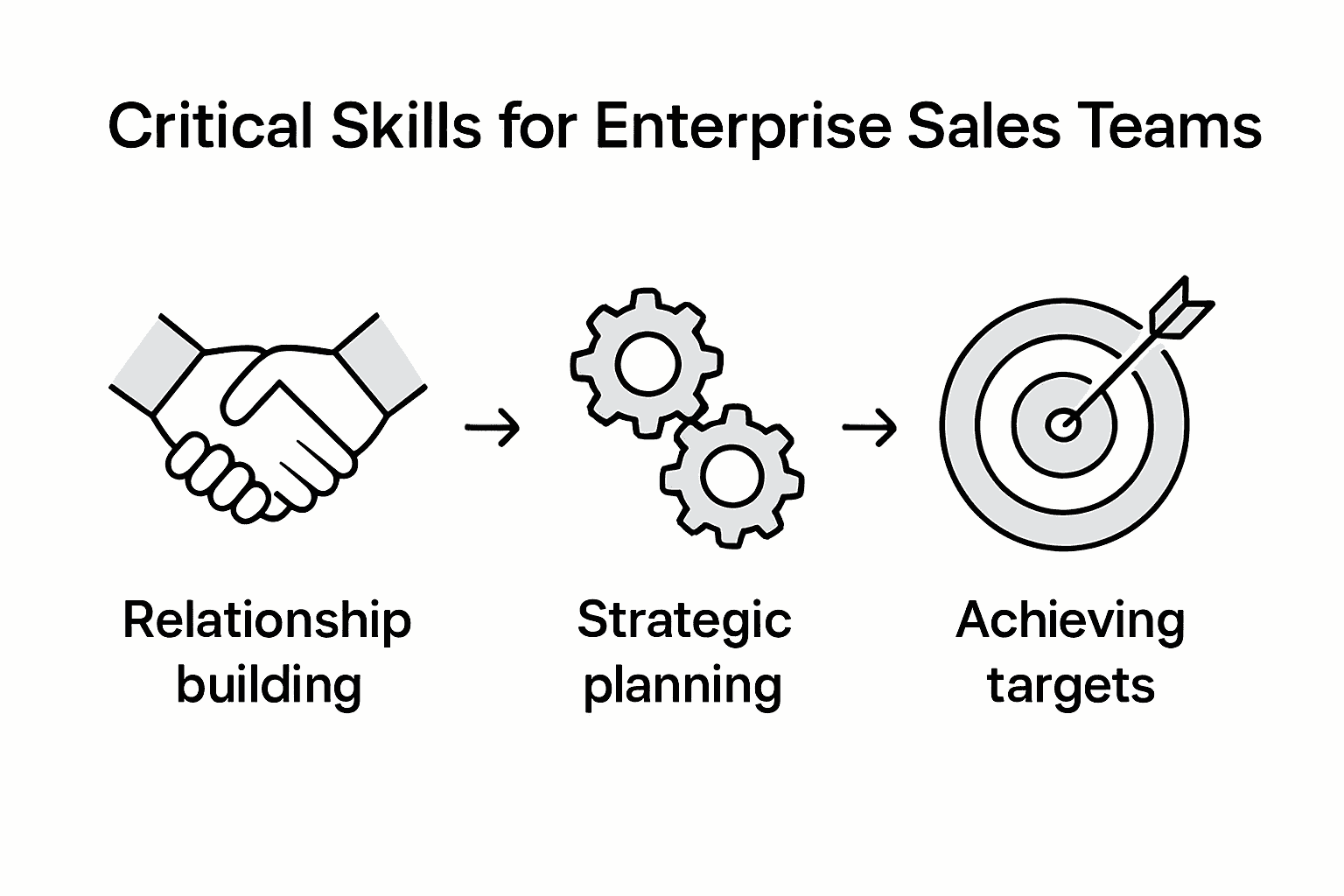
Key critical skills for enterprise sales teams include:
Interpersonal and Strategic Competencies
Advanced relationship management
Strategic stakeholder engagement
Sophisticated communication techniques
Emotional intelligence in complex negotiations
Technical and Analytical Capabilities
Advanced data interpretation skills
Complex problem solving abilities
Strategic solution design
Comprehensive market intelligence gathering
Organisational Navigation Skills
Understanding corporate hierarchies
Managing multi-level buying committees
Creating compelling business cases
Demonstrating measurable value propositions
Successful enterprise sales teams must fundamentally transform their strategies, embracing a comprehensive approach that integrates process, mindset, and adaptive methodologies. This holistic approach transcends traditional sales techniques, requiring teams to become strategic partners rather than mere vendors.
Pro Tip for Skill Development: Invest consistently in continuous learning programmes that develop both technical sales competencies and advanced interpersonal skills, creating a well-rounded enterprise sales professional capable of navigating complex business environments.
Common Pitfalls and How to Avoid Them
Enterprise sales presents complex challenges that can derail even the most promising opportunities. Sales professionals frequently encounter critical mistakes that compromise their ability to successfully navigate intricate corporate landscapes.
Key Enterprise Sales Pitfalls Include:
Strategic Misalignment
Applying generic sales approaches to complex enterprise environments
Failing to understand unique organisational contexts
Neglecting comprehensive stakeholder mapping
Presenting standardised solutions instead of tailored strategies
Engagement and Communication Failures
Insufficient deep stakeholder engagement
Overlooking secondary decision influencers
Inadequate communication across hierarchical levels
Weak value proposition articulation
Procedural and Execution Errors
Underestimating extended sales cycle durations
Inconsistent follow-up strategies
Poor opportunity qualification processes
Lack of adaptive communication techniques
Enterprise sales require fundamentally different strategies compared to traditional sales approaches, demanding a sophisticated, nuanced methodology that transcends conventional selling techniques. Success hinges on developing a comprehensive understanding of complex organisational ecosystems and creating genuine value-driven partnerships.
Pro Tip for Pitfall Prevention: Develop a rigorous, systematic approach to enterprise sales that prioritises deep organisational research, multi-level stakeholder engagement, and continuous adaptive strategy refinement.
Accelerate Your Enterprise Sales Success with Practical Expertise
Navigating the complex world of enterprise sales requires more than just traditional selling techniques. As highlighted in the article, mastering prolonged sales cycles, multi-stakeholder engagement, and tailored solution design are critical to overcoming the common pain points of unpredictable revenue, stalled deals, and low win rates. At The Sales Coach Network, we understand these challenges deeply and specialise in embedding scalable sales operating systems that transform these hurdles into predictable, measurable growth.
Our approach goes beyond generic training by focusing on practical, strategic interventions like consultative sales training, advanced qualification methodologies, and disciplined execution frameworks. Whether it is enhancing your team’s ability to build consensus across organisational levels or accelerating complex deal closures, our sales training programmes and enterprise sales coaching services are designed to deliver lasting impact. Don’t let long sales cycles and complex decision-making slow down your growth — partner with experts who embed systems to help you Adapt, Accelerate, and Achieve.
Ready to fix the systemic problems holding back your enterprise sales performance? Explore how The Sales Coach Network can help you embed the discipline and strategy needed to drive sustainable revenue growth. Take the next step towards transforming your sales outcomes today.
Frequently Asked Questions
What is enterprise sales, and why is it important?
Enterprise sales involves selling complex products or services to large organisations, focusing on strategic relationship building and tailored solutions to address sophisticated business challenges. It is important for driving growth in B2B markets.
How does the enterprise sales cycle differ from traditional sales cycles?
The enterprise sales cycle is typically longer, often lasting 6 to 18 months, and involves multiple stakeholders and complex decision-making processes. In contrast, traditional sales cycles tend to be shorter and less intricate.
What are the key skills required for success in enterprise sales?
Successful enterprise sales professionals need advanced relationship management, strategic stakeholder engagement, emotional intelligence, data interpretation skills, and a deep understanding of organisational hierarchies.
What common pitfalls should be avoided in enterprise sales?
Key pitfalls include strategic misalignment by applying generic sales approaches, insufficient stakeholder engagement, and underestimating the sales cycle duration. Avoiding these can enhance the likelihood of successful outcomes.
Recommended