
Sales Engineering and Product Management – Driving Revenue
- The Sales Coach Network
- Jan 28
- 7 min read


Sales teams in many large British technology firms encounter mounting pressure when complex solutions and demanding clients slow sales cycles and muddle qualification. With intricate products often requiring both deep technical and commercial insight, the challenge is not just selling but guiding prospects from uncertain leads to closed business. Understanding how Sales Engineering and Product Management bridge technical depth and client needs can reveal strategies for accelerating decisions and building stronger, value-driven relationships throughout every stage of the deal.
Table of Contents
Key Takeaways
Point | Details |
Sales Engineering and Product Management are crucial roles | These professions combine technical expertise with business strategies to ensure technological solutions meet market demands. |
Collaboration is essential for success | Effective communication between sales and product teams leads to better alignment with customer needs and more successful product outcomes. |
Developing a hybrid skill set is vital | Professionals should cultivate both technical knowledge and strong communication skills to bridge gaps between technology and business value. |
Proactive risk management is critical | Identifying and addressing organisational silos and technical debt can prevent common pitfalls and promote innovation in product development. |
Defining Sales Engineering and Product Management
Sales Engineering and Product Management represent critical interconnected disciplines that drive technological innovation and commercial success. These professional domains blend technical expertise with strategic business acumen to transform complex technical solutions into market-ready offerings.
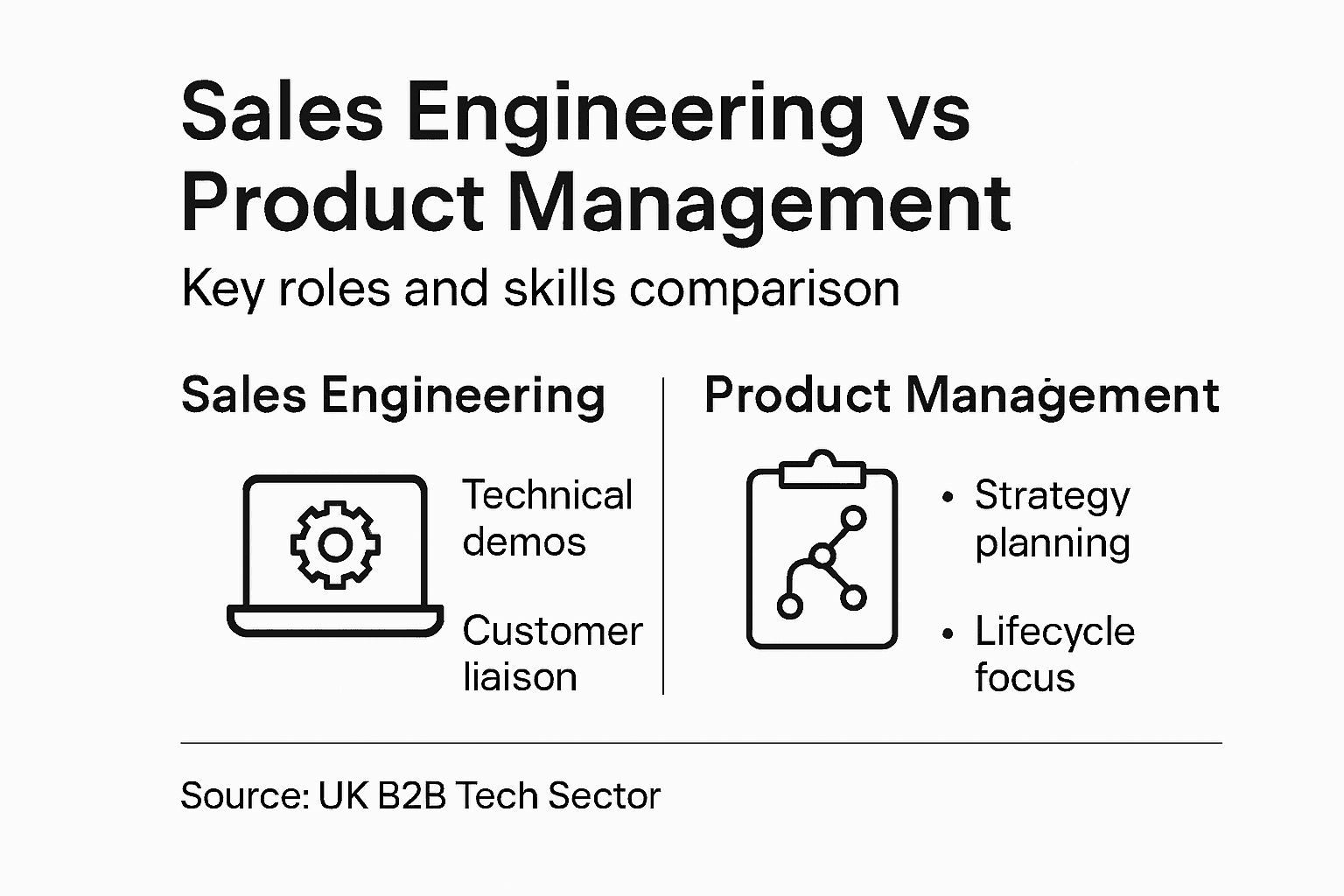
Sales engineers serve as pivotal intermediaries, bridging technical complexity and customer needs by consulting customers and presenting technically sophisticated solutions. They possess a unique skill set that integrates deep technical knowledge with commercial understanding, enabling them to translate intricate product capabilities into compelling value propositions for potential buyers.
Product management focuses on guiding a product’s entire lifecycle, from initial conception through market launch and ongoing development. Professionals in this field strategically oversee product design, coordinate development teams, analyse market dynamics, and ensure that technological innovations align precisely with customer requirements and organisational objectives. Their role demands a comprehensive understanding of both technological capabilities and market demands.
Pro tip: Cultivate cross-functional communication skills to excel in sales engineering and product management, as success depends on effectively translating technical complexity into business value.
Here is a comparison of Sales Engineering and Product Management roles in UK B2B technology firms:
Aspect | Sales Engineering | Product Management |
Primary Focus | Bridging tech and client needs | Overseeing product lifecycle |
Core Skills | Technical consulting, persuasion | Strategic planning, team leadership |
Key Outcome | Deliver tailored client solutions | Launch and improve products |
Typical Interaction | Direct contact with customers | Coordination with diverse teams |
Key Roles in UK B2B Technology Firms
Sales roles in contemporary UK technology firms have evolved beyond traditional selling approaches, demanding sophisticated skills that integrate technical understanding with strategic business acumen. High-growth technology companies now prioritise multifaceted professionals who can navigate complex enterprise environments and translate technological capabilities into tangible business value.
The landscape of B2B technology roles encompasses several critical positions. Enterprise account executives must demonstrate advanced AI fluency, revenue operations architects require systems thinking, and product marketing professionals need the ability to articulate complex technological solutions in accessible language. These roles demand not just technical knowledge, but exceptional communication skills, strategic thinking, and an understanding of rapidly evolving market dynamics.

Beyond traditional sales functions, UK technology firms are increasingly seeking professionals who can bridge multiple disciplines. This includes roles that integrate sales strategy, product development, and marketing communications. Successful candidates must exhibit adaptability, technical literacy, and the capacity to understand nuanced customer challenges across different industry sectors. The most valuable team members are those who can seamlessly translate technological capabilities into compelling business propositions that address specific organisational needs.
Pro tip: Develop a hybrid skill set that combines technical understanding with strong communication abilities to become an indispensable asset in UK B2B technology firms.
Collaboration Across Sales and Product Teams
In modern UK technology firms, successful collaboration between sales and product teams is no longer optional but a strategic imperative. Innovative companies are breaking down traditional organisational silos to create a more integrated approach to product development and market engagement.
The synergy between sales and product teams requires establishing clear communication channels and shared objectives. Sales professionals bring critical customer insights about market demands, emerging needs, and competitive landscapes, while product teams translate these insights into tangible technological solutions. This collaborative approach ensures that product development remains closely aligned with real-world customer requirements, reducing the risk of creating solutions that fail to address genuine market challenges.
Successful collaboration mechanisms include regular cross-functional meetings, joint strategy sessions, and integrated performance metrics that reward collective achievements rather than departmental success. Product managers and sales engineers must develop a mutual understanding of each other’s constraints, capabilities, and strategic goals. By creating platforms for continuous dialogue and knowledge sharing, organisations can transform potential interdepartmental friction into a powerful engine of innovation and market responsiveness.
Pro tip: Implement quarterly cross-functional workshops where sales and product teams share insights, challenges, and collaborative strategies to foster deeper organisational alignment.
Essential Skills, Tools, and Success Measures
Sales engineering and product management demand a sophisticated skill set that goes beyond traditional professional boundaries. UK professionals require a nuanced blend of technical and interpersonal capabilities that enable them to navigate complex technological landscapes and customer relationships with remarkable agility.
The core competencies for these roles span multiple dimensions. Technical expertise remains fundamental, but equally critical are advanced communication skills, strategic thinking, and the ability to translate complex technological concepts into compelling business value propositions. Successful practitioners must demonstrate prowess in data analysis, stakeholder management, and consultative problem-solving. This multifaceted approach requires professionals to act as both technical experts and strategic advisors, bridging the gap between product innovation and market needs.
Measuring success in these roles extends beyond traditional sales metrics. Performance evaluation encompasses factors such as customer satisfaction, product adoption rates, solution complexity management, and the ability to develop innovative approaches to market challenges. Tools like customer relationship management systems, advanced analytics platforms, and collaborative communication technologies play a crucial role in enabling professionals to track progress, identify opportunities, and demonstrate tangible value creation.
Pro tip: Develop a personal development portfolio that showcases your ability to translate technical capabilities into measurable business outcomes, highlighting both your technical expertise and strategic thinking skills.
Risks, Challenges, and Common Pitfalls
Sales engineering and product management inherently involve navigating complex organisational landscapes fraught with potential obstacles. Software product management confronts multifaceted challenges that demand strategic agility and proactive risk mitigation strategies.
Key risks emerge from several critical areas. Organisational silos frequently obstruct effective communication, creating information gaps that can derail product development and sales initiatives. Technical debt accumulation represents another significant challenge, where short-term compromises in product design can lead to long-term systemic inefficiencies. Strategy volatility compounds these issues, with frequent shifts in organisational priorities potentially undermining consistent product development and sales alignment.
Mitigating these risks requires a holistic approach that emphasises cross-functional transparency, structured development processes, and adaptive strategic planning. Successful teams implement robust communication frameworks, regularly reassess technical infrastructures, and maintain flexibility in their product and sales strategies. By anticipating potential challenges and developing comprehensive contingency plans, organisations can transform potential pitfalls into opportunities for innovation and growth.
Below is a summary of common organisational risks and effective mitigation strategies:
Risk Area | Typical Challenge | Recommended Strategy |
Organisational Silos | Poor cross-team communication | Schedule regular cross-functional reviews |
Technical Debt | Long-term inefficiencies | Continuous technical reassessment |
Strategy Volatility | Shifting business priorities | Adaptive, flexible planning |
Misalignment | Product lacks market relevance | Integrate market insights into development |
Pro tip: Establish quarterly cross-functional review sessions to proactively identify and address emerging risks before they escalate into significant organisational challenges.
Unlock Revenue Growth by Bridging Sales Engineering and Product Management
The article highlights the challenges UK B2B technology firms face in aligning sales engineering and product management to drive predictable revenue growth. Common pain points include organisational silos, strategy volatility, and the difficulty of translating technical expertise into compelling business value. These barriers often result in stalled deals, low win rates, and lengthy sales cycles. At The Sales Coach Network, we understand that sustainable growth demands more than isolated training — it requires embedding a scalable sales operating system that integrates cross-functional collaboration, advanced qualification approaches, and disciplined execution.
Our tailored programmes focus on:
Increasing pipeline opportunity by teaching proactive, consultative sales techniques
Enhancing average deal values through value-based executive conversations
Improving win rates with rigorous qualification and differentiation frameworks
Shortening sales cycles with a disciplined cadence to advance complex deals
Take the first step to solve your complex sales challenges today. Explore how The Sales Coach Network can embed the practical frameworks discussed in the article such as the VALID Differentiation Framework and the Sales Ecosystem Framework to align your sales and product teams effectively. Discover our sales training programmes and coaching services designed specifically for senior leaders managing complex B2B technology teams. Don’t let misalignment and inconsistency limit your revenue growth—partner with experts who deliver measurable, sustainable results.
Frequently Asked Questions
What is the role of a Sales Engineer?
Sales engineers act as intermediaries between the technical aspects of a product and the customer’s needs, offering consulting and presenting tailored technical solutions to clients.
How do Sales Engineering and Product Management work together?
Sales engineering and product management collaborate to ensure that product development aligns with customer requirements. Sales professionals provide market insights, while product managers focus on developing solutions that meet those demands.
What skills are essential for success in Sales Engineering and Product Management?
Key skills include technical expertise, advanced communication skills, strategic planning, and the ability to translate complex technical concepts into business value propositions.
How can companies mitigate risks in Sales Engineering and Product Management?
Companies can mitigate risks by fostering cross-functional communication, implementing structured development processes, and maintaining flexibility in their strategies to adapt to shifting priorities.
Recommended


