
What Is Sales Enablement: Driving Revenue Results
- The Sales Coach Network
- Dec 19, 2025
- 7 min read


Most british companies still misunderstand what sales enablement truly involves. Countless organisations believe it is just about giving the sales team more training or better tools, yet research indicates that over 60 percent of sales efforts miss their targets due to misaligned processes and unclear support. Understanding why sales enablement matters helps companies unlock better sales outcomes, stronger performance, and smoother collaboration across every team.
Table of Contents
Key Takeaways
Point | Details |
Sales Enablement is Comprehensive | It is a strategic approach that integrates multiple functions and resources to enhance the effectiveness of sales teams. |
Customisation is Essential | Creating tailored content and resources aligned with specific team needs and challenges drives better outcomes. |
Regular Audits Improve Effectiveness | Conducting annual audits of sales enablement tools and processes ensures that they adapt to evolving organisational requirements. |
Cross-Functional Collaboration is Key | Breaking down silos between different departments fosters a unified approach to customer engagement and sales success. |
Sales Enablement Defined and Misunderstood
Sales enablement represents a strategic approach designed to equip sales teams with the essential resources, tools, and knowledge required to perform more effectively. Sales enablement is fundamentally a collection of tasks and tools intended to improve the execution of key sales activities, including critical functions like pursuing opportunities, managing significant accounts, and targeting high-potential prospects.
Contrary to common misconceptions, sales enablement is not merely a single function or department, but a comprehensive ecosystem that spans multiple organisational dimensions. It encompasses a growing body of knowledge about supporting sales forces effectively, integrating sales messaging, content, training, coaching, technology, and cross-functional collaboration. This holistic approach requires breaking down traditional silos between marketing, sales, product development, and customer support teams.
Successful sales enablement strategies go beyond providing generic training materials. They involve creating tailored, contextually relevant resources that align with specific sales team challenges, buyer personas, and organisational objectives. This means developing sophisticated content libraries, implementing advanced training programmes, and establishing robust technological infrastructure that supports seamless information sharing and performance tracking.
Expert Insight: Strategic alignment is crucial - sales enablement must be deeply integrated with the organisation’s overall commercial strategy, not treated as an isolated tactical intervention.
Pro Tip: Conduct a comprehensive sales enablement audit annually to assess the effectiveness of your current tools, training resources, and collaborative mechanisms, ensuring continuous improvement and adaptability.
Core Components and Practical Processes
Sales enablement comprises several critical core components designed to support and enhance the sales force’s effectiveness, including sales force support, sales management, technology infrastructure, and strategic content development. These interconnected elements work together to provide sales teams with the comprehensive resources needed to navigate complex selling environments and drive consistent performance.
The progression of sales enablement maturity follows a strategic trajectory, moving through distinct stages that represent increasingly sophisticated approaches to supporting sales teams. These stages evolve from Ad Hoc and Collaborative to Integrated and ultimately Transformative, with each phase demanding more nuanced cross-functional alignment and more advanced technological integration.

To clarify the evolution of sales enablement maturity, here is a table comparing each stage:
Maturity Stage | Defining Characteristics | Typical Challenges | Strategic Opportunities |
Ad Hoc | Isolated efforts, limited structure | Inconsistent outcomes | Foundation for future formalisation |
Collaborative | Emerging cross-team support | Alignment gaps | Builds shared vision across departments |
Integrated | Well-defined processes, solid tech underpinning | Change management resistance | Enhances data-driven decision making |
Transformative | Advanced integration, continuous improvement | Maintaining agility | Fuels sustainable revenue growth |
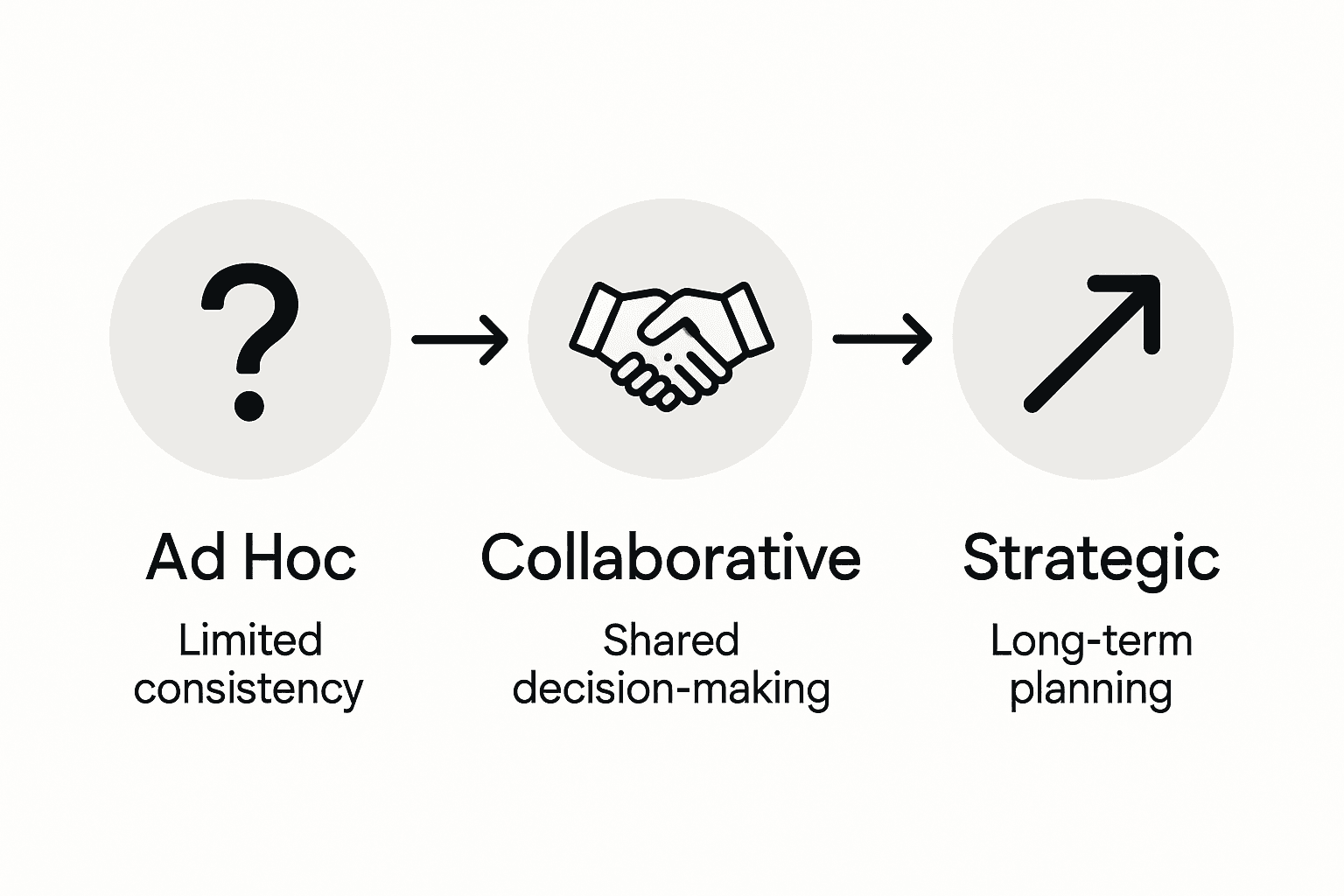
Practical implementation requires a holistic approach that goes beyond traditional training methodologies. This means developing targeted content libraries, implementing advanced technological platforms, creating rigorous coaching frameworks, and establishing clear performance measurement mechanisms. Successful organisations recognise that sales enablement is not a one-time intervention, but a continuous process of refinement and strategic adaptation.
Key Focus Areas:
Sales force knowledge enhancement
Technology infrastructure development
Content strategy and creation
Performance tracking and analytics
Cross-functional collaboration
Pro Tip: Design a quarterly sales enablement review process that systematically evaluates the effectiveness of your current tools, training resources, and collaborative mechanisms, ensuring continuous improvement and organisational agility.
Types of Sales Enablement Tools and Support
Sales enablement platforms represent sophisticated software solutions designed to facilitate comprehensive sales processes, providing sales teams with critical resources including targeted content, advanced training modules, workflow automation, and sophisticated analytics capabilities. These technological ecosystems are engineered to transform how sales organisations approach performance improvement, strategic alignment, and revenue generation.
Key Types of Sales Enablement Tools:
Content Management Systems
Customer Relationship Management (CRM) Platforms
Sales Training and Learning Management Systems
Performance Analytics and Reporting Tools
Communication and Collaboration Platforms
Workflow orchestration systems play a pivotal role in integrating various tools and processes, creating seamless interactions between sales and marketing functions. These sophisticated platforms enable organisations to streamline complex workflows, reduce operational friction, and create more cohesive cross-functional collaboration mechanisms.
Successful implementation requires a strategic approach that goes beyond mere tool acquisition. Organisations must carefully evaluate their specific sales ecosystem, understanding unique team dynamics, technological infrastructure, and performance objectives. This means selecting tools that not only provide technological capabilities but also align with the organisation’s specific cultural and strategic requirements.
Here is a summary of how major sales enablement tools provide business value:
Tool Type | Core Functionality | Business Impact |
Content Management System | Centralises sales content | Ensures fast, up-to-date communication |
CRM Platform | Manages customer relationships | Improves pipeline visibility |
Analytics/Reporting Tools | Tracks team performance | Enables data-driven improvements |
Learning Management System | Delivers ongoing training | Accelerates skill development |
Collaboration Platform | Streamlines team communication | Boosts cross-functional alignment |
Expert Insight: Technology alone cannot transform sales performance - it must be accompanied by robust training, clear processes, and a culture of continuous learning and improvement.
Pro Tip: Conduct a comprehensive technology audit annually to assess the effectiveness of your current sales enablement tools, ensuring they continue to meet evolving organisational needs and technological capabilities.
Roles and Responsibilities Within Teams
Successful sales enablement organisations strategically focus on functions that drive maximum revenue, enabling sales teams to prioritise selling activities while minimising administrative overhead. This requires a meticulously designed approach to role definition and responsibilities across different organisational levels.
Key Roles in Sales Enablement:
Sales Leadership
Sales Enablement Specialists
Sales Managers
Training and Development Professionals
Marketing Collaboration Managers
Each role within the sales ecosystem carries distinct responsibilities that contribute to the overall performance and effectiveness of the sales function. Sales leaders must establish strategic direction, enablement specialists design targeted training programmes, sales managers drive day-to-day performance, and training professionals ensure continuous skill development. The most effective teams create a seamless, collaborative environment where these roles interact dynamically to support revenue generation.
Cross-functional collaboration becomes paramount in modern sales enablement strategies. This means breaking down traditional organisational silos, creating transparent communication channels, and establishing clear accountability frameworks. Sales teams must work closely with marketing, product development, and customer success departments to ensure a unified approach to customer engagement and revenue growth.
Expert Insight: Effective sales enablement is not about individual heroics, but about creating a holistic, interconnected system where each team member understands their unique contribution to organisational success.
Pro Tip: Implement quarterly role alignment workshops to clarify responsibilities, identify potential collaboration gaps, and ensure all team members understand how their individual contributions support broader organisational objectives.
Common Pitfalls and How to Avoid Them
Many organisations struggle with ineffective sales enablement approaches that fail to focus on genuine revenue-driving functions, creating complex systems that ultimately reduce rather than enhance sales productivity. The most critical mistake is developing intricate processes that distract sales teams from their primary objective: generating meaningful revenue.
Key Sales Enablement Pitfalls:
Over-complicating sales processes
Lack of clear strategic alignment
Insufficient ongoing training
Poor technological integration
Minimal cross-functional collaboration
Sales enablement maturity progresses through distinct stages, with many organisations remaining trapped in Ad Hoc or Collaborative phases, which significantly limit their potential for transformative performance improvement. Successful organisations recognise that advancing requires a strategic, holistic approach that goes beyond superficial training interventions and demands comprehensive systemic change.
Addressing these pitfalls requires a multifaceted strategy that emphasises simplification, strategic alignment, and continuous improvement. Sales leaders must create lean, focused enablement frameworks that directly support revenue generation, eliminate unnecessary administrative burdens, and provide targeted support that genuinely empowers sales professionals to perform at their highest potential.
Expert Insight: Complex systems do not create sales excellence - clarity, focus, and strategic simplicity do.
Pro Tip: Conduct a quarterly sales enablement process audit to identify and eliminate unnecessary complexity, ensuring your support mechanisms remain agile, relevant, and directly linked to revenue generation objectives.
Unlock Your Sales Potential with Strategic Enablement
The article highlights common challenges such as ineffective sales processes, poor strategic alignment, and the need for continuous improvement within sales enablement ecosystems. If you are a senior revenue leader battling unpredictable revenue, stalled deals, or low win rates, these pain points may feel all too familiar. Sales enablement is more than providing tools or training—it is about embedding a holistic, scalable system that drives sustainable revenue growth through strategic focus, targeted coaching, and strong cross-functional collaboration.
At The Sales Coach Network, we understand these challenges deeply. We specialise in transforming sales teams within complex B2B organisations by fixing systemic issues rather than offering generic solutions. Our approach aligns with key article concepts such as integrating sales messaging, content strategy, technology, and leadership coaching to boost sales velocity. Explore our sales training programs and discover how our proven frameworks like the Sales Ecosystem Framework and VALID Differentiation Framework directly address the pitfalls discussed, creating clarity, focus and measurable performance uplift.
Ready to move beyond ad hoc efforts and build an integrated, transformative sales enablement capability that delivers consistent revenue results Explore the practical solutions of The Sales Coach Network today and start embedding discipline, accountability and continuous learning into your team. Visit The Sales Coach Network to learn more and take the first step towards predictable, scalable growth.
Frequently Asked Questions
What is sales enablement?
Sales enablement is a strategic approach that equips sales teams with the necessary resources, tools, and knowledge to enhance their effectiveness in pursuing opportunities, managing accounts, and targeting high-potential prospects.
How can sales enablement improve revenue generation?
By providing tailored and relevant resources, training, and technological support, sales enablement aligns sales strategies with organisational goals, enhances team performance, and ultimately drives consistent revenue growth.
What are the core components of effective sales enablement?
Core components include sales force support, sales management, technology infrastructure, strategic content development, performance tracking, and cross-functional collaboration.
What common pitfalls should organisations avoid in sales enablement?
Common pitfalls include over-complicating sales processes, lack of clear strategic alignment, insufficient ongoing training, poor technological integration, and minimal cross-functional collaboration.
Recommended