
B2B Sales Execution Guide for Sustainable Growth UK
- The Sales Coach Network
- Dec 31, 2025
- 7 min read


Almost four out of five british sales leaders believe their current approach fails to deliver the pipeline growth they need. In a market shaped by fierce competition and shifting client expectations, defining a clear and unified direction for your sales organization has never been more critical. This resource cuts through the noise to reveal practical steps that help senior sales executives align teams, sharpen execution, and drive measurable advancements in both pipeline quality and win rates.
Table of Contents
Quick Summary
Key Insight | Explanation |
1. Define Strategic Sales Direction | Establish a blueprint that aligns sales with your business’s goals, setting clear objectives for revenue growth. |
2. Equip Teams with Enablement | Provide the necessary tools, resources, and training to empower your sales team for better performance. |
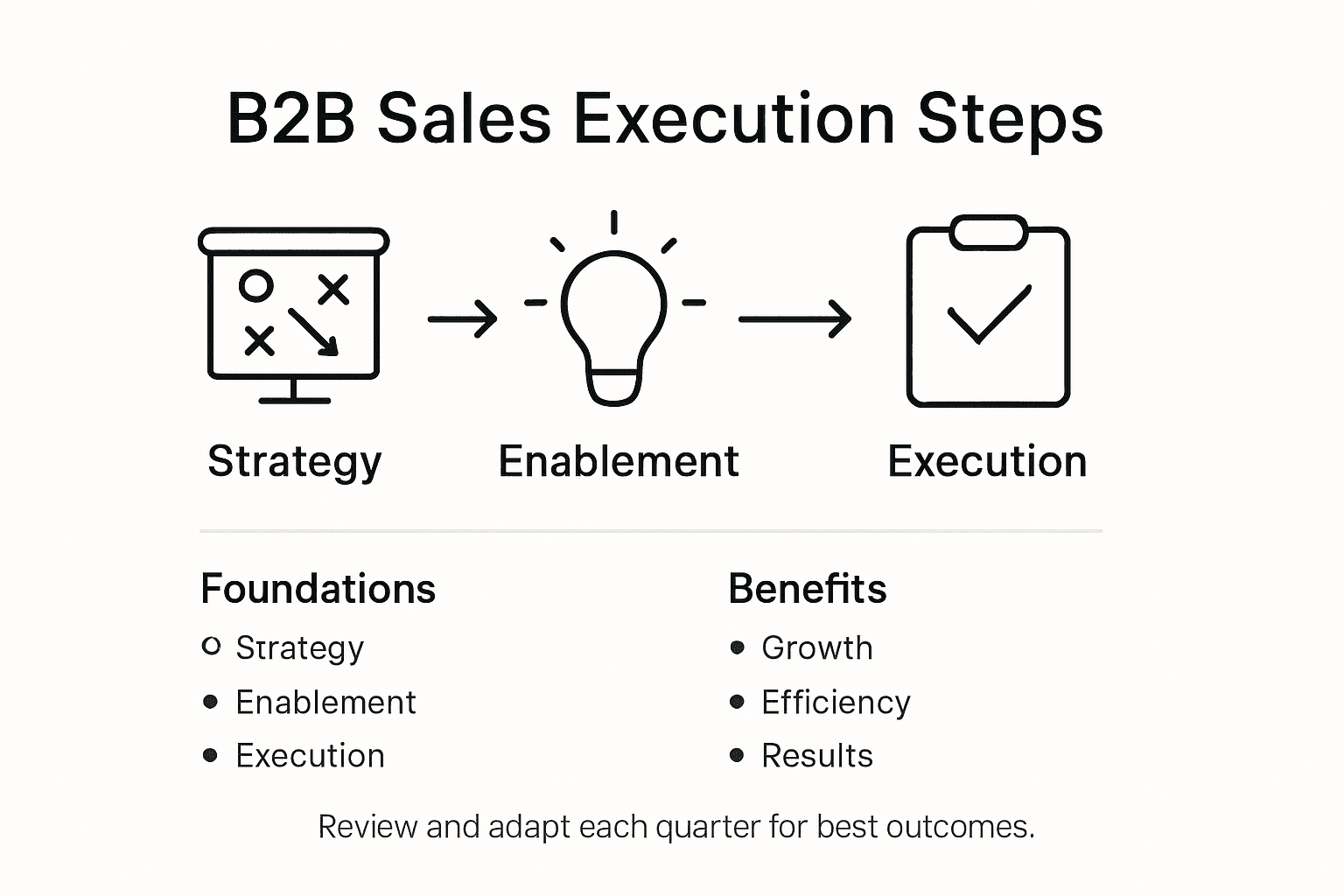
3. Embed Disciplined Sales Execution | Implement structured processes that ensure consistent performance and accountability across the sales organisation. |
4. Validate Outcomes and Optimise Processes | Use data-driven insights to continuously refine sales strategies and improve overall effectiveness. |
Step 1: Define Strategic Sales Direction
Defining your strategic sales direction establishes the foundational blueprint for sustainable revenue growth across your organisation. This critical first step transforms sales from a reactive function into a proactive strategic driver that aligns precisely with your broader business objectives.
To craft an effective strategic sales direction, you must systematically analyse your current market position, customer landscape, and organisational capabilities. Strategic sales positioning requires deep understanding of how your sales function interfaces with overall business goals. Begin by conducting a comprehensive assessment that examines your existing sales processes, team competencies, customer segments, and competitive environment.
Your strategic direction should articulate clear targets around pipeline development, deal qualification, revenue generation, and market expansion. Create a documented framework that outlines specific objectives such as targeted deal sizes, ideal customer profiles, sales methodologies, and performance metrics. This approach ensures every team member understands the organisation’s sales vision and can work cohesively towards shared goals.
Top Tip: Schedule quarterly strategic reviews to validate and recalibrate your sales direction based on emerging market dynamics and internal performance data.
Step 2: Equip Teams with Critical Enablement
Effective sales enablement transforms your sales team from a collection of individuals into a strategic powerhouse capable of driving sustainable revenue growth. This critical step involves creating a comprehensive infrastructure that supports your sales professionals with the right tools, knowledge, and resources.
B2B sales enablement represents a strategic process that goes beyond traditional training. It involves systematically equipping your sales team with content libraries, targeted educational resources, and technology platforms that streamline their ability to engage potential clients effectively. Focus on developing a holistic enablement approach that encompasses four essential pillars: content and resources, training and coaching, technology and tools, and strategic process alignment.

Design your enablement strategy by first mapping the specific competencies and knowledge gaps within your sales team. Create customised training programmes that provide practical skills, product knowledge, and sales techniques tailored to your unique market environment. Implement a robust technology ecosystem that includes customer relationship management systems, sales intelligence platforms, and communication tools that enhance your team’s effectiveness and efficiency.
Top Tip: Conduct quarterly skills assessments and enablement audits to ensure your sales team’s capabilities continuously evolve with changing market demands.
The table below highlights essential tools and processes for sales enablement and their impact:
Enablement Area | Example Tool or Method | Resulting Advantage |
Content & Resources | Central knowledge library | Faster client response times |
Training & Coaching | Tailored skill workshops | Improved deal win rates |
Technology & Tools | CRM and analytics platforms | Increased sales productivity |
Process Alignment | Structured sales workflows | Reduced errors and delays |
Step 3: Embed Disciplined Sales Execution
Disciplined sales execution transforms strategic planning into tangible results by creating a structured framework that consistently drives performance across your entire sales organisation. This crucial step bridges the gap between ambitious goals and practical implementation.
Sales performance improvement requires developing rigorous practices that balance accountability with team support. Establish clear performance metrics, implement regular monitoring processes, and create a culture of continuous learning and adaptation. Design standardised workflows that provide salespeople with consistent guidelines while maintaining enough flexibility to respond to unique client scenarios.
Key elements of disciplined execution include creating comprehensive playbooks, establishing weekly performance reviews, implementing robust customer relationship tracking systems, and developing a transparent coaching framework. Ensure your managers are equipped with the skills to provide meaningful performance feedback, recognise individual strengths, and support ongoing skill development. By creating a systematic approach that combines structure with individual empowerment, you can build a sales team that consistently delivers exceptional results.
Top Tip: Develop a performance dashboard that provides real time visibility into key sales metrics, enabling immediate insights and rapid strategic adjustments.
Step 4: Validate Outcomes and Optimise Processes
Validating sales outcomes and optimising processes represents the critical final stage of creating a high-performance sales ecosystem. This step transforms raw performance data into strategic insights that drive continuous improvement across your entire sales organisation.
Sales process optimization is a strategic and ongoing effort that requires systematic analysis of every sales journey phase. Develop a comprehensive performance evaluation framework that examines key metrics including lead qualification effectiveness, deal conversion rates, average sales cycle duration, and customer satisfaction levels. Focus on identifying both successful patterns and potential bottlenecks that might impede sales performance.
Implement a data driven approach to process refinement by conducting regular retrospective analyses. Create cross functional feedback mechanisms that allow sales representatives, managers, and supporting teams to contribute insights about workflow challenges. Leverage advanced analytics tools to track granular performance indicators, enabling you to make precise adjustments that incrementally improve overall sales effectiveness. Your goal is to build a responsive and adaptive sales mechanism that continuously learns and evolves based on empirical evidence.
Top Tip: Establish a quarterly performance review ritual where data insights are transparently shared and collaborative improvement strategies are developed.
Here is a summary of how each step contributes uniquely to a high-performance sales organisation:
Step | Primary Focus | Key Business Benefit |
Define Strategic Sales Direction | Align sales with business goals | Drives unified sales vision |
Equip Teams with Enablement | Build team capabilities | Enhances sales effectiveness |
Embed Disciplined Execution | Standardise performance routines | Ensures consistent results |
Validate & Optimise | Use data for improvement | Enables continuous learning |
Unlock Sustainable Growth with Expert Sales Execution Support
The challenges highlighted in “B2B Sales Execution Guide for Sustainable Growth UK” mirror the frustrations many senior sales leaders face today. If your team struggles with low win rates, inconsistent sales execution, or lengthy sales cycles, these issues often stem from a lack of a cohesive strategy that aligns execution, enablement and ongoing optimisation. This article’s focus on disciplined execution and continuous validation resonates deeply with our proven approach at The Sales Coach Network, where we address systemic barriers to predictable revenue rather than temporary fixes.
At The Sales Coach Network we offer practical, tailored solutions rooted in the Forty-20-40 Principle. Our expert practitioners help you define strategic sales direction, equip your teams with targeted enablement, and embed disciplined execution processes that last. We go beyond traditional training to embed scalable sales operating systems that deliver measurable growth. If you want to reduce deal friction, increase win rates, and optimise your sales ecosystem with real data-driven insights explore our Sales Training Programs and Sales Coaching Services.
Take the next step and transform uncertainty into sustainable revenue growth by partnering with experts who understand complex, large-scale B2B sales challenges. Discover how to adapt, accelerate and achieve your sales goals today by visiting The Sales Coach Network. Start shaping your high-performance sales organisation now.
Frequently Asked Questions
What are the key steps in a B2B sales execution strategy?
To create an effective B2B sales execution strategy, follow four key steps: define your strategic sales direction, equip your teams with essential enablement resources, embed disciplined sales execution practices, and validate outcomes while optimising processes. Start by documenting your sales vision and objectives to ensure alignment across the organisation.
How can I determine the right sales methodologies for my team?
To determine the appropriate sales methodologies for your team, assess your market environment and analyse your team’s current capabilities. Conduct a skills assessment and customise training programmes that fit your specific customer profiles and sales goals.
What tools should I implement to enhance sales enablement?
Implement a variety of tools that support sales enablement, including a central knowledge library for resources, customer relationship management (CRM) platforms for tracking client interactions, and training software for ongoing skill development. Start with selecting one fundamental tool within 30 days to empower your sales team effectively.
How often should I review and adjust my sales strategy?
You should conduct quarterly reviews of your sales strategy to ensure it remains aligned with both market dynamics and internal performance metrics. Schedule these reviews to recalibrate objectives as needed and involve your sales team in the discussion for comprehensive insights.
What performance metrics should I track for sales success?
Key performance metrics to track for sales success include lead qualification effectiveness, deal conversion rates, and average sales cycle duration. Focus on collecting this data regularly to identify successful patterns and potential bottlenecks for improvement.
How can I foster a culture of continuous learning within my sales team?
To foster a culture of continuous learning, implement regular coaching sessions, structured feedback mechanisms, and skill development workshops for your sales team. Encourage open communication around performance insights and celebrate learning milestones to motivate ongoing improvement.
Recommended