
Sales Performance Improvement Steps for B2B Leaders
- The Sales Coach Network
- Nov 30, 2025
- 7 min read


Most british companies struggle to unlock their full sales potential because over 60 percent lack a clear system for measuring and improving performance. With changing markets and rising customer expectations, having a robust framework for sales transformation is no longer just helpful, it is absolutely critical. This guide uncovers practical, research-backed steps for british businesses to analyse, realign, and energise their sales efforts with measurable, lasting results.
Table of Contents
Quick Summary
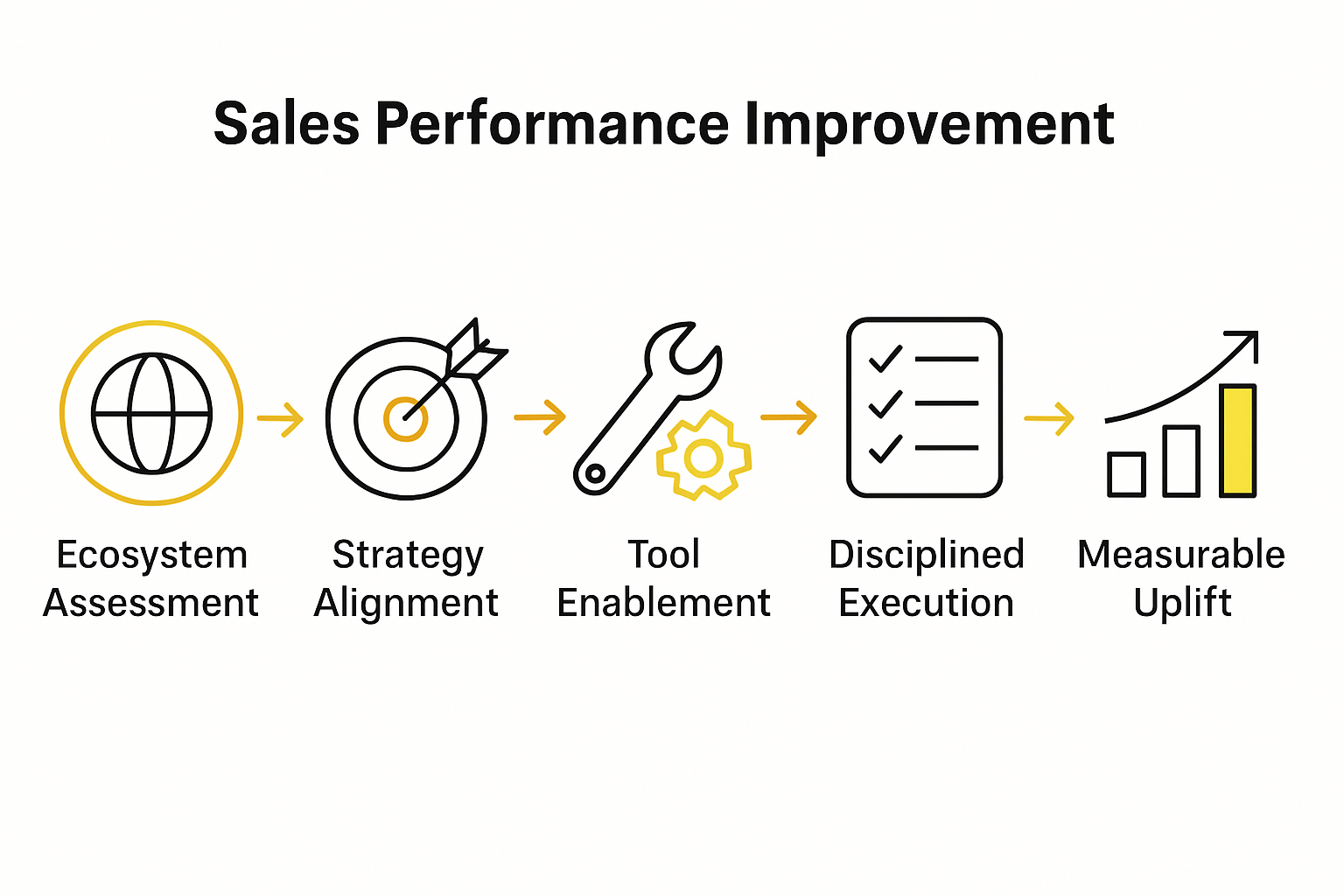
Main Insight | Detailed Explanation |
1. Assess Your Sales Ecosystem | Evaluate sales and marketing alignment to identify disconnections affecting revenue potential. Understand five core dimensions for effective assessment. |
2. Define a Commercial Strategy | Create a framework that aligns sales capabilities with customer expectations, ensuring cross-functional collaboration for effective strategy development. |
3. Equip Teams with Essential Tools | Implement integrated sales enablement tools to enhance communication and tracking, ensuring selection aligns with organisational needs without overwhelming systems. |
4. Embed Disciplined Execution | Develop structured practices for accountability and continuous learning, balancing monitoring with team support to maintain flexibility in execution. |
5. Validate Performance Uplift | Use a comprehensive framework to measure revenue growth and conversion rates, ensuring an objective approach to track the effectiveness of sales transformations. |
Step 1: Assess Existing Sales Ecosystem
Assessing your existing sales ecosystem provides the foundational roadmap for transformative performance improvement. By comprehensively understanding your current sales infrastructure, you uncover critical opportunities for strategic enhancement.
According to research from Northumbria University, evaluating your sales ecosystem requires a holistic examination of several interconnected components. Begin with a granular analysis of your current sales and marketing alignment. Most organisations suffer from significant disconnection between these critical functions, which directly impacts revenue generation potential.
Your assessment should systematically examine five core dimensions of your sales ecosystem:
Sales Team Capabilities: Technical skills, product knowledge, consultative selling competencies
Technology Infrastructure: CRM systems, communication tools, sales enablement platforms
Sales Process Workflow: Lead generation, qualification, opportunity management, closing mechanisms
Performance Metrics: Win rates, average deal size, sales cycle length, pipeline velocity
Organisational Culture: Collaboration levels, performance expectations, coaching frameworks
Research from Sheffield Hallam University emphasises that truly effective sales ecosystems require more than surface-level analysis. You must dig deeper to articulate genuine value propositions and understand intricate customer interaction dynamics.
Warning: Avoid superficial assessments. The most successful sales transformations emerge from rigorous, data-driven ecosystem evaluations that challenge existing assumptions and reveal hidden performance constraints.
Once you have completed a comprehensive ecosystem assessment, you will be prepared to move into strategic design and targeted improvement interventions. The insights gained here will become your strategic blueprint for predictable, scalable sales performance.
Step 2: Define Aligned Commercial Strategy
Defining an aligned commercial strategy represents the critical foundation for sustainable sales performance transformation. This strategic blueprint will serve as your organisation’s roadmap for targeted growth and consistent revenue generation.
Research from Warwick Business School highlights the paramount importance of redefining sales roles to match evolving market dynamics. Your commercial strategy must transcend traditional approaches by creating a comprehensive framework that aligns your sales capabilities with emerging customer expectations.
To develop a robust aligned commercial strategy, focus on these essential components:
Strategic Positioning: Clearly articulate your unique value proposition
Target Market Segmentation: Identify and prioritise most valuable customer segments
Revenue Objectives: Establish precise quantitative growth targets
Competitive Landscape Analysis: Understand market positioning and differentiation opportunities
Resource Allocation: Match strategic goals with required capabilities and investments
Strategic Sales Training becomes instrumental in transforming your strategic vision into executable actions. Your strategy must remain adaptable yet disciplined, creating a structured approach that enables consistent performance.
Warning: Avoid creating strategies in isolation. Effective commercial strategies require cross functional collaboration, ensuring alignment between sales leadership, marketing, product development, and customer success teams.
Once you have defined your aligned commercial strategy, you will be prepared to design targeted enablement programmes that translate strategic intent into measurable sales performance improvements.
Step 3: Equip Teams with Proven Tools
Equipping your sales teams with proven tools represents a transformative strategy for enhancing performance and driving consistent revenue growth. This critical step bridges the gap between strategic intent and practical execution.
Research from Northumbria University highlights the significant impact of strategic tool implementation, particularly in marketing automation technologies that can seamlessly connect sales and marketing functions. The right tools can dramatically improve communication, tracking, and overall sales effectiveness.
When selecting and implementing sales enablement tools, consider these essential categories:
Customer Relationship Management Systems
Sales Intelligence and Prospecting Platforms
Communication and Collaboration Technologies
Performance Tracking and Analytics Solutions
Learning and Development Resources
Sales Enablement Tools play a pivotal role in creating a structured approach to sales performance. Your tool selection must align with your specific organisational needs, enabling your team to work smarter and more efficiently.

Research from Warwick Business School emphasises the importance of transparency and trust in modern sales environments. Choose tools that promote clear communication, data visibility, and collaborative workflows.
Warning: Avoid tool sprawl. Implementing too many disconnected technologies can create confusion and reduce productivity. Select integrated solutions that genuinely enhance your team’s capabilities.
Once you have equipped your team with the right tools, you will be prepared to establish a robust coaching and development framework that transforms these technological investments into tangible sales performance improvements.
Step 4: Embed Disciplined Execution Practices
Embedding disciplined execution practices transforms strategic intentions into measurable sales performance outcomes. This critical step bridges the gap between planning and consistent delivery, creating a systematic approach to achieving revenue objectives.
Research from Warwick Business School emphasises the importance of implementing proactive transparency and tailored control systems within sales organisations. Disciplined execution requires a structured framework that promotes accountability, consistency, and continuous improvement.
To successfully embed disciplined execution practices, focus on these key dimensions:
Performance Tracking Mechanisms
Regular Accountability Reviews
Clear Milestone Definitions
Structured Reporting Protocols
Continuous Learning and Adaptation Processes
Building a Consistent Sales Coaching Programme becomes instrumental in reinforcing these execution practices. Your approach must balance rigorous monitoring with supportive coaching that enables team growth and development.
Research from University of Reading highlights the critical need for defining strategic outputs and aligning execution practices with broader organisational goals. This ensures that your disciplined approach remains connected to overarching business objectives.
Warning: Avoid creating overly bureaucratic systems that stifle creativity. Disciplined execution should provide structure and clarity while maintaining flexibility and encouraging innovative problem solving.
Once you have embedded these disciplined execution practices, you will have established a robust framework for consistent sales performance and continuous organisational improvement.
Step 5: Validate Measurable Performance Uplift
Validating measurable performance uplift represents the ultimate validation of your sales transformation strategy. This critical step transforms theoretical improvements into concrete evidence of organisational growth and effectiveness.
Research from Northumbria University highlights the importance of developing a comprehensive Sales and Marketing funnel framework that provides tangible metrics for performance validation. By implementing a unified approach, you create a robust mechanism for tracking genuine performance improvements.
To effectively validate performance uplift, concentrate on these fundamental measurement dimensions:
Revenue Growth Trajectory
Sales Velocity Metrics
Opportunity Conversion Rates
Average Deal Value Progression
Customer Acquisition Cost Reduction
Quantifying Value becomes instrumental in establishing clear benchmarks and tracking meaningful progress. Your validation process must go beyond surface level numbers and delve into substantive performance indicators.
Research from Warwick Business School suggests that successful performance validation requires transparency and a willingness to reinvent traditional sales approaches. Your measurement strategy should reflect this progressive mindset.
Warning: Avoid confirmation bias. Ensure your performance validation methodology remains objective and capable of revealing genuine insights rather than merely confirming preconceived expectations.
Once you have validated measurable performance uplift, you will have concrete evidence of your sales transformation efforts and a clear pathway for continued organisational growth.
Unlock Sustained Sales Performance Improvement
The challenges outlined in the article highlight exactly why many B2B sales leaders struggle with unpredictable revenue and stalled deals. By focusing on a rigorous assessment of your sales ecosystem and embedding disciplined execution practices you can break free from inconsistent team performance and long sales cycles. At The Sales Coach Network we understand that true transformation requires more than generic training. It demands strategic alignment, proven tools and leadership coaching rooted in real-world experience.
Our sales training programmes and expert sales coaching services directly address the core pain points raised, from increasing qualified pipeline opportunities to boosting win rates through consultative techniques. We work alongside senior revenue leaders to embed scalable sales operating systems that deliver measurable uplift across all four key drivers of revenue. Ready to turn your sales challenges into predictable growth Learn more at The Sales Coach Network and discover how our tailored approach can help you Adapt Accelerate and Achieve in today’s complex B2B markets.
Frequently Asked Questions
What are the first steps in assessing my sales ecosystem?
To start assessing your sales ecosystem, conduct a thorough evaluation of your current sales and marketing alignment. Review your sales team capabilities, technology infrastructure, sales process workflow, performance metrics, and organisational culture to identify key areas for improvement within 30 days.
How can I define a commercial strategy that aligns with my sales goals?
Define your commercial strategy by clearly articulating your unique value proposition and identifying your target market segments. Focus on establishing specific quantitative revenue objectives and ensuring that your strategy is realistic and actionable within the next quarter.
What tools should I implement to enhance my sales team’s performance?
Equip your sales team with customer relationship management systems, sales intelligence platforms, and communication tools. Prioritise integration and ease of use to ensure your tools support effective workflows and can be adopted seamlessly within the next few weeks.
How can I establish disciplined execution practices in my sales organisation?
Establish disciplined execution by creating structured reporting protocols, performance tracking mechanisms, and regular accountability reviews. Aim to implement these frameworks within the next 45 days to improve consistency and drive results.
What metrics should I track to validate sales performance improvements?
To validate sales performance improvements, focus on tracking revenue growth, sales velocity metrics, and opportunity conversion rates. Set clear benchmarks for these metrics and review them quarterly to ensure you are making tangible progress.
How do I avoid confirmation bias when validating performance uplift?
To avoid confirmation bias, ensure your performance validation process uses objective metrics and incorporates diverse viewpoints. Regularly review your findings with a focus on evidence-based insights rather than preconceived notions, which can help you refine your strategy effectively.
Recommended