
Sales Performance: Driving Predictable Growth in B2B Firms
- The Sales Coach Network
- Jan 5
- 7 min read


Most British sales leaders find that outdated assumptions about performance quickly hold back progress. Inconsistent pipeline quality and win rates drag on results, despite best efforts and advanced technology investments. Recent research shows that over 60 percent of sales organisations struggle because they operate with myths rather than proven facts. This article exposes common misconceptions, clarifies what really drives sustainable sales results, and highlights strategies that enable British B2B IT firms to build stronger, more predictable pipelines.
Table of Contents
Key Takeaways
Point | Details |
Sales Performance is Multifaceted | It encompasses both quantitative and qualitative dimensions, involving skills, strategies, and organisational systems. |
Common Myths are Misleading | Sales success is not an innate talent; it can be learned and improved through coaching and development. |
Sales Velocity is Crucial | Understanding the primary drivers such as pipeline opportunities and average deal value is essential for accelerating revenue growth. |
Navigating B2B Challenges Requires Strategy | Effective methodologies must address complex stakeholder dynamics and emphasise consultative, value-driven engagement. |
Defining Sales Performance and Common Myths
Sales performance represents the systematic evaluation of a sales organisation’s effectiveness in generating revenue, managing client relationships, and achieving strategic objectives. Unlike simplistic perspectives that reduce performance to pure financial metrics, contemporary understanding recognises performance as a multifaceted construct encompassing both quantitative outcomes and qualitative behavioural dimensions.
Research highlights that sales performance is not a static concept but a dynamic interplay of skills, strategies, and systemic enablers. Academic studies reveal that performance metrics extend beyond traditional sales volume, incorporating critical elements like goal orientation, technological proficiency, and adaptive selling approaches. Modern sales professionals must navigate increasingly complex buyer ecosystems, requiring sophisticated competencies that transcend basic transactional skills.
Several pervasive myths undermine genuine sales performance improvement. Contrary to popular belief, sales excellence is not an innate talent but a learnable skill set. Extensive coaching research demonstrates that targeted development programmes can systematically enhance sales capabilities, challenging the notion that some individuals are inherently predisposed to sales success. Key misconceptions include assumptions that training alone produces sustainable performance improvements, managers cannot effectively coach sales teams, and technology can completely replace human relationship-building skills.
Expert Recommendation: Develop a holistic performance improvement strategy that integrates targeted skill development, technological enablement, and continuous coaching to drive sustainable sales excellence.
Here is a summary of common myths versus reality in sales performance:
Myth | Reality | Business Impact |
Sales success is innate | Skills are learnable and coachable | Wider talent pool and improved team capability |
Training is enough for improvement | Continuous development and coaching required | Sustained growth and higher retention |
Technology can replace human touch | Relationships still need personal engagement | Stronger client loyalty and trust |
Key Drivers of Sales Velocity and Results
Sales velocity represents the critical measurement of how quickly opportunities move through the sales pipeline, transforming potential revenue into actual financial results. Understanding the core drivers that accelerate this process is fundamental for B2B organisations seeking predictable and sustainable growth strategies.
Contemporary research on sales performance drivers reveals a complex ecosystem of interconnected factors that determine sales success. Key elements include selling-related knowledge, adaptiveness, role clarity, cognitive aptitude, and work engagement. Modern sales professionals must function as sophisticated knowledge brokers, capable of navigating increasingly complex buyer relationships and technological landscapes.

The primary drivers of sales velocity can be categorised into four fundamental components: pipeline opportunities, average deal value, win rates, and sales cycle duration. Successful organisations focus on systematically improving each of these elements through targeted strategies. This requires a holistic approach that combines strategic skill development, technological enablement, robust qualification methodologies, and continuous performance coaching.
Expert Strategy: Develop a comprehensive performance improvement framework that simultaneously addresses knowledge enhancement, adaptive selling skills, technological proficiency, and disciplined execution to accelerate sales velocity.
Types of Sales Performance Systems
Sales performance systems represent sophisticated frameworks designed to measure, manage, and optimise organisational revenue generation capabilities. These systems have evolved significantly from traditional metrics-based approaches to more holistic, technology-enabled platforms that integrate multiple dimensions of sales effectiveness.
Systematic research reveals the complexity of modern sales performance management systems, highlighting the need for comprehensive frameworks that extend beyond simplistic numerical evaluations. Contemporary systems typically incorporate a blend of objective outcomes and subjective behavioural assessments, recognising that sales performance is a multifaceted construct requiring nuanced measurement techniques.
Primary types of sales performance systems include quantitative metrics systems, behavioural assessment frameworks, technological integration platforms, and holistic performance ecosystems. Quantitative systems focus on traditional metrics like revenue generated, deal closure rates, and pipeline value. Behavioural assessment frameworks evaluate softer skills such as communication effectiveness, adaptability, and client relationship management. Technological integration platforms leverage data analytics, artificial intelligence, and comprehensive tracking mechanisms to provide real-time performance insights.
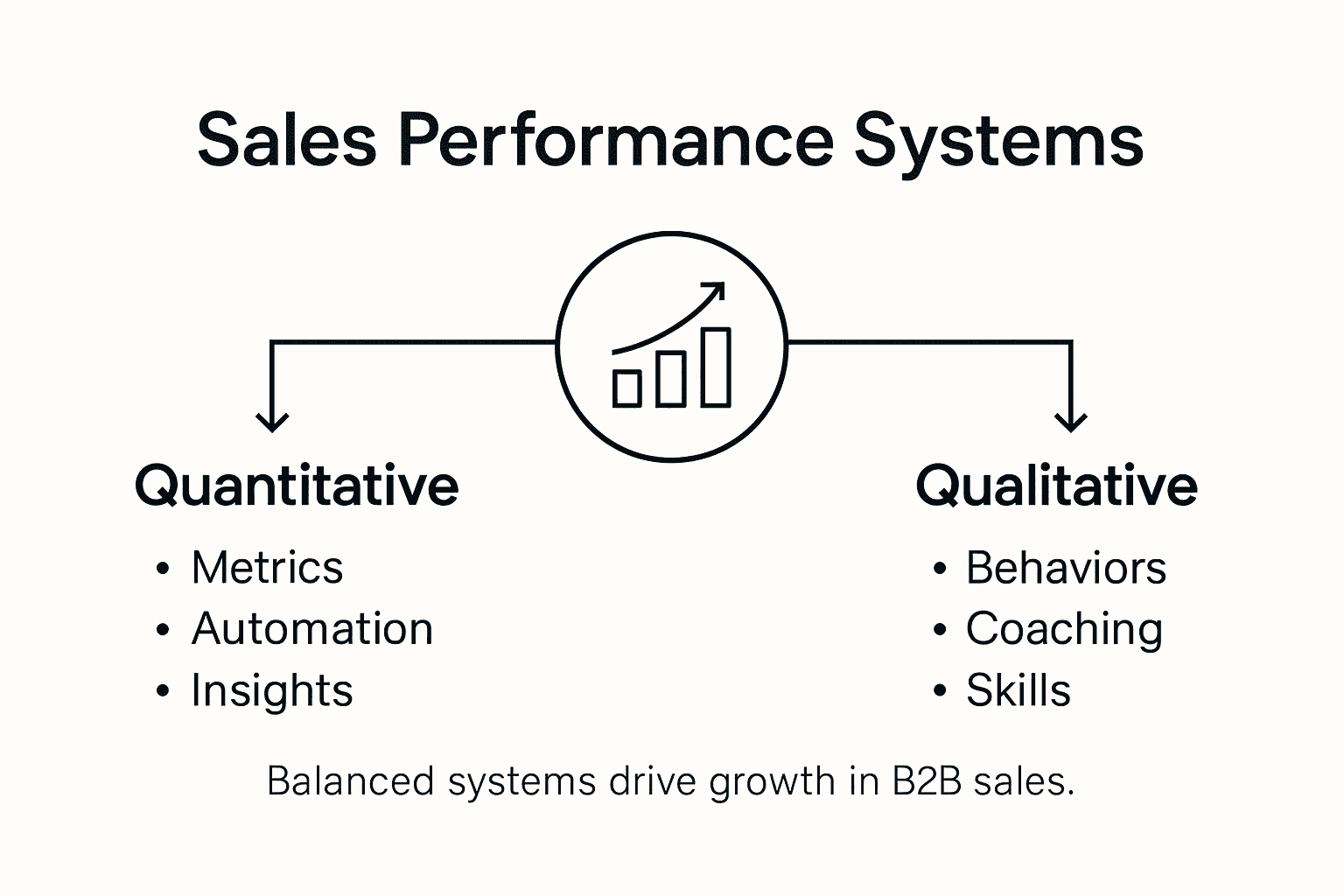
Expert Strategy: Implement a multi-dimensional performance system that balances quantitative metrics, behavioural assessments, and technological insights to create a comprehensive view of sales team effectiveness.
Below is a comparison of primary types of sales performance systems and their unique benefits:
System Type | Focus Area | Key Benefit | Typical Use Case |
Quantitative Metrics | Revenue and output | Tracks financial outcomes | Monitoring sales quotas |
Behavioural Assessment | Skills and behaviour | Improves adaptability and communication | Coaching and development programmes |
Technological Platform | Data and automation | Real-time performance analysis | Integrating CRM and analytics |
Holistic Ecosystem | Combination approach | Comprehensive team effectiveness | Strategic planning and continuous improvement |
Sales Performance Methodologies in B2B Environments
B2B sales methodologies represent sophisticated approaches designed to navigate the complex landscape of enterprise-level client relationships, moving beyond traditional transactional selling techniques. These methodologies recognise the intricate decision-making processes and multiple stakeholder interactions characteristic of sophisticated business purchasing environments.
Doctoral research exploring predictors of sales performance highlights the critical importance of adaptive sales approaches that align with evolving client demands and organisational capabilities. Modern B2B sales methodologies emphasise a consultative, value-driven approach that requires deep understanding of client ecosystems, strategic alignment, and the ability to demonstrate tangible business outcomes.
Effective B2B sales methodologies typically encompass several key dimensions: strategic opportunity identification, comprehensive client diagnostics, consultative engagement frameworks, value proposition development, and rigorous qualification processes. These methodologies demand a holistic approach that integrates advanced technologies, sophisticated communication strategies, and data-driven insights to create meaningful client engagements that transcend traditional sales interactions.
Expert Strategy: Develop a dynamic sales methodology that balances strategic insight, technological enablement, and consultative engagement to create meaningful, value-driven client relationships.
Pitfalls That Undermine Sustainable Growth
Sustainable growth in B2B sales environments demands strategic awareness of critical performance obstacles that can rapidly erode revenue potential. Understanding these systemic challenges is fundamental to developing robust mitigation strategies that protect organisational momentum and competitive positioning.
Contemporary B2B sales research highlights significant growth impediments driven by complex market dynamics. Key pitfalls include economic pressures creating extended sales cycles, overreliance on top-performing individuals, inadequate lead qualification processes, and inconsistent stakeholder engagement strategies that fragment potential revenue streams.
Structural challenges frequently manifest through predictable patterns: insufficient pipeline diversity, reactive rather than proactive sales approaches, weak qualification methodologies, and limited understanding of evolving client ecosystem requirements. These limitations create systemic vulnerabilities that restrict organisations from achieving consistent, scalable revenue growth. Successful B2B sales teams must develop comprehensive diagnostic capabilities that identify and address these performance constraints before they become deeply embedded organisational constraints.
Expert Strategy: Implement a rigorous, data-driven performance assessment framework that systematically identifies and mitigates potential growth restrictions across your sales ecosystem.
Unlock Predictable Growth by Mastering Sales Performance
Understanding the complex challenges of maintaining consistent sales velocity and overcoming the myths surrounding sales success is only the first step. If you are driven by the need to increase pipeline opportunities, boost average deal value, improve win rates, and reduce sales cycle time, you require more than generic advice—you need a tested system designed for B2B environments. The Sales Coach Network specialises in embedding scalable sales operating systems that address these core drivers with practical, expert-led solutions tailored for complex sales teams.
Our proven methodology follows the real-world principles discussed in the article. We combine strategic focus, hands-on enablement, and disciplined execution to eradicate unpredictability and stalled deals. Whether you are seeking to enhance your team’s consultative skills, implement advanced qualification processes, or establish continuous coaching that sustains performance, our sales training programmes and sales coaching services are designed to deliver measurable results.
Are you ready to move beyond myths and friction points to achieve sustainable, predictable revenue growth? Discover how our expert practitioners help senior revenue leaders transform their sales ecosystems. Begin your journey today by learning more at The Sales Coach Network and take the first step towards accelerating your sales velocity.
Frequently Asked Questions
What is sales performance in B2B firms?
Sales performance in B2B firms refers to the systematic evaluation of a sales organisation’s effectiveness in generating revenue, managing client relationships, and achieving strategic objectives. It includes both quantitative outcomes and qualitative behavioural dimensions.
What are the common myths about sales performance?
Common myths about sales performance include the belief that sales success is innate, that training alone is sufficient for improvement, and that technology can completely replace human relationship-building skills. In reality, skills can be learned and developed through continuous coaching.
What drives sales velocity in a business?
Sales velocity is driven by four main components: pipeline opportunities, average deal value, win rates, and sales cycle duration. By improving these elements, organisations can accelerate their sales processes and enhance revenue generation.
How can B2B firms improve their sales performance systems?
B2B firms can improve their sales performance systems by implementing multi-dimensional frameworks that balance quantitative metrics, behavioural assessments, and technological insights. This holistic approach helps provide a comprehensive view of sales team effectiveness.
Recommended