
Sales Team Performance: Driving Predictable Growth
- The Sales Coach Network
- Jan 2
- 7 min read


Over 60 percent of british B2B sales leaders say that traditional pipeline metrics no longer capture the full picture of team performance. In a rapidly shifting market, relying on yesterday’s benchmarks leaves room for missed opportunities and stagnant growth. Senior decision-makers need a holistic understanding that addresses both numbers and behaviours. This article demystifies the critical drivers behind performance and reveals practical strategies to empower modern sales teams to consistently win in the british technology sector.
Table of Contents
Key Takeaways
Point | Details |
Holistic Sales Performance Framework | Effective B2B sales performance relies on integrating individual skills, team structures, and technology to drive consistent revenue generation. |
Interconnected Drivers of Sales Velocity | The four key drivers—number of opportunities, average deal size, win rate, and sales cycle length—must be managed holistically for optimal performance. |
Forty-20-40 Principle for Change | Sustainable sales transformation requires balanced focus on strategic alignment, targeted enablement, and disciplined implementation. |
Role of Sales Leaders | Sales leaders must develop comprehensive strategies and build high-performing teams through coaching and performance management. |
Defining Sales Team Performance in B2B Contexts
B2B sales team performance represents a complex, multidimensional assessment of an organisation’s ability to consistently generate revenue through strategic selling practices. Performance goes far beyond simple sales volume metrics, encompassing critical elements of team capability, process efficiency, and strategic alignment.
In modern B2B contexts, sales performance is defined through multiple interconnected skill dimensions that extend well beyond traditional transactional approaches. These dimensions include interpersonal capabilities, market knowledge, technological adaptiveness, and strategic relationship management. High-performing teams demonstrate exceptional abilities to understand customer needs, navigate complex buying committees, and construct compelling value propositions that resonate with executive stakeholders.
Successful B2B sales performance requires a holistic framework that integrates individual seller skills, team structures, organisational processes, and technological enablement. Empirical research highlights that performance drivers are multifaceted, involving not just sales activities but strategic behaviours, motivation levels, and consistent execution of structured methodologies. Key performance indicators typically include conversion rates, average deal value, sales cycle duration, win rates, and pipeline quality.
Expert Insight: Develop a comprehensive performance scorecard that tracks both quantitative outcomes and qualitative skill development to drive sustainable sales excellence.
Four Key Drivers of Sales Velocity
Sales velocity represents a critical performance metric that provides comprehensive insights into an organisation’s revenue generation potential. Understanding the four interconnected drivers of sales velocity enables sales leaders to diagnose bottlenecks, optimise performance, and create more predictable growth strategies.
The four fundamental drivers of sales velocity are number of opportunities, average deal size, win rate, and sales cycle length. Each component plays a vital role in determining overall sales performance. Number of opportunities reflects the volume of potential deals entering the pipeline, while average deal size indicates the potential revenue value of those opportunities. Win rate measures the percentage of opportunities successfully converted into sales, and sales cycle length tracks the time required to close a deal.
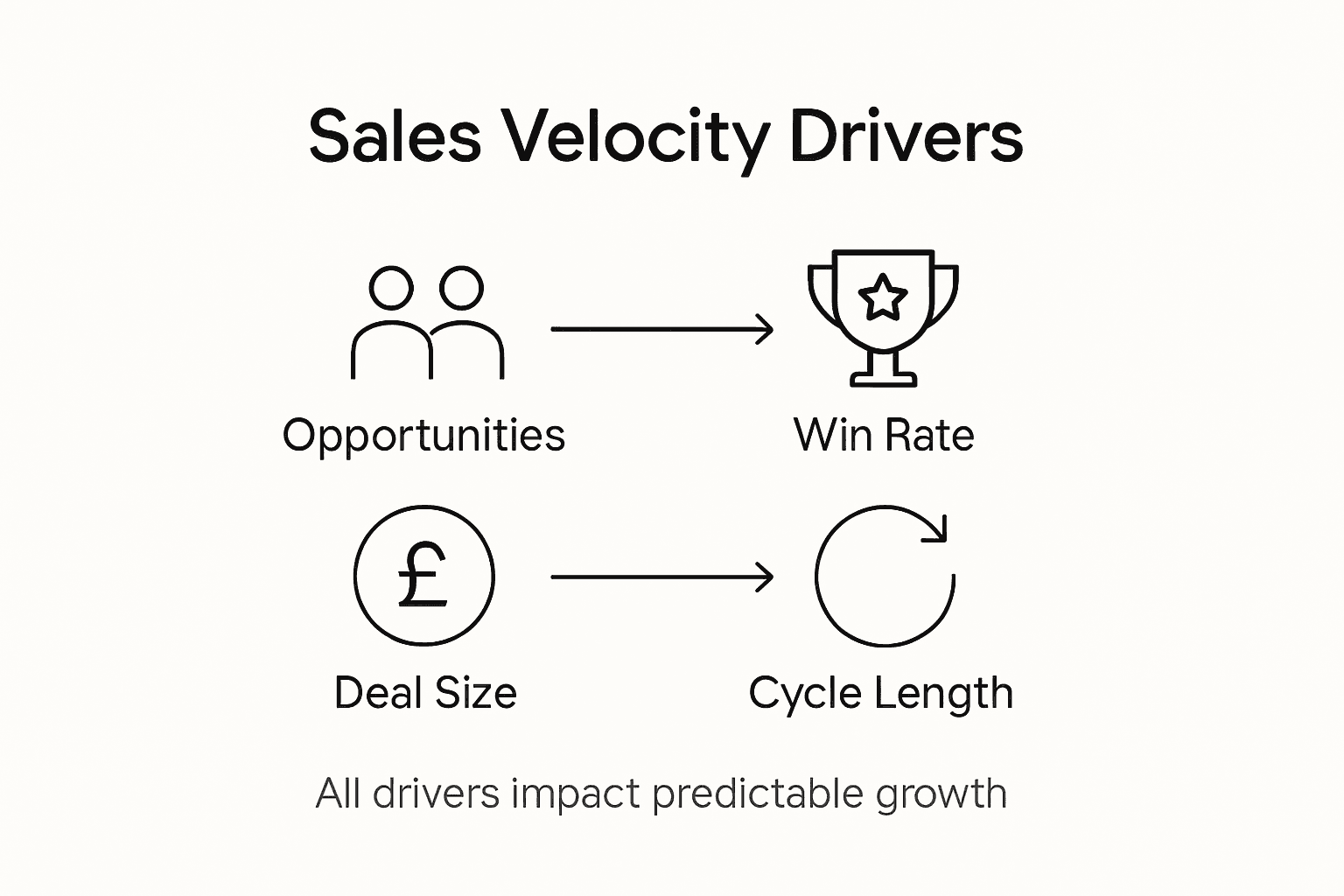
Successful B2B sales organisations recognise that these drivers are not independent metrics but deeply interconnected elements requiring holistic management. Improving one driver can positively impact others - for instance, better qualification processes can simultaneously reduce sales cycle length and increase win rates. Strategic sales teams develop sophisticated tracking mechanisms to monitor these metrics continuously, using data-driven insights to make targeted interventions and refine their sales approach.
The following table summarises the interconnections between the four drivers of sales velocity and their business implications:
Driver | Description | Business Impact | Influence on Other Drivers |
Number of Opportunities | Deals entering pipeline | Directly affects revenue potential | Impacts average deal size, win rate |
Average Deal Size | Value of each closed deal | Determines total revenue growth | Affected by qualification processes |
Win Rate | Percentage of converted deals | Indicates sales effectiveness | Shorter sales cycle can improve win rate |
Sales Cycle Length | Time to close a deal | Influences resource efficiency | Reduced cycle often boosts win rate |
Pro Tip: Create a dynamic sales velocity dashboard that tracks all four drivers in real-time, enabling immediate identification of performance trends and potential improvement areas.
The Forty-20-40 Principle for Sustainable Change
The Forty-20-40 Principle represents a sophisticated approach to driving sustainable sales transformation that transcends traditional change management methodologies. Designed as a strategic framework for comprehensive organisational performance improvement, this principle acknowledges that meaningful change requires a holistic, balanced intervention across multiple dimensions.
At its core, the Forty-20-40 Principle divides organisational change efforts into three critical components. The first 40% focuses on strategic alignment, ensuring leadership develops a clear, coherent vision and commercial direction. The subsequent 20% addresses targeted enablement, equipping teams with practical skills, tools, and knowledge necessary for execution. The final 40% concentrates on disciplined, consistent implementation, embedding new behaviours through rigorous accountability and ongoing performance management.
This principle recognises that most transformation efforts fail not because of poor strategy or inadequate training, but because of insufficient attention to sustained execution. By allocating explicit proportions of effort and resources to strategy, enablement, and implementation, organisations can create a more predictable pathway to meaningful change. The approach demands active leadership engagement, systematic skill development, and a commitment to continuous reinforcement, making it a powerful alternative to fragmented, piecemeal improvement initiatives.
Below is a concise breakdown of the Forty-20-40 Principle, highlighting the focus of each stage and its contribution to sustainable change:
Stage | Focus Area | Core Activities | Organisational Benefit |
First 40% | Strategic alignment | Vision setting and goal definition | Ensures unified commercial direction |
Middle 20% | Targeted enablement | Skill development and tool deployment | Equips teams for effective execution |
Final 40% | Disciplined implementation | Behaviour reinforcement and accountability | Embeds lasting change organisation-wide |
Pro Tip: Conduct a quarterly review of your organisation’s change initiatives, explicitly mapping efforts against the Forty-20-40 framework to identify potential gaps in your transformation strategy.
Roles and Responsibilities of Sales Leaders
Sales leadership represents a complex and dynamic role that extends far beyond traditional management responsibilities. Strategic sales leadership demands a multifaceted approach to driving organisational performance, requiring leaders to simultaneously navigate strategic, operational, and human performance dimensions.

At the strategic level, sales leaders are responsible for developing and implementing comprehensive revenue generation strategies that align with broader organisational objectives. This involves creating clear commercial direction, identifying market opportunities, and establishing robust frameworks for consistent performance. Key strategic responsibilities include market analysis, opportunity assessment, defining sales methodologies, and creating predictable revenue generation models that can be consistently replicated across sales teams.
Operationally, sales leaders must build high-performing teams through a combination of talent development, performance management, and continuous coaching. This requires a nuanced approach to team enablement, including recruitment of top talent, designing effective training programmes, implementing performance tracking mechanisms, and creating a culture of accountability and continuous improvement. Successful sales leaders understand that their role is fundamentally about creating an ecosystem where individual sellers can consistently achieve exceptional results.
Pro Tip: Conduct monthly performance retrospectives that blend quantitative metrics with qualitative insights, enabling data-driven coaching and continuous team development.
Pitfalls and Mistakes Undermining Performance
Sales team performance is often compromised by a complex web of systemic challenges that undermine organisational effectiveness. Critical performance bottlenecks emerge from interconnected operational and strategic mistakes that can dramatically reduce revenue generation potential and team productivity.
One fundamental pitfall is the persistent failure to integrate data-driven decision-making and technological innovation into sales processes. Many organisations continue to rely on outdated methodologies, neglecting advanced tools that could provide competitive advantages. These mistakes manifest through inefficient lead qualification processes, inconsistent communication strategies, and a lack of sophisticated performance tracking mechanisms. Sales teams frequently struggle with fragmented customer data, inadequate training programmes, and misaligned incentive structures that fail to motivate sellers effectively.
Technological resistance and strategic myopia represent significant performance barriers. Sales leaders who underestimate technological advances and fail to adapt their approaches risk becoming obsolete, particularly in rapidly evolving B2B markets. The most common mistakes include maintaining rigid sales processes, neglecting continuous skills development, and failing to create adaptive, learning-oriented team cultures that can respond quickly to changing market dynamics.
Pro Tip: Implement quarterly skills audits and technology assessments to proactively identify and address performance gaps within your sales team.
Unlock Your Sales Team’s True Potential and Drive Predictable Growth
The article highlights the critical challenges faced by B2B sales leaders: inconsistent pipeline opportunities, low win rates, extended sales cycles and difficulties embedding lasting change. If you recognise the frustration of stalled deals and unpredictable revenue, you are not alone. Understanding concepts like the Four Key Drivers of Sales Velocity and the Forty-20-40 Principle is essential. However, applying them to achieve sustainable sales performance requires expert guidance and a proven system.
At The Sales Coach Network, we specialise in turning these complex sales challenges into measurable success. Our approach goes beyond generic training to embed scalable sales operating systems targeting every aspect of performance outlined in the article. We help increase pipeline volume, boost deal size, improve win rates and accelerate sales cycles. By applying the Forty-20-40 framework, we ensure strategic alignment, targeted enablement and disciplined execution combine to embed lasting change. Discover more about our practical and results-driven sales training programs and sales coaching services designed specifically for complex B2B organisations.
Stop leaving sales success to chance. Engage with experienced practitioners who understand the realities behind predictable growth. Visit The Sales Coach Network today to learn how to transform your team’s performance and secure sustainable revenue growth.
Frequently Asked Questions
What are the key dimensions of B2B sales team performance?
B2B sales team performance is defined through multiple interconnected dimensions, including interpersonal capabilities, market knowledge, technological adaptiveness, and strategic relationship management.
How can organisations improve their sales velocity?
Organisations can improve sales velocity by optimising the four drivers: number of opportunities, average deal size, win rate, and sales cycle length. Focusing on these interconnected metrics allows for targeted improvements across the sales process.
What is the Forty-20-40 Principle in sales management?
The Forty-20-40 Principle is a framework that divides organisational change efforts into three components: strategic alignment (40%), targeted enablement (20%), and disciplined implementation (40%), ensuring a balanced approach to sustainable sales transformation.
What common mistakes do sales teams make that hinder performance?
Common mistakes include failing to integrate data-driven decision-making, resisting technological advancements, maintaining rigid sales processes, and neglecting continuous skills development, all of which can reduce team productivity and revenue potential.
Recommended