Sales Strategy
Sales Pipeline Growth Step by Step for UK B2B Leaders
The Sales Coach Network8 min read


Most British technology firms lose out on nearly half of their qualified sales opportunities before the contract stage. For senior revenue leaders, this persistent challenge threatens growth and exposes weaknesses in pipeline strategy. Whether your B2B team wrestles with unclear qualification standards or inconsistent win rates, adopting precise, actionable steps can dramatically change outcomes. This guide breaks down proven methods that help British sales teams build stronger pipelines, making every stage from lead generation to deal closure more predictable and rewarding.
Table of Contents
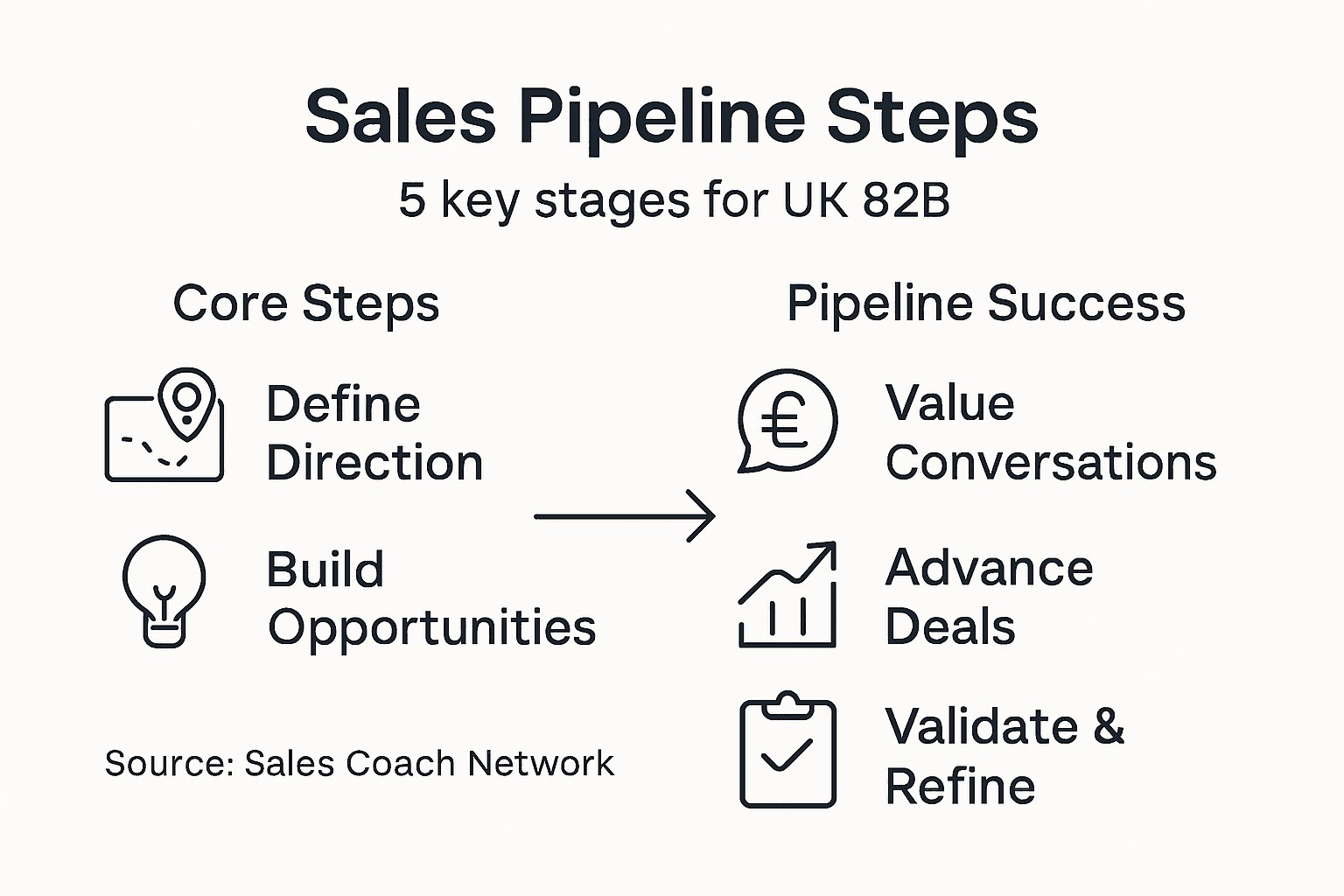
Quick Summary
Main Insight | Explanation |
1. Define Strategic Direction Clearly | Establish precise definitions and criteria for each sales stage to guide your sales pipeline effectively. |
2. Prioritise High-Potential Opportunities | Use data-driven insights and lead scoring to focus on leads that match your ideal customer profile, increasing conversion chances. |
3. Strengthen Value-Based Conversations | Shift discussions from product features to genuine business value that addresses client pain points and strategic challenges. |
4. Implement Disciplined Execution | Create systematic plans with milestones to track deal progression and ensure consistent follow-up throughout the sales process. |
5. Continuously Validate and Refine Processes | Regularly analyse performance metrics and adapt strategies based on insights to enhance pipeline efficiency and effectiveness. |
Step 1: Define strategic direction and pipeline criteria
Defining your strategic direction and pipeline criteria is the foundation for predictable revenue growth in UK B2B sales. This critical first step transforms your sales approach from reactive guesswork to a disciplined, targeted process.
Successful pipeline development starts with understanding your precise B2B sales pipeline mechanics. This means establishing crystal clear definitions for each sales stage, identifying rigorous entry and exit criteria, and creating qualification standards that match your market realities. UK sales leaders must map their pipeline around realistic buyer profiles, ensuring each potential opportunity truly merits significant investment of time and resources.
To construct an effective pipeline strategy, focus on three core elements: ideal customer profile, deal size parameters, and realistic sales cycle duration. This involves deep market research, analysing historical performance data, and creating repeatable qualification frameworks. Your goal is to build a systematic approach that helps your team prioritise high potential opportunities and quickly disqualify prospects unlikely to convert.
Top tip: Create a visual pipeline map that every sales team member can reference, ensuring consistent understanding of qualification criteria and progression standards.
Step 2: Build and qualify new sales opportunities
Building and qualifying new sales opportunities is a strategic process that transforms cold prospects into potential revenue streams for your B2B organisation. This step requires a systematic approach to identifying and nurturing high potential leads.
To effectively generate opportunities, embrace targeted account marketing strategies that leverage data driven insights. This means moving beyond traditional prospecting by using firmographic data, mapping key decision makers, and implementing sophisticated lead scoring systems. Prioritise accounts with demonstrable intent signals and align your outreach with their specific business challenges.
Successful opportunity creation demands a multifaceted approach. Develop a robust social selling strategy on professional platforms like LinkedIn, create personalised multi touch communication campaigns, and use intent data tools to understand prospect readiness. Your qualification process should ruthlessly filter opportunities based on strategic fit, potential deal value, and likelihood of conversion. This means establishing clear criteria that go beyond surface level interest and focus on genuine business alignment.
Top tip: Design a lead scoring matrix that weights prospects based on engagement level, strategic fit, and demonstrated buying signals to streamline your qualification process.
Step 3: Strengthen value-based client conversations
Strengthening value-based client conversations is a critical skill that transforms sales interactions from transactional exchanges to strategic partnerships. This step requires a nuanced approach to understanding and articulating genuine business value for your prospects.
Mastering customer-centric dialogues demands deep exploration of your client’s specific pain points and desired business outcomes. Sales professionals must move beyond superficial product features and instead focus on uncovering the strategic challenges that truly matter to the prospect. This involves active listening, thoughtful questioning, and the ability to reframe discussions around measurable business impact rather than technical specifications.
Successful value-based conversations require a multi-channel engagement strategy that builds trust and demonstrates expertise. Develop communication approaches that blend data-driven insights, personalised messaging, and transparent value propositions. Your goal is to position yourself as a strategic advisor who understands the client’s business context and can deliver meaningful, quantifiable outcomes. This means preparing meticulously, researching the prospect’s industry challenges, and crafting a narrative that speaks directly to their specific strategic objectives.
Top tip: Create a structured discovery framework that helps you systematically uncover and validate the unique business value your solution can deliver to each specific prospect.
Step 4: Advance deals with disciplined execution
Advancing deals requires a strategic and methodical approach that transforms potential opportunities into closed business. This step is about creating a structured pathway to move prospects consistently through your sales pipeline with precision and purpose.

Executing with discipline means implementing systematic performance assessment strategies that provide clear accountability and rigorous tracking. Sales teams must develop comprehensive execution plans that break down complex deals into manageable stages, each with specific milestones and clear ownership. This approach demands continuous monitoring, regular pipeline reviews, and a commitment to understanding and addressing potential barriers that could impede deal progression.
The key to successful deal advancement lies in combining data driven insights with proactive management. Create detailed deal tracking mechanisms that capture critical information about each opportunity engagement. Implement robust qualification frameworks that help your team quickly identify which deals merit continued investment and which should be strategically deprioritised. Your goal is to build a repeatable process that reduces uncertainty, minimises wasted effort, and increases the predictability of your sales outcomes.
Top tip: Develop a standardised deal review cadence where each opportunity is systematically assessed against clear progression criteria, ensuring only the most promising opportunities receive concentrated team effort.
Step 5: Validate results and refine pipeline processes
Validating results and refining pipeline processes is the critical final stage that transforms raw sales data into actionable strategic insights. This step ensures your sales organisation continues to evolve and improve its performance through systematic assessment and intelligent adaptation.
Implementing systematic pipeline management strategies requires a disciplined approach to measuring and analysing key performance metrics. Sales leaders must establish rigorous data hygiene practices, consistently review conversion rates, and develop a comprehensive understanding of pipeline dynamics. This involves creating detailed tracking mechanisms that capture not just surface level results, but the underlying factors that drive or impede sales progression.
Successful pipeline validation demands more than simple number crunching. Integrate advanced analytics tools that provide deeper insights into deal progression, identifying potential bottlenecks and hidden risks before they impact overall performance. Your refinement process should be dynamic ongoing effort that continuously adapts to changing market conditions, evolving customer needs, and emerging sales methodologies. By treating your pipeline as a living system rather than a static document, you create a resilient framework that can quickly respond to new challenges and opportunities.
Top tip: Conduct quarterly pipeline audits that combine quantitative data analysis with qualitative insights from your sales team to ensure your processes remain responsive and effective.
The table below compares traditional B2B sales approaches with advanced pipeline strategies discussed in the article:
Aspect | Traditional Approach | Advanced Pipeline Strategy |
Lead Qualification | Based on gut feeling | Data-driven, systematic |
Pipeline Management | Reactive, unstructured | Proactive, mapped stages |
Client Conversations | Product-focused | Value-driven, advisory |
Deal Progression | Irregular follow-up | Milestone-based tracking |
Performance Review | End-of-quarter only | Continuous and adaptive |
Here is a summary table outlining the five key steps for building a predictable B2B sales pipeline in the UK:
Step | Main Objective | Key Outcome |
Define strategic direction | Set criteria and priorities | Targeted, high-quality pipeline |
Build & qualify opportunities | Identify and assess new leads | Focus on best-fit prospects |
Strengthen client conversations | Explore business value deeply | Trusted advisor relationships |
Advance deals | Apply disciplined process | Consistent deal progression |
Validate & refine pipeline | Review and adapt processes | Ongoing pipeline improvement |
Unlock Predictable Growth with Expert Sales Pipeline Solutions
The journey outlined in “” highlights common challenges faced by senior revenue leaders: struggling with inconsistent pipeline quality, prolonged sales cycles, and the need for disciplined deal progression. If you are tired of reactive sales approaches and want to embed a targeted, systematic process that enhances qualification, strengthens value-based conversations, and drives measurable results – you are not alone.
At The Sales Coach Network we specialise in partnering with B2B organisations like yours to solve these very issues. Our proven frameworks and leadership-led programmes focus on increasing pipeline opportunities, advancing deals rigorously, and improving win rates through strategic discipline. Explore our Sales Training Programs designed to equip your teams with practical skills and behaviours that stick and discover how our coaching services embed accountability and adherence to new methodologies.
Take control of your sales pipeline today. Learn how to adapt your strategy, accelerate your sales velocity, and achieve sustainable revenue growth by partnering with experts who understand the complexity of your market. Visit The Sales Coach Network to get started on building the predictable sales success your organisation deserves.
Frequently Asked Questions
How do I define the criteria for my B2B sales pipeline?
To define your B2B sales pipeline criteria, establish clear definitions for each sales stage, including entry and exit criteria. Conduct deep market research and analyse historical performance data to create repeatable qualification frameworks.
What steps should I take to build and qualify new sales opportunities?
To build and qualify new sales opportunities, implement targeted account marketing strategies that focus on analysing firmographic data and mapping key decision makers. Develop a lead scoring matrix to prioritise high-potential leads based on strategic fit and engagement levels.
How can I strengthen client conversations to focus on value?
Strengthen client conversations by shifting your focus from product features to the specific business value your solution can provide. Use active listening and thoughtful questioning to uncover your client’s pain points and frame discussions around measurable outcomes.
What is a disciplined approach to advancing deals in my pipeline?
A disciplined approach involves creating a structured deal tracking mechanism that breaks down opportunities into manageable stages with specific milestones. Monitor progress regularly and be proactive in addressing any barriers to deal progression.
How do I validate results and refine my pipeline processes?
Validate results by systematically measuring and analysing key performance metrics to identify bottlenecks in your sales pipeline. Conduct quarterly pipeline audits that assess both quantitative data and qualitative insights from your sales team to adapt processes effectively.
Recommended