Sales Strategy
Pipeline Management: Driving Predictable B2B Sales Growth
The Sales Coach Network9 min read


Nearly 60 percent of British B2B revenue leaders report missed forecasts due to weak pipeline visibility. For senior teams in large information technology firms, this challenge directly impacts qualified lead volume and win rates. Understanding the mechanics of pipeline management is no longer optional. This article reveals how proven strategies and modern tools give British organisations a more predictable path to stronger sales results.
Table of Contents
Key Takeaways
Point | Details |
Effective Pipeline Management | Streamlines the sales process by systematically tracking and analysing opportunities for better forecasting and resource allocation. |
Diverse Strategies | Employing various pipeline management strategies such as Opportunity Scoring and Velocity-Based Management enhances visibility and revenue growth. |
Crucial Technology Integration | Utilising advanced tools like CRM systems and predictive analytics is essential for driving accuracy and enhancing collaboration in pipeline management. |
Proactive Risk Management | Regular audits and a culture of transparency help in identifying potential risks, ensuring the reliability of revenue forecasts. |
What Is Pipeline Management In B2B Sales
Pipeline management represents a critical strategic approach for B2B sales organisations to systematically track, analyse, and optimise their sales opportunities from initial contact through to final closure. At its core, pipeline management is about creating a structured, predictable pathway for converting potential prospects into committed customers.
The essence of pipeline management lies in transforming sales from an unpredictable art into a measurable science. By tracking sales prospects through distinct stages, sales teams can develop a granular understanding of how potential customers progress through their buying journey. This approach allows businesses to forecast revenue with greater accuracy, allocate resources more strategically, and identify potential bottlenecks that might impede sales progression.
Effective pipeline management involves several key components:
Systematic opportunity tracking
Regular performance analysis
Precise sales stage definition
Continuous prospect qualification
Data-driven decision making
By implementing robust pipeline management practices, sales teams transform their approach from reactive to proactive. Instead of waiting for opportunities to emerge, they can actively cultivate and nurture potential deals, understanding precisely where each prospect sits within the sales ecosystem.
Expert Tip: Implement a consistent weekly pipeline review process to ensure real-time visibility and prompt intervention for stalling opportunities.
Types Of Pipeline Management Strategies
B2B sales teams deploy multiple strategic approaches to pipeline management, each designed to enhance visibility, improve forecasting, and drive revenue growth. Understanding these strategies allows organisations to select and adapt methodologies that best suit their specific business context and sales ecosystem.
One primary pipeline management strategy is the stage-based approach, which segments the sales journey into distinct, measurable phases. This method enables sales leaders to track prospect progression, identify potential bottlenecks, and allocate resources strategically. By monitoring sales performance metrics, teams can refine their understanding of how deals move through different stages and optimise their conversion rates.
Key pipeline management strategies include:
Opportunity Scoring Strategy
Velocity-Based Management
Predictive Analytics Approach
Relationship-Driven Pipeline Management
Behaviour-Based Segmentation
Each strategy offers unique insights and advantages. The Opportunity Scoring Strategy, for instance, involves quantifying potential deals based on specific criteria such as deal size, prospect engagement level, and likelihood of conversion. This allows sales teams to prioritise high-value opportunities and concentrate their efforts where they are most likely to generate significant returns.
The Velocity-Based Management strategy focuses on understanding and reducing the time prospects spend in each pipeline stage. By analysing the speed at which deals progress, sales teams can identify friction points, streamline their sales processes, and ultimately accelerate revenue generation.
The following table highlights the differences between popular pipeline management strategies for B2B sales:
Strategy Type | Key Focus | Typical Benefits |
Opportunity Scoring | Deal prioritisation | Targets high-value prospects |
Velocity-Based Management | Speed of progression | Reduces time to closure |
Predictive Analytics | Forecasting accuracy | Improves revenue predictions |
Relationship-Driven Pipeline | Client engagement | Strengthens long-term relationships |
Behaviour-Based Segmentation | Buyer behaviour | Adapts communication and follow-up |
Expert Tip: Implement a hybrid pipeline management approach that combines multiple strategies to create a more comprehensive and adaptive sales ecosystem.
Key Stages And Features Of Effective Pipelines
Building an effective sales pipeline requires a structured approach that transforms potential opportunities into predictable revenue streams. Each stage must be carefully designed to provide maximum visibility, precise tracking, and strategic progression of potential sales opportunities.

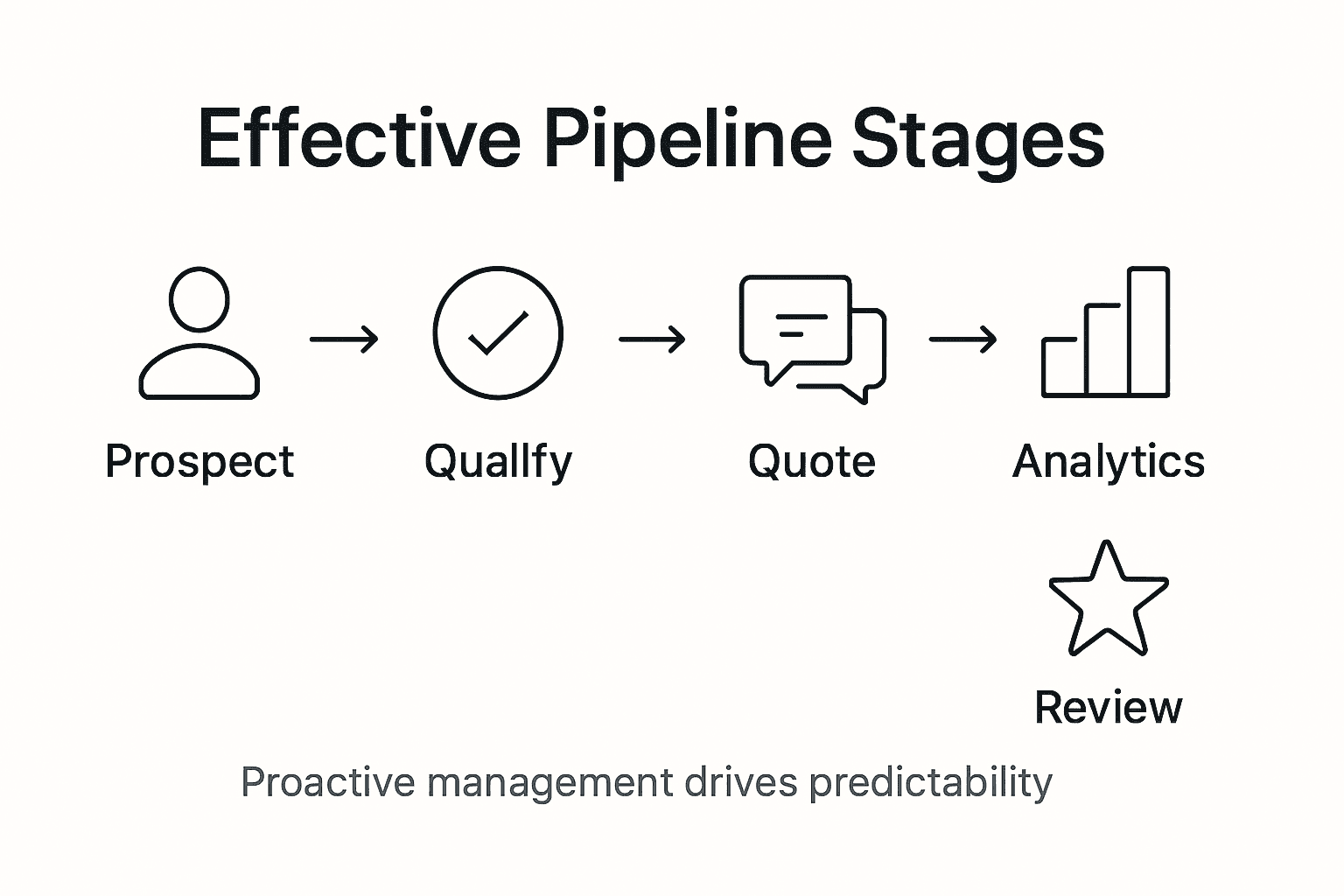
The core stages of an effective B2B sales pipeline typically include systematic progression through distinct sales cycle stages, which encompass critical phases such as prospecting, lead qualification, engagement, proposal development, negotiation, and deal closure. Standardised progression becomes paramount, ensuring that every sales representative follows a consistent methodology for advancing potential deals.
Key features of robust sales pipelines include:
Clear stage definitions
Precise qualification criteria
Measurable conversion rates
Comprehensive opportunity tracking
Data-driven progression mechanisms
Successful pipeline management demands granular understanding of each stage’s specific requirements. For instance, the prospecting phase requires targeted research and initial engagement strategies, while the qualification stage necessitates rigorous assessment of potential client compatibility and genuine purchasing intent. Sales teams must develop nuanced approaches that allow for flexibility while maintaining structural integrity.
Moreover, modern sales pipelines integrate advanced analytics and collaborative tools to enhance forecasting accuracy. By implementing dynamic tracking mechanisms, organisations can create real-time visibility into potential revenue streams, enabling proactive management and strategic resource allocation.
Expert Tip: Implement a quarterly pipeline health check to review and recalibrate your stage definitions and progression criteria.
The Role Of Data, Tools, And Technology
Modern B2B sales pipeline management has been revolutionised by sophisticated digital technologies that transform how organisations track, analyse, and predict sales performance. The integration of advanced data platforms and intelligent tools has become fundamental to creating predictable, scalable revenue strategies.
Digital tools and data analytics now represent the central nervous system of contemporary sales ecosystems, generating granular customer insights and enabling precision-driven decision making. Advanced technologies such as artificial intelligence, machine learning, and comprehensive customer relationship management systems have dramatically enhanced sales teams’ ability to understand, predict, and influence potential revenue streams.
Key technological components driving pipeline management include:
Customer Relationship Management (CRM) platforms
Predictive analytics engines
Automated lead scoring systems
Real-time performance dashboards
Intelligent forecasting tools
The transformation extends beyond mere data collection. Modern sales technologies provide contextual intelligence, allowing organisations to understand not just what is happening in their sales pipeline, but why it is happening. By leveraging sophisticated algorithms and machine learning capabilities, sales teams can now anticipate potential challenges, identify high-probability opportunities, and develop proactive strategies for deal progression.
Moreover, these technological solutions enable unprecedented levels of collaboration and transparency. Sales representatives, managers, and executives can now access instantaneous insights, share real-time information, and make data-driven decisions that align entire organisations towards consistent revenue generation objectives.
Below is a summary of essential technological tools and their impact on B2B pipeline management effectiveness:
Tool Type | Main Function | Business Impact |
CRM Systems | Opportunity tracking | Improves team collaboration |
Predictive Analytics Engines | Data-driven forecasting | Enhances pipeline reliability |
Automated Lead Scoring | Deal assessment | Increases conversion rates |
Performance Dashboards | Real-time monitoring | Enables faster interventions |
Intelligent Forecasting Tools | Revenue projections | Supports strategic planning |
Expert Tip: Invest in integrated technological solutions that provide comprehensive visibility across your entire sales ecosystem.
Critical Risks And Common Pitfalls To Avoid
Navigating B2B sales pipeline management demands strategic awareness of potential risks that can systematically undermine revenue generation and forecasting accuracy. Sales leaders must develop a keen understanding of the subtle yet destructive challenges that can compromise pipeline integrity and performance.
Six major risks quietly weaken pipeline reliability and predictability, requiring organisations to implement robust mitigation strategies. Critical pipeline vulnerabilities emerge from multiple interconnected factors, including communication breakdowns, data inconsistencies, and inadequate qualification processes.
Key risks threatening sales pipeline effectiveness include:
Ghost stakeholders disrupting deal progression
False positive forecasting
Stalled deal momentum
Inconsistent opportunity qualification
Contaminated data repositories
Siloed communication systems
The most insidious pitfalls often stem from systemic operational weaknesses rather than individual performance limitations. Sales teams frequently struggle with inadequate process documentation, overreliance on manual data entry, and insufficient accountability mechanisms. These challenges create blind spots that can lead to missed opportunities and unreliable revenue predictions.
Successful pipeline risk management requires a proactive, integrated approach that combines technological solutions, rigorous qualification frameworks, and continuous performance monitoring. By establishing clear protocols, implementing intelligent tracking systems, and fostering a culture of transparency, organisations can significantly reduce the likelihood of pipeline disruptions.
Expert Tip: Conduct monthly pipeline health audits to identify and address potential risks before they compromise your revenue forecasting.
Best Practices For Improving Pipeline Performance
Driving exceptional pipeline performance requires a strategic, multifaceted approach that integrates advanced methodologies, technological capabilities, and disciplined organisational practices. B2B sales teams must develop sophisticated systems that transform pipeline management from a reactive process to a proactive revenue generation engine.
Best practices in B2B pipeline management demand rigorous, systematic implementation, focusing on creating structured yet adaptable frameworks. Performance optimisation hinges on several critical elements that collectively enhance pipeline reliability, predictability, and overall sales effectiveness.
Key best practices for improving pipeline performance include:
Conducting regular comprehensive pipeline audits
Establishing strict stage progression criteria
Implementing robust opportunity qualification frameworks
Developing disciplined follow-up protocols
Leveraging automated tracking and analytics
Ensuring seamless sales and marketing alignment
Successful pipeline performance improvement requires a holistic approach that transcends traditional sales methodologies. Sales teams must cultivate a data-driven culture that emphasises continuous learning, precise measurement, and rapid adaptation. This means moving beyond simple metrics to develop nuanced understanding of deal dynamics, buyer behaviours, and potential conversion impediments.
Integrating advanced technological solutions plays a crucial role in pipeline performance enhancement. Sophisticated CRM systems, predictive analytics tools, and intelligent tracking mechanisms enable sales organisations to transform raw data into actionable insights, creating a more responsive and strategic approach to revenue generation.
Expert Tip: Implement a monthly cross-functional pipeline review that includes perspectives from sales, marketing, and revenue operations to ensure comprehensive performance assessment.
Unlock Predictable B2B Sales Growth with Expert Pipeline Management
Navigating the complexities of pipeline management in B2B sales requires more than basic tracking and forecasting. The challenges highlighted in this article such as stalled deal momentum, inconsistent opportunity qualification, and unreliable revenue predictions are exactly what The Sales Coach Network specialises in resolving. We partner with senior revenue leaders to embed scalable sales operating systems that tackle these systemic issues head-on, transforming unpredictable sales into a disciplined, predictable engine for growth.
If you are frustrated by low win rates, long sales cycles, or lack of qualified pipeline, our practical and holistic approach can help you increase pipeline opportunities, accelerate deal progression, and improve win rates through proven methodologies. Explore how our sales leadership training and sales coaching services provide the rigour, technology integration, and accountability needed to turn your pipeline data into actionable strategies.
Take the next step in transforming your sales pipeline from a liability into a strategic advantage. Visit The Sales Coach Network now to learn how our expert practitioners embed lasting change and drive measurable, sustainable revenue growth.
Frequently Asked Questions
What is pipeline management in B2B sales?
Pipeline management in B2B sales is the strategic process of tracking, analysing, and optimising sales opportunities from initial contact to closure, providing a structured pathway for converting prospects into customers.
What are common strategies used in pipeline management?
Common strategies include stage-based approaches, opportunity scoring, velocity-based management, predictive analytics, and relationship-driven methods to enhance visibility and drive revenue growth.
How can data and technology improve B2B sales pipeline management?
Data and technology improve pipeline management by providing advanced analytics, automation, and real-time tracking, enabling sales teams to make data-driven decisions and enhance forecasting accuracy.
What are some best practices for improving sales pipeline performance?
Best practices include conducting regular pipeline audits, establishing strict progression criteria, implementing robust qualification frameworks, leveraging automation, and ensuring alignment between sales and marketing.
Recommended