
Sales Team Manager: Driving Predictable UK Results
- The Sales Coach Network
- Jan 7
- 8 min read


Only 16 percent of British sales leaders say their teams consistently hit ambitious targets, despite having world-class B2B products and solutions. Long sales cycles and shifting buyer demands make performance management a daily challenge for managers in the United Kingdom. Understanding the true scope of a sales team manager’s role can reveal concrete ways to drive effectiveness, motivate teams, and build stronger results through structured training and coaching.
Table of Contents
Key Takeaways
Point | Details |
Role of Sales Team Manager | Sales team managers are strategic leaders focused on driving performance through coaching, mentorship, and targeted strategies for improvement. |
Sales Team Structures | Different management structures, such as functional or geographic, affect team effectiveness and can be adjusted to meet organisational goals. |
Skills Development | Emphasising continuous learning and a blend of structured training alongside personalised coaching is crucial for enhancing sales performance. |
Avoiding Common Pitfalls | Address issues like communication breakdowns and inadequate performance management by establishing clear goals and robust feedback mechanisms. |
Defining the Sales Team Manager Role
A sales team manager plays a critical role in driving organisational revenue and team performance across UK businesses. In essence, these professionals are strategic leaders responsible for guiding, motivating, and developing sales teams towards achieving consistent revenue targets. Sales managers coordinate team operations through a multifaceted approach that blends performance monitoring, strategic planning, and interpersonal leadership.
The core responsibilities of a sales team manager extend far beyond simple target tracking. They are expected to analyse sales performance metrics, develop targeted strategies for improvement, and create an environment that supports continuous professional development. This involves detailed performance evaluation, task allocation, setting clear expectations, and providing ongoing coaching and mentorship to team members. Effective sales managers understand that their role is not just about numbers, but about nurturing individual talent and creating a collaborative, high-performing sales ecosystem.
In the UK business landscape, sales team managers typically demonstrate a sophisticated blend of skills. These include advanced communication capabilities, robust leadership qualities, analytical thinking, and the ability to work effectively under pressure. Most employers prioritise practical sales and management experience over formal academic qualifications, recognising that real-world expertise is paramount in driving sales success. The role may involve significant travel, participation in industry events, and direct interaction with both internal teams and external stakeholders.
Pro tip: Invest time in understanding each team member’s individual strengths and motivational triggers to create personalised development pathways that enhance overall team performance.
Types of Sales Team Management Structures
In the dynamic landscape of UK sales organisations, sales team management structures play a pivotal role in determining overall performance and effectiveness. Sales teams can be structured through multiple models that align with specific business objectives, each offering unique advantages and challenges for driving predictable revenue growth.
The most common sales team management structures include the functional, geographic, market-based, and product-specific approaches. In the functional model, team members are organised based on specific roles such as lead generation, account management, and client relationship development. Geographic structures divide sales responsibilities by territorial boundaries, ensuring localised expertise and targeted approach. Market-based structures segment teams according to specific industry verticals or customer segments, allowing for specialised knowledge and tailored selling strategies. Product-specific structures enable deep expertise in particular product lines, particularly beneficial for organisations with complex or technical offerings.
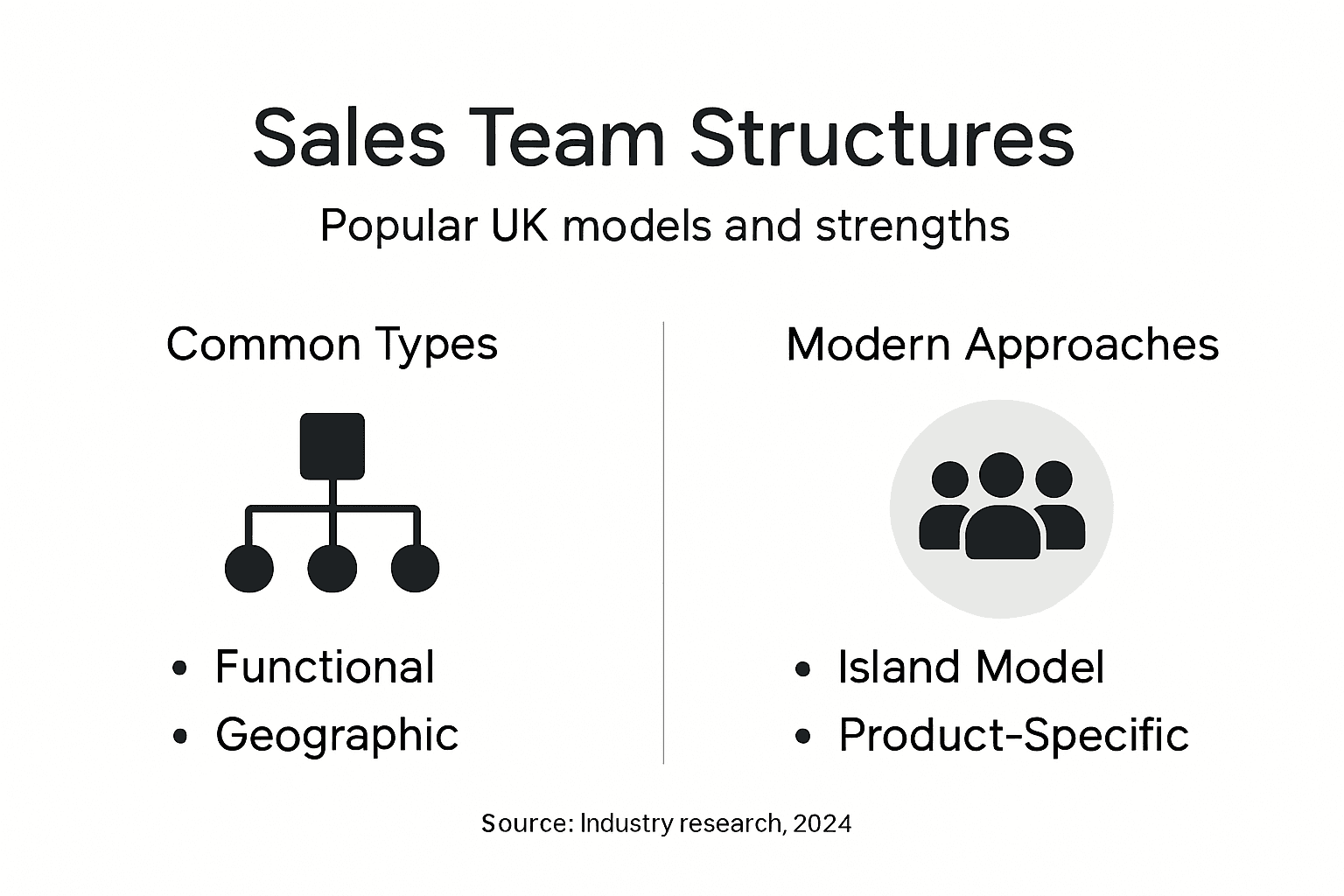
Additionally, contemporary sales organisations are increasingly adopting more nuanced structures like the island model, assembly line approach, and pod systems. The island model provides individual salespeople with complete ownership of the sales process, offering maximum autonomy. The assembly line structure specialises team members into distinct stages of the sales funnel, enhancing efficiency through role-specific expertise. Pod structures create cross-functional teams that combine various skills and perspectives, promoting collaborative problem-solving and comprehensive client engagement.
Pro tip: Regularly assess and adapt your sales team structure to match evolving business goals, market dynamics, and team capabilities to maintain optimal performance and growth.
Here’s a concise comparison of common sales team management structures and their business advantages:
Structure Type | Typical Use Case | Strengths | Potential Limitation |
Functional | Role-based sales teams | Clarity of responsibility | Limited flexibility |
Geographic | Regionally focused organisations | Local market expertise | Duplication of resources |
Market-based | Industry or segment-driven sales | Specialised customer focus | Complex team coordination |
Product-specific | Large or technical product ranges | Deep product knowledge | Siloed approach possible |
Pod/Assembly Line | Collaborative hybrid environments | Versatile client handling | Resource-intensive setup |
Key Skills and Proven Methodologies
Successful sales team managers must develop a comprehensive suite of skills and adopt structured methodologies to drive predictable results in the competitive UK business landscape. Proven sales methodologies provide structured frameworks for consistently engaging buyers and closing deals effectively, transforming individual performance into organisational success.
Key skills for modern sales team managers encompass strategic communication, advanced analytical thinking, emotional intelligence, and adaptive leadership. Strategic communication involves articulating clear expectations, providing constructive feedback, and creating motivational environments. Analytical thinking enables managers to interpret complex sales metrics, identify performance trends, and develop targeted improvement strategies. Emotional intelligence allows for nuanced team management, helping leaders understand individual motivational drivers and build resilient, collaborative teams. Adaptive leadership ensures managers can quickly respond to market changes, technological disruptions, and evolving customer expectations.

Among the most respected sales methodologies, approaches like Challenger Sale, SPIN Selling, and Solution Selling stand out for their systematic approach to understanding customer needs. The Challenger Sale methodology encourages sales professionals to provide unique insights and challenge client assumptions. SPIN Selling focuses on asking strategic questions to uncover underlying customer pain points. Solution Selling emphasises tailoring proposals directly to specific customer challenges. These methodologies share a common thread of moving beyond transactional interactions towards consultative, value-driven conversations that demonstrate deep understanding of client business objectives.
Pro tip: Invest in continuous learning and rotate team members through different sales methodologies to build versatility and prevent skill stagnation.
Sales Manager Responsibilities and Legal Duties
Sales managers operate within a complex regulatory landscape that demands comprehensive understanding of both business objectives and legal obligations. Sales managers are responsible for ensuring compliance with intricate sales regulations while maintaining ethical standards and driving organisational performance.
The core responsibilities of sales managers extend across multiple critical domains. Strategically, they must develop and implement sales strategies, set realistic targets, and create performance frameworks that align with organisational goals. Legally, this involves maintaining meticulous documentation, managing contractual obligations, and ensuring transparent business practices. Managers must navigate complex areas such as data protection regulations, consumer rights legislation, and industry-specific compliance requirements. This includes protecting customer information, maintaining accurate sales records, and adhering to advertising standards that prevent misleading commercial communications.
Beyond strategic and legal considerations, sales managers play a pivotal role in risk management and organisational governance. They are responsible for implementing robust internal controls, conducting regular performance reviews, and creating accountability mechanisms within their teams. This involves developing clear reporting structures, establishing ethical guidelines, and ensuring that sales practices remain both legally compliant and commercially effective. Managers must also stay current with evolving legislative frameworks, understanding how changes in commercial law might impact sales strategies and operational approaches.
Pro tip: Develop a comprehensive compliance checklist and conduct quarterly reviews to ensure your sales practices remain legally robust and aligned with current regulatory standards.
Coaching Versus Training: What Drives Results
In the dynamic world of sales performance, understanding the nuanced difference between training and coaching is critical for driving sustainable results. Sales training and coaching represent distinct yet complementary approaches to developing sales professionals, each playing a unique role in organisational growth and individual skill enhancement.
Training typically represents a structured, standardised approach focused on imparting fundamental knowledge and skills. It provides sales teams with essential information, techniques, and procedural understanding through formal programmes, workshops, and instructional sessions. These interventions deliver critical baseline competencies, covering areas like product knowledge, sales methodologies, communication strategies, and basic customer engagement techniques. However, training alone cannot guarantee performance transformation, as it often fails to address individual learning styles, specific performance gaps, and contextual nuances.
Coaching, by contrast, represents a personalised, ongoing development process tailored to individual sales professional’s specific strengths, weaknesses, and potential. Unlike generic training programmes, coaching involves one-on-one interactions, deep performance analysis, behavioural modification, and continuous skill refinement. Effective coaching creates a supportive environment where sales professionals can receive targeted feedback, develop strategic thinking, enhance emotional intelligence, and learn advanced problem-solving techniques. This individualised approach enables sales managers to identify and address unique challenges, build confidence, and systematically improve performance through sustained, personalised intervention.
Pro tip: Implement a blended approach that combines structured training with personalised coaching to create a comprehensive skill development ecosystem for your sales team.
This table summarises the impact of coaching versus training in sales team development:
Approach | Primary Focus | Best For | Impact on Performance |
Training | Skills & knowledge | New starters | Establishes foundational ability |
Coaching | Personalised guidance | Developing professionals | Enhances strategic thinking |
Blended | Combined development | All team members | Drives sustained, robust results |
Common Pitfalls and How to Avoid Them
Successful sales team management requires a nuanced understanding of potential challenges that can derail performance and team morale. Common sales team management mistakes can significantly impact organisational effectiveness, necessitating proactive identification and strategic mitigation strategies.
The most prevalent pitfalls in sales team management typically cluster around several critical areas: communication breakdowns, inadequate performance management, technological limitations, and inconsistent leadership approaches. Poor communication can create misalignment between team expectations and organisational goals, leading to reduced motivation and productivity. Ineffective performance management often stems from unclear objectives, lack of meaningful feedback, and absence of transparent performance metrics. Technological challenges arise when sales teams are equipped with outdated tools that fail to support modern sales processes, hindering efficiency and data-driven decision-making.
Addressing these challenges requires a comprehensive, systematic approach. Sales managers must establish clear communication channels, implement robust performance tracking mechanisms, and invest in modern technological infrastructure. This involves developing transparent goal-setting frameworks, creating regular feedback loops, and providing continuous skill development opportunities. Critically, successful management demands a balance between setting high performance standards and maintaining a supportive, collaborative team environment. Leaders must cultivate a culture of accountability while simultaneously supporting individual growth, recognising that sustainable performance emerges from a combination of strategic guidance, technological empowerment, and genuine personal development.
Pro tip: Conduct monthly diagnostic reviews of your sales team’s performance metrics, communication effectiveness, and technological readiness to proactively identify and address potential systemic challenges.
Elevate Your Sales Team Management for Predictable UK Revenue
The challenges faced by Sales Team Managers in the UK are clear from the article: achieving consistent revenue targets, refining coaching versus training approaches, and embedding scalable sales operating systems that deliver measurable growth. The pain points of unpredictable pipeline, lengthy sales cycles, and uneven team performance demand a holistic, practical solution that aligns strategy with disciplined execution and leadership-led coaching.
At The Sales Coach Network, we partner exclusively with senior revenue leaders to transform these exact issues into predictable, scalable growth. Our unique approach integrates advanced sales methodologies, leadership training, and hands-on coaching frameworks that ensure your sales managers become powerful architects of success. By focusing on strategic communication, personalised coaching, and the Forty-20-40 Principle, we help you avoid common pitfalls such as fragmented structures or inconsistent skill development.
Explore how our sales training programs and sales coaching services can empower your sales managers to drive sustained team performance and shorten sales cycles. Don’t let uncertainty or underperformance hold back your sales organisation. Take the first step to adapt, accelerate, and achieve measurable UK business results today through partnership with the Sales Coach Network. Your next breakthrough starts here.
Frequently Asked Questions
What are the primary responsibilities of a sales team manager?
Sales team managers are responsible for guiding, motivating, and developing their teams to achieve revenue targets. This includes performance monitoring, strategic planning, task allocation, and providing coaching and mentorship.
What skills are essential for a successful sales team manager?
Key skills for sales team managers include strategic communication, analytical thinking, emotional intelligence, and adaptive leadership. These skills help managers engage buyers effectively and lead their teams to success.
How do coaching and training differ in developing a sales team?
Training focuses on imparting foundational knowledge and skills in a structured manner, while coaching is a personalised, ongoing development process that targets individual performance, tailoring feedback and support to specific challenges.
What common pitfalls should sales managers avoid to enhance team performance?
Sales managers should avoid communication breakdowns, inadequate performance management, technological limitations, and inconsistent leadership. Proactive strategies include establishing clear communication, robust performance tracking, and investing in modern tools.
Recommended