
Sales Velocity Drivers: Accelerating Revenue Growth
- Kathryn Bailey

- Apr 30
- 6 min read

Most advice about increasing sales velocity overlooks how British companies are redefining success with faster, smarter strategies. In a world where slow deal cycles can cost millions, understanding the speed at which revenue is generated truly matters. With over 60 percent of high-performing British sales teams prioritizing data-driven decisions, this guide highlights the essential sales metrics industry leaders track to maximize growth and outperform their competition.
Table of Contents
Key Takeaways
Point | Details |
Understanding Sales Velocity | Sales velocity quantifies how efficiently businesses convert opportunities into revenue, driven by key components such as the number of opportunities and average deal value. |
Four Pillars of Sales Velocity | Customer retention, account growth, technology, and data analytics are vital for enhancing sales velocity and driving revenue growth. |
Pipeline Management | Rigorous qualification and advanced predictive technologies are essential for optimising pipeline opportunities and ensuring high-quality leads. |
Improving Deal Value and Cycle Times | Strategic value propositions and effective sales cycle management can significantly enhance deal value and win rates, promoting quicker revenue generation. |
Defining Sales Velocity and Its Importance
Sales velocity represents the comprehensive measurement of how quickly businesses transform potential opportunities into actual revenue. At its core, sales velocity quantifies the speed and efficiency of a company’s sales process, providing crucial insights into organisational performance and growth potential. By understanding and optimising this metric, sales leaders can unlock significant strategic advantages.
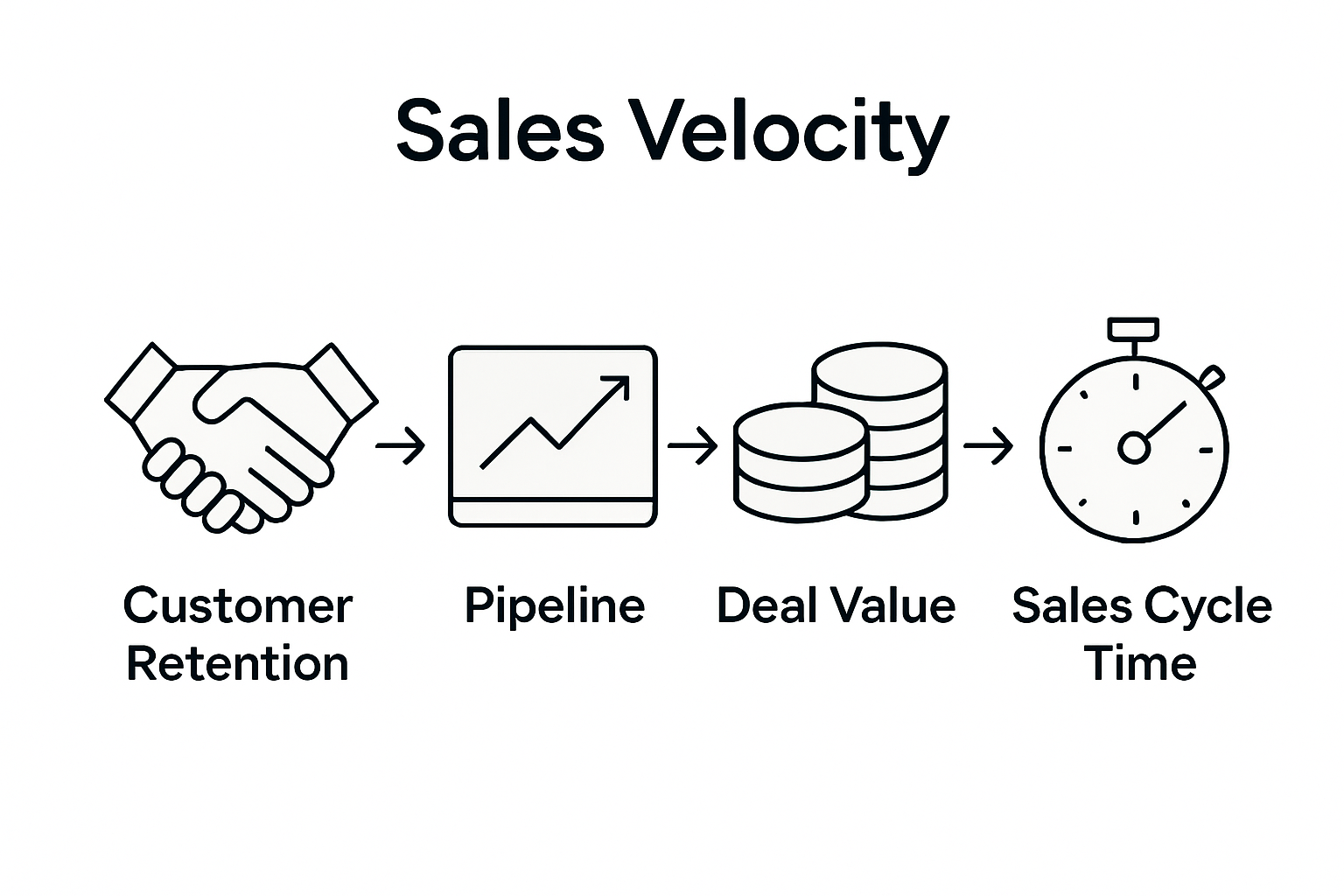
In increasingly dynamic business environments, improving market analysis and customer satisfaction becomes essential for achieving higher sales velocity and sustainable profit generation. The metric encompasses four critical components: number of opportunities, average deal value, win rate, and sales cycle length. When these elements are strategically enhanced, organisations can dramatically accelerate their revenue generation capabilities.
Understanding sales velocity goes beyond simple number crunching. Effective sales performance strategies require a holistic approach that integrates comprehensive analysis with tactical execution. Businesses must develop sophisticated frameworks that enable rapid opportunity identification, streamlined qualification processes, and targeted engagement strategies. This approach transforms sales velocity from a passive metric into an active driver of organisational growth and competitive advantage.
Key components of sales velocity include:
Number of potential sales opportunities
Average monetary value of deals
Probability of deal closure
Total time required to complete sales cycles
By meticulously tracking and improving these interconnected elements, sales teams can create a robust, responsive revenue generation engine that adapts swiftly to changing market dynamics.
Four Pillars of Sales Velocity Drivers
Sales velocity is fundamentally driven by four interconnected pillars that collectively determine an organisation’s revenue generation potential. Leveraging comprehensive sales strategies requires a nuanced understanding of these critical components: retaining existing customers, growing current accounts, acquiring new customers, and systematically enabling the sales force.
Customer Retention and Account Growth emerge as primary velocity drivers. This pillar focuses on deepening relationships with existing clients, transforming transactional interactions into strategic partnerships. Sales team effectiveness plays a crucial role in identifying upselling and cross-selling opportunities, thereby increasing the average deal value and reducing customer acquisition costs.

Technology and Data Analytics represent another pivotal pillar in accelerating sales velocity. Modern organisations are increasingly utilising advanced sales acceleration methods that integrate sophisticated technologies such as customer relationship management (CRM) systems, artificial intelligence, and predictive analytics. These tools enable precise opportunity tracking, more accurate forecasting, and streamlined sales processes.
Key components of these four pillars include:
Strategic customer relationship management
Advanced technological integration
Continuous sales force training and development
Adaptive opportunity identification strategies
Data-driven performance measurement
By holistically addressing these interconnected pillars, organisations can create a dynamic, responsive sales ecosystem that consistently drives revenue growth and maintains competitive advantage in increasingly complex market landscapes.
How Pipeline Opportunities Influence Growth
Pipeline opportunities represent the critical lifeblood of organisational revenue generation, serving as the foundational mechanism through which businesses transform potential interactions into sustainable financial growth. Salesforce management systems play a pivotal role in shaping how sales teams understand, track, and optimise these critical opportunities for maximum strategic impact.
Pipeline Quality and Quantity are intrinsically linked to revenue acceleration. Modern organisations increasingly recognise that it is not merely about generating numerous leads, but cultivating high-potential opportunities that demonstrate genuine conversion potential. Sales performance improvement strategies emphasise the importance of rigorous qualification processes that filter opportunities based on strategic alignment, potential deal value, and likelihood of successful closure.
Advanced predictive technologies are revolutionising pipeline management by enabling more sophisticated opportunity identification and prioritisation. Explainable AI technologies now provide sophisticated account prioritisation engines capable of predicting customer growth potential, identifying upsell opportunities, and proactively mitigating potential churn risks with unprecedented accuracy.
Key strategies for enhancing pipeline opportunities include:
Implementing robust qualification frameworks
Utilising advanced predictive analytics
Developing targeted engagement approaches
Creating systematic opportunity tracking mechanisms
Continuously refining lead generation processes
By adopting a strategic, data-driven approach to pipeline management, organisations can transform their sales processes from reactive mechanisms into proactive growth engines that consistently deliver measurable revenue expansion.
Improving Deal Value and Win Rates
Successful organisations understand that improving deal value and win rates requires a sophisticated, multifaceted approach that goes beyond traditional sales tactics. Machine learning techniques are increasingly demonstrating remarkable potential in predicting and enhancing customer engagement strategies, providing sales teams with unprecedented insights into potential deal performance.
Strategic Value Proposition Development emerges as a critical driver in maximising deal value. Value selling approaches emphasise the importance of articulating compelling business cases that transcend mere product features, focusing instead on demonstrating tangible economic impact, risk mitigation, and transformative potential for potential clients.
Advanced deal coaching methodologies play a pivotal role in systematically improving win rates. By implementing rigorous qualification frameworks, sales teams can develop more targeted engagement strategies that prioritise high-potential opportunities and allocate resources more effectively. Deal coaching strategies provide structured mechanisms for identifying potential deal weaknesses, developing targeted intervention strategies, and incrementally improving overall sales performance.
Key strategies for enhancing deal value and win rates include:
Developing comprehensive value propositions
Implementing advanced opportunity qualification frameworks
Utilising predictive analytics for opportunity assessment
Creating targeted coaching and skill development programmes
Continuously refining engagement approaches based on data insights
By adopting a holistic, data-driven approach to deal management, organisations can transform their sales processes, consistently improving both deal value and win rates while creating more predictable and sustainable revenue generation mechanisms.
Shortening Sales Cycle Times Effectively
Reducing sales cycle times represents a critical strategic objective for organisations seeking to accelerate revenue generation and improve overall operational efficiency. Advanced temporal forecasting techniques are increasingly demonstrating remarkable potential in providing granular insights that can dramatically streamline sales processes and reduce unnecessary temporal friction.
Technological Enablement plays a pivotal role in compressing sales cycle durations. Sales team enablement strategies focus on equipping sales professionals with sophisticated tools, data analytics capabilities, and structured methodologies that allow for more rapid opportunity identification, qualification, and progression through complex buying landscapes.
Effective sales cycle compression requires a multifaceted approach that addresses both technological and human performance dimensions. By implementing rigorous qualification frameworks, developing targeted engagement strategies, and leveraging predictive analytics, sales teams can systematically identify and eliminate friction points that unnecessarily extend deal timelines. Strategic interventions that prioritise clear communication, rapid response mechanisms, and data-driven decision-making can significantly accelerate opportunity conversion rates.
Key strategies for shortening sales cycle times include:
Implementing advanced opportunity tracking systems
Developing clear, streamlined qualification frameworks
Utilising predictive analytics for opportunity assessment
Creating rapid communication and escalation protocols
Continuously refining engagement approaches based on performance data
By adopting a holistic, technology-enabled approach to sales cycle management, organisations can transform their revenue generation processes, creating more agile, responsive, and efficient sales ecosystems that consistently deliver accelerated results.
Unlock Your Sales Velocity with Expert Guidance
If you are facing challenges like unpredictable revenue, stalled deals, or long sales cycles, this article on sales velocity drivers highlights the very pain points many senior revenue leaders experience daily. Key elements such as increasing pipeline opportunities, boosting deal value, improving win rates, and shortening sales cycle times are not just theoretical concepts but critical goals that demand precise and sustained action. At The Sales Coach Network, we understand that these challenges require more than generic advice. Our expert practitioners embed scalable sales operating systems that target the four key drivers of revenue growth. This approach ensures your sales teams move beyond luck and instinct to measurable, sustainable improvement.
Explore our tailored sales training programmes and sales coaching services designed to arm your teams with practical skills and leadership frameworks. Our proven methodology including the Sales Accelerator Method helps large B2B organisations adapt, accelerate, and achieve their revenue goals faster. Start transforming your sales velocity today by partnering with the specialists who deliver results, not just promises.
Frequently Asked Questions
What is sales velocity?
Sales velocity measures how quickly a business converts potential sales opportunities into actual revenue, providing insights into sales efficiency and performance.
What are the key components of sales velocity?
The key components of sales velocity include the number of potential sales opportunities, average deal value, win rate, and the total time required to complete sales cycles.
How can organisations improve their sales velocity?
Organisations can improve sales velocity by enhancing customer retention, leveraging technology for pipeline management, implementing effective sales training, and utilising data analytics for decision-making.
What role does pipeline management play in sales velocity?
Pipeline management is crucial as it helps businesses identify, track, and optimise sales opportunities, ultimately influencing the quality and speed of revenue generation.
Recommended
Pourquoi Rapidité De Livraison En Vidéo : Guide Complet