
Sales Manager Qualifications – What Leading UK Firms Need
- The Sales Coach Network
- Jan 27
- 9 min read


Long sales cycles can drain energy and momentum from even the most capable teams in large British B2B IT organisations. Senior leaders know that finding the right mix of formal education, practical experience, and structured development is key for building and sustaining high-performing sales managers. By exploring multiple pathways to sales leadership, you will discover proven strategies to help transform your team’s results and accelerate the pace of deals.
Table of Contents
Key Takeaways
Point | Details |
Diverse Pathways | Numerous pathways exist to become a Sales Manager in the UK, blending formal education, apprenticeships, and practical experience. Identifying the right pathway for your organisation is crucial for management development. |
Crucial Skills | Successful Sales Managers combine formal qualifications with essential skills such as communication, leadership, and strategic thinking. These skills significantly impact team performance and revenue outcomes. |
Legal Obligations | Sales Managers must understand employment law, data protection regulations, and compliance procedures to avoid legal pitfalls and ensure smooth operations. Integrating these responsibilities into daily practices enhances team focus on sales. |
Avoiding Pitfalls | Promoting individuals without assessing their leadership capabilities can damage team effectiveness. Conducting skills audits and prioritising communication and ethical standards are essential for fostering a successful sales environment. |
…
Pathways: Degrees, Apprenticeships and Experience
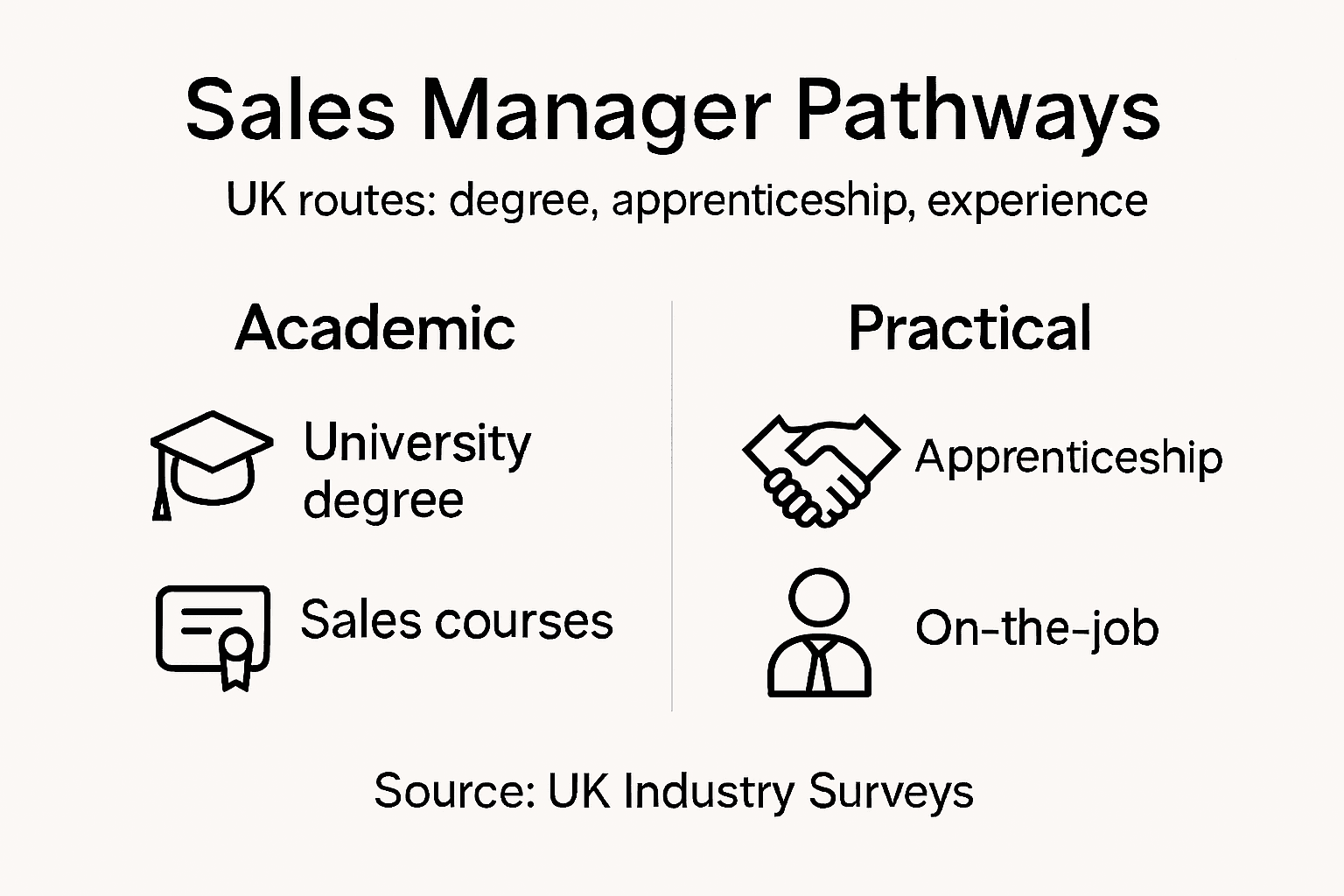
There’s no single route to becoming a Sales Manager in the UK. Instead, leading firms recognise multiple pathways that combine formal education with practical experience. The most common entry points involve a blend of qualifications, work-based learning, and progression through sales roles. Understanding which pathway suits your organisation and your team members is crucial for building a strong management pipeline.
Formal degree programmes offer one established route. BA degrees in Sales and Marketing Management provide structured academic foundations combined with workplace placements, giving graduates both theoretical knowledge and real sales exposure. These programmes typically run three years and include modules on sales strategy, customer relationship management, and team leadership. Graduates emerge with recognised credentials and often transition quickly into junior sales management positions.
Apprenticeships have become increasingly popular and respected in UK sales organisations. The Level 6 Degree Apprenticeship in B2B Sales sits at the higher end of apprenticeship qualifications and works differently from traditional degrees. Apprentices earn a salary whilst studying part-time, gaining hands-on experience alongside theoretical learning. This approach suits people who learn better through doing and prefer earning whilst qualifying. Many large B2B organisations now recruit specifically for these programmes.
Experience-based progression remains the most traditional pathway. Most Sales Managers start in frontline sales roles, build a track record of achieving targets, and gradually move into supervisory responsibilities. This organic progression typically takes three to five years but produces managers who deeply understand the sales process and customer challenges. The combination of proven sales success with subsequent management training creates credible, respected leaders.
Hybrid approaches are becoming more common in sophisticated organisations. Someone might start with a degree apprenticeship, spend two years in a sales role, then move into a management position with additional leadership coaching. This combination of formal learning, practical experience, and structured development creates well-rounded managers capable of handling complex B2B sales environments.
The most effective approach depends on your organisation’s growth strategy and available talent. For rapid team expansion, recruiting graduates through apprenticeships brings fresh capability quickly. For stability, promoting internal high performers ensures continuity and cultural alignment. Progression into leadership roles often involves combining experience with formal qualifications or coaching programmes, creating managers who balance theoretical knowledge with proven field success.
Here’s how the main Sales Manager pathways compare in the UK:
Pathway Type | Typical Duration | Main Advantages | Key Suitability |
Degree Programme | 3 years | Deep theory and workplace placements | Graduate entrants |
Degree Apprenticeship | 3-4 years (part-time) | Earn while learning on the job | Practical learners |
Experience-Based | 3-5 years | Deep market and process understanding | Internal promotion |
Hybrid Approach | 3-6 years blended | Balanced skills and flexibility | Strategic hires |
Pro tip Invest in identifying high-potential sales people early and create clear progression pathways combining their experience with targeted management training or coaching. This reduces hiring uncertainty and builds loyalty within your team.
Essential Skills and Industry Certifications
Qualifications alone don’t make effective Sales Managers. The best candidates combine formal credentials with a specific set of interpersonal and strategic skills that directly impact team performance and revenue outcomes. In complex B2B IT environments, these skills become even more critical as managers navigate longer sales cycles, multiple stakeholders, and sophisticated buying committees.
Technical sales knowledge forms the foundation. Managers must understand product features, industry trends, and competitive positioning deeply enough to coach their teams confidently. However, this technical grounding means little without strong communication abilities. The capacity to articulate value propositions clearly, explain complex concepts simply, and adapt messaging for different audiences separates average managers from exceptional ones. Your best Sales Manager candidates demonstrate this naturally in interviews and conversations.
Leadership and team management skills are non-negotiable. This includes the ability to motivate diverse personalities, set clear expectations, provide constructive feedback, and develop talent within the team. Many organisations overlook this until they promote a brilliant salesperson who lacks people management ability. The difference between a high performer and a high-performing manager lies largely in these human-centred skills, not just sales acumen.

Strategic thinking capability matters significantly in larger organisations. Sales Managers must see beyond individual deals to understand market trends, forecast pipeline accurately, and align their team’s efforts with broader commercial objectives. They need to analyse data, identify patterns, and make decisions based on evidence rather than instinct alone.
Industry certifications add credibility and structure. The Chartered Institute of Marketing and similar professional bodies offer qualifications in sales management and customer-facing leadership. Certifications in Salesforce, HubSpot, or other CRM platforms demonstrate technical competency. However, certifications work best when combined with proven sales results and demonstrated coaching ability.
What many organisations discover is that structured management training often matters more than individual certifications. Programs focusing on advanced qualification methodologies, deal management, and team coaching create measurable improvements in team performance. The most valuable candidates bring a combination: proven sales success, natural leadership instincts, relevant qualifications, and openness to ongoing development through coaching and training.
Pro tip When evaluating candidates, prioritise those with a track record of developing team members and achieving consistent results over impressive credentials alone. Ask specifically about teams they’ve built and how they’ve improved individual performer capabilities.
Managerial Responsibilities and Legal Frameworks
Sales Managers occupy a unique position in organisations. They’re responsible for driving revenue whilst simultaneously managing complex legal and ethical obligations that many people overlook until something goes wrong. Understanding these dual responsibilities is essential for anyone recruiting, developing, or becoming a Sales Manager in the UK.
On the commercial side, responsibilities are straightforward. Sales Managers set sales targets, monitor team performance against those targets, coach individual performers, and develop regional or national sales strategies. They analyse pipeline data, forecast revenue, identify gaps in capability, and decide resource allocation. These activities directly drive business results and occupy most managers’ daily focus. Yet the legal and compliance side demands equal attention.
Employment law creates significant obligations that many sales organisations underestimate. Managers must understand employment law responsibilities including fair hiring practices, proper classification of workers, performance management procedures, and termination protocols. Breaching these creates liability for both the individual manager and the organisation. For instance, inadequate documentation of performance issues can lead to unfair dismissal claims that prove costly and damaging.
Data protection laws add another layer of complexity. Under General Data Protection Regulation (GDPR) and UK Data Protection Act 2018, Sales Managers handle customer and prospect data daily. They must ensure their teams collect, store, and process this information lawfully. Unauthorised data sharing, poor security practices, or failure to respect customer preferences can result in significant fines and reputational damage.
Compliance with sales and advertising standards matters too. Sales Managers must ensure their teams operate within Consumer Rights Act protections, follow industry-specific regulations, and avoid misleading claims. Fair trade practices and advertising standards form part of broader governance duties that prevent legal exposure. In IT and technology sectors specifically, additional regulations may apply depending on the solutions being sold.
Contract management also falls under managerial responsibility. Managers must understand the commercial terms they’re negotiating, recognise when legal review is needed, and ensure compliance with internal approval processes. Agreeing to terms outside organisational policy or legal boundaries creates unnecessary risk.
The most effective Sales Managers build these compliance obligations into their systems and coaching. Rather than viewing legal frameworks as obstacles, they integrate them into daily practice, making them invisible to salespeople but present in every interaction.
Below is a summary of essential legal responsibilities for UK Sales Managers:
Legal Area | Core Focus | Risk if Neglected | Example Impact |
Employment Law | Fair recruitment and procedures | Unfair dismissal claims | Legal costs and payouts |
Data Protection (GDPR) | Safe handling of personal data | Regulatory fines | Damaged reputation |
Sales & Advertising Standards | Honest and legal sales claims | Customer complaints | Loss of public trust |
Contract Management | Correct commercial terms and reviews | Unenforceable contracts | Financial and compliance risks |
Pro tip Create a simple compliance checklist for your sales team covering key legal areas relevant to your business. Review it quarterly with your manager and legal team to ensure your organisation stays current with regulatory changes.
Common Pitfalls and How to Avoid Them
Promoting the wrong person into a Sales Manager role can set back team performance by months. Leading UK B2B organisations consistently encounter the same pitfalls when building or expanding their management layers. Understanding these common mistakes helps you avoid expensive missteps that damage morale, revenue, and retention.
The first major pitfall is promoting exceptional salespeople without assessing their leadership capability. Being brilliant at closing deals doesn’t translate to motivating a diverse team or handling difficult performance conversations. You’ll end up with a frustrated former top performer and a demoralised team. Before promoting, assess whether candidates have demonstrated coaching ability, patience with underperformers, and genuine interest in developing others.
Poor communication practices create another significant problem. Managers who communicate inconsistently, avoid difficult conversations, or fail to articulate clear expectations leave their teams confused about priorities and confused about their own performance. This ambiguity directly impacts pipeline quality and sales velocity. Effective Sales Managers establish cadences, communicate decisively, and ensure alignment across the team.
Failing to set realistic sales targets undermines credibility quickly. Targets that are arbitrary, disconnected from market reality, or simply too aggressive demotivate teams and create perverse behaviours. Work backwards from market opportunity, account for seasonal patterns, and involve the team in target-setting conversations to build buy-in.
Neglecting legal compliance and data protection creates ongoing liability. Many organisations focus solely on revenue targets whilst ignoring employment law, GDPR obligations, and ethical sales practices. This gap exposes the business to regulatory action, litigation, and reputational damage. Building compliance into your management systems from day one prevents costly problems later.
Stagnation in skill development poses a subtle but serious risk. Managers who don’t pursue continuous professional development through qualifications and coaching become disconnected from evolving market practices and team capabilities. Regular field coaching, performance evaluations, and exposure to new methodologies keep managers sharp and relevant.
Finally, weak culture development around integrity creates lasting damage. When managers overlook unethical behaviour to meet targets, they normalise shortcuts that eventually harm the business. The strongest organisations foster a culture where compliance and ethical standards are non-negotiable alongside commercial performance.
Pro tip Conduct a management skills audit before promoting anyone into a Sales Manager role. Assess team leadership capability, communication clarity, and integrity separately from sales results. The best candidate isn’t always your top salesperson.
Unlock the Full Potential of Your Sales Managers Today
The article highlights the critical challenge leading UK firms face: finding Sales Managers who combine proven sales expertise, formal qualifications, leadership skills, and a deep understanding of legal compliance. If your organisation struggles with inconsistent team performance, stalled deals, or unpredictable revenue, these pain points reflect a systemic problem—not just a people problem. Recognising the importance of blending practical experience with targeted development is key to building a resilient and high-performing sales management team.
At The Sales Coach Network we specialise in partnering with ambitious B2B organisations to embed scalable sales operating systems that deliver measurable, sustainable revenue growth. Our approach focuses on leadership development, advanced qualification methodologies, and managing complex sales cycles through coaching and tailored training. We provide comprehensive sales leadership training that equips Sales Managers with the skills to drive team coaching, navigate compliance issues, and consistently hit targets.
Ready to transform your sales management capabilities? Explore how our sales coaching services and leadership programmes can help you bridge the gap between qualification and real-world success. Don’t wait for costly mistakes in promotions or underdeveloped teams. Visit The Sales Coach Network now and take the first step to building a sales leadership team that consistently delivers predictable and scalable growth.
Frequently Asked Questions
What qualifications are preferred for Sales Managers?
Leading firms often prefer qualifications such as a BA degree in Sales and Marketing Management or a Level 6 Degree Apprenticeship in B2B Sales, combining theoretical knowledge with practical experience.
How important is experience in becoming a Sales Manager?
Experience is vital; most Sales Managers progress through frontline sales roles, gaining practical insights and skills that help them manage teams effectively.
What skills are essential for successful Sales Managers?
Essential skills include strong communication, leadership, strategic thinking, technical sales knowledge, and the ability to motivate and develop team members.
What common pitfalls should be avoided when promoting Sales Managers?
Common pitfalls include promoting top salespeople without assessing leadership capability, failing to set realistic sales targets, and neglecting legal compliance and data protection responsibilities.
Recommended