
Sales & Marketing Manager – Driving Revenue Growth
- The Sales Coach Network
- Jan 25
- 12 min read


Long sales cycles and unpredictable pipelines can leave even experienced sales leaders searching for answers. In the UK’s large B2B IT sector, roles that blend sales and marketing are now at the centre of efforts to keep revenue on track. Understanding the unique demands of a Sales and Marketing Manager is crucial, as this position transforms disconnected actions into a single, pipeline-focused strategy purpose-built for consistent growth.
Table of Contents
Key Takeaways
Point | Details |
Dual Role Importance | The Sales and Marketing Manager bridges marketing initiatives with sales execution, crucial for driving revenue growth in B2B IT environments. |
Experience Over Qualifications | A proven track record of meeting sales targets is often valued more than formal qualifications, reflecting the hands-on nature of the role. |
Strategic and Tactical Balance | Successful managers must blend strategic planning with tactical execution and be adaptable to changing market conditions. |
Avoiding Silos | Ensuring tight alignment between sales and marketing functions is critical, as misalignment can lead to wasted budget and lost opportunities. |
Defining the Sales & Marketing Manager Role
The Sales and Marketing Manager role sits at a critical junction within B2B IT organisations. This position bridges the gap between strategic marketing initiatives and frontline sales execution, requiring leaders who understand both the nuances of demand generation and the mechanics of deal closure. Unlike pure sales roles that focus solely on converting opportunities, or marketing roles concentrated on brand and awareness, the Sales and Marketing Manager must orchestrate both functions to drive sustainable revenue growth. In large, complex IT environments where sales cycles stretch across months and buying committees involve multiple stakeholders, this dual accountability becomes the difference between a pipeline that stalls and one that flows predictably.
At its core, sales managers lead teams tasked with achieving agreed revenue targets, but the modern Sales and Marketing Manager extends this mandate significantly. They must organise and coach sales representatives whilst simultaneously owning the strategy that keeps the pipeline full. The role involves recruiting and training staff, developing go-to-market strategies, managing team performance against targets, and crucially, ensuring that marketing activities align with what sales teams actually need to win deals. This person designs campaigns, oversees budgets, and develops promotional strategies, but always with an eye on whether these efforts translate into qualified opportunities that salespeople can convert.
What makes this role particularly demanding in IT firms is the technical complexity involved. Marketing managers in UK organisations are responsible for overseeing budgets and planning campaigns that must resonate with C-suite technology decision-makers, yet sales leaders must also be pragmatic enough to pivot when market conditions shift. They need both creativity and discipline, strategic vision and tactical execution. Employers consistently value market knowledge, a proven track record of hitting targets, and real sales experience over formal qualifications. The best Sales and Marketing Managers have spent time in the field, understand what objections sound like, and know the friction points in your particular market.
In practice, this means owning pipeline generation strategy, leading sales teams, managing marketing spend, liaising with external agencies, and ultimately taking responsibility for the numbers. It’s a role that demands versatility, resilience, and the ability to move seamlessly from strategic planning sessions to hands-on coaching conversations with struggling sales representatives.
Here’s a summary of key differences between pure Sales Manager, Marketing Manager, and dual Sales & Marketing Manager roles in B2B IT firms:
Function | Sales Manager | Marketing Manager | Sales & Marketing Manager |
Main Focus | Closing deals | Building awareness, generating leads | Overseeing both demand generation and deal closure |
Success Metric | Achieved revenue targets | Campaign reach, brand growth | Revenue growth through aligned strategies |
Daily Activities | Managing sales teams, forecasting | Planning campaigns, managing budgets | Coordinating teams, aligning marketing with sales needs |
Necessary Expertise | Sales negotiation, deal progression | Campaign strategy, market positioning | Combining sales tactics with marketing strategy |
Pro tip: When recruiting or interviewing for a Sales and Marketing Manager, prioritise candidates with direct experience in your market segment and proven success managing teams through lengthy sales cycles; theoretical knowledge of best practices matters far less than someone who understands your specific buyer journey and can coach others through it.
Essential Skills and Qualifications in the UK
Succeeding as a Sales and Marketing Manager in the UK requires a specific blend of technical proficiency and interpersonal capability. Unlike many leadership positions that can be filled with academic credentials alone, this role demands a combination of proven sales experience and demonstrated business results. Most UK employers place significant weight on a proven track record of meeting sales targets rather than on formal qualifications. You could hold every relevant diploma, but if you cannot show you have consistently delivered revenue, you will struggle to convince hiring managers or boards that you can drive growth. This pragmatic approach reflects the reality of B2B IT sales: results matter more than paperwork.
On the technical skills front, leadership and strategic planning capabilities form the foundation of the role. You need to understand how to read and interpret sales data, forecast pipeline accurately, and make decisions based on metrics rather than gut feel. Proficiency with main software platforms is non-negotiable, particularly customer relationship management (CRM) systems, spreadsheet applications, and marketing automation tools. Many candidates underestimate the importance of data analysis skills. You cannot manage what you cannot measure, and in complex B2B environments with extended sales cycles, the ability to dissect pipeline data and identify bottlenecks becomes a critical competitive advantage. Beyond the numbers, effective communication skills allow you to move seamlessly between translating executive strategy for frontline teams and presenting sales performance to the board with credibility.

What truly distinguishes high-performing Sales and Marketing Managers is their ability to operate under pressure whilst maintaining strategic focus. The role oscillates constantly between tactical firefighting and long-term planning. You might spend your morning coaching a struggling rep through a stalled deal, then shift to reviewing marketing campaign performance metrics, then move into a board conversation about quarterly forecasts. Multilingual capability is valuable in larger organisations with international operations, but not essential unless your specific market demands it. The qualities that matter most are resilience, adaptability, and genuine empathy for your team’s challenges. You must have walked the walk in sales yourself, experiencing the rejection and complexity that your team faces daily.
Regarding formal qualifications, apprenticeships or business degrees can strengthen your candidacy, but most employers prioritise a proven sales record and market knowledge over academic credentials. Many successful Sales and Marketing Managers in IT have come through entry-level sales roles and developed their skills through real-world experience rather than formal study. If you lack structured qualifications, professional development through recognised bodies such as the Institute of Sales Professionals can add credibility and demonstrate commitment to the field.
Pro tip: Build a documented portfolio of your career wins, including specific pipeline you generated, deal values you closed, and team revenue targets you achieved; when interviewing for Sales and Marketing Manager roles, these concrete examples will carry far more weight than listing qualifications, especially in the UK market where hiring managers value evidence over credentials.
Responsibilities: Strategy, Leadership, and Delivery
The Sales and Marketing Manager sits at the intersection of three critical dimensions: setting the strategic direction, leading the people who execute it, and delivering the revenue results that justify the investment. This is not a role where you can excel in one area whilst neglecting the others. Weak strategy combined with strong execution still produces suboptimal results. Strong strategy undermined by poor leadership creates confusion and misalignment. And strong leadership without clear strategy simply means your team is running efficiently in the wrong direction.
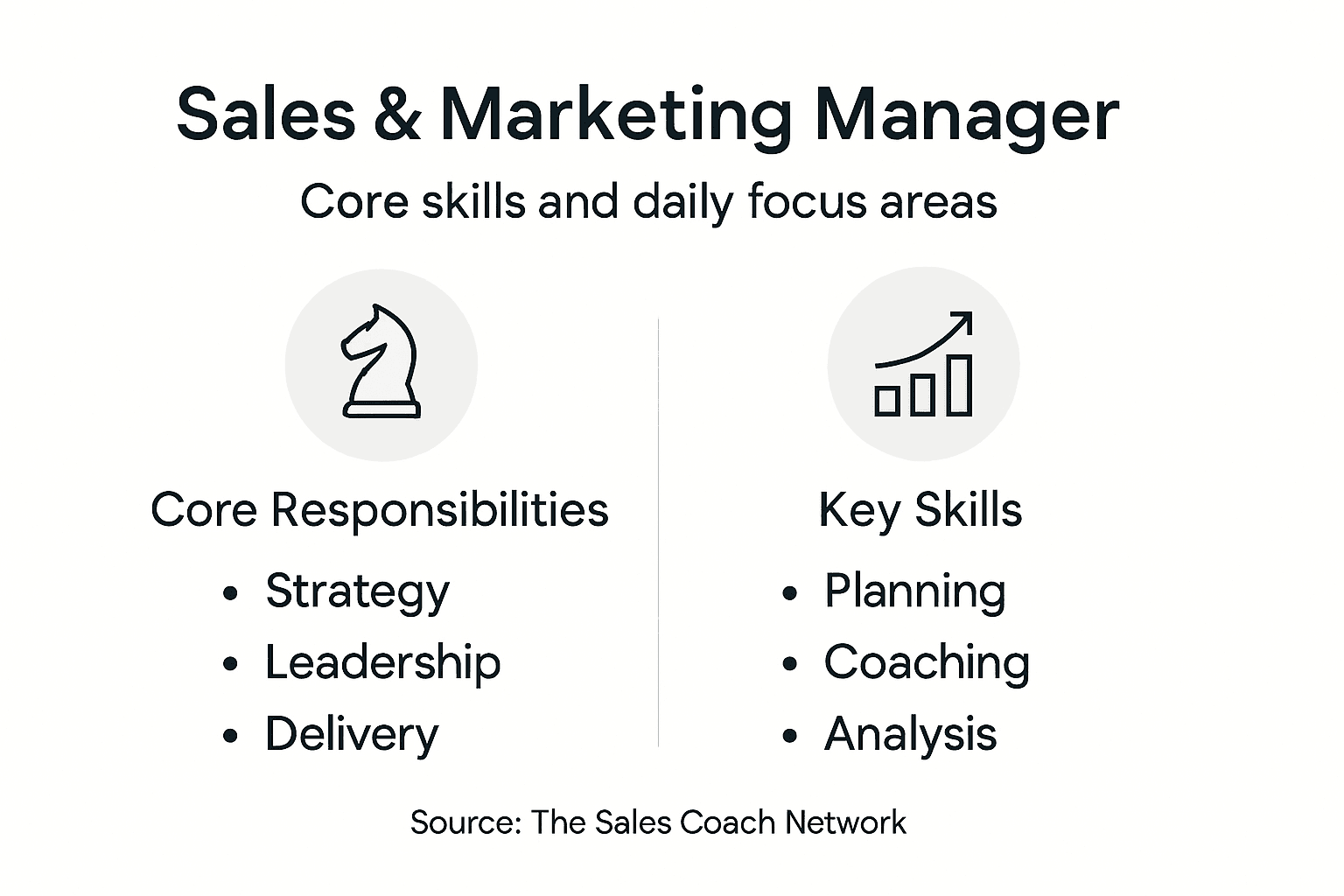
On the strategic front, your responsibility is to develop and implement operational marketing and sales strategies that align with broader business objectives. This means conducting market analysis, identifying where opportunities exist within your segment, and determining where your organisation can compete effectively. Leadership responsibilities include managing teams and overseeing creative development of campaigns and value propositions that resonate with your target buyers. You must also develop sales plans that allocate resources intelligently across regions or segments, recognising that not all opportunities carry equal potential. Budget ownership is non-negotiable; you are accountable for tracking campaign performance, monitoring spend against plan, and ensuring marketing activities deliver genuine return on investment rather than simply consuming budget. In complex B2B IT environments, this often means shifting allocation away from activities that look good in presentations but generate little qualified pipeline, and towards approaches that actually fill your funnel with deals worth pursuing.
Leadership in this context means coaching sales representatives and marketing team members through the nuance of your market. You are responsible for gathering market intelligence and translating that into actionable direction for your team. When competitive dynamics shift, when buyer priorities change, or when a particular approach stops working, you must recognise this quickly and adjust tactics accordingly. This requires regular time with your sales team, listening to what they encounter in the field, understanding the objections they face, and coaching them to handle new market dynamics. You are not managing from a dashboard; you are actively involved in developing your team’s capability. This includes recruiting talent, training them in your methodologies, and creating an environment where high performers thrive and struggling performers receive intensive support or move on.
Delivery means taking accountability for results. You must develop sales plans and monitor performance against agreed targets, then report those results clearly to senior management. In large IT organisations, this often means forecasting pipeline accurately several months in advance, managing complex buying committees, and maintaining discipline around deal progression. You identify new business opportunities, not by hoping they arrive inbound, but through proactive market engagement and partnership development. You adjust your approach based on what is and is not working, rather than stubbornly pursuing a plan that the market has rejected. This balance between strategic commitment and tactical flexibility is what separates effective leaders from those who become obstacles to their own teams.
Pro tip: Establish a monthly cadence where you spend at least one day per week in the field with your sales team, listening to client conversations and understanding pipeline dynamics firsthand; this ground-truth perspective will inform your strategy far more effectively than internal meetings alone, and your presence signals that you understand the real work.
Challenges and Mistakes to Avoid
The Sales and Marketing Manager role exposes you to a particular set of pitfalls that can derail even experienced leaders. The most dangerous mistake is treating sales and marketing as separate functions that happen to report to the same person. When sales and marketing operate in silos, the consequences are immediate and painful. Marketing generates campaigns that sales dismisses as irrelevant. Sales teams complain they never receive qualified leads. Budgets get wasted on initiatives that do not translate into pipeline. In large B2B IT organisations with complex buying cycles, this misalignment can cost hundreds of thousands in lost opportunity. Failing to align marketing strategies with sales targets creates exactly this dynamic. The remedy is straightforward but demands discipline: establish joint planning cycles where sales and marketing teams sit together to define what “qualified” actually means, what campaigns will drive what types of opportunities, and how success will be measured. This alignment must then be reinforced through regular reviews and course corrections.
Another critical mistake is allowing data-driven discipline to slip. You might begin your tenure with rigorous pipeline reviews, accurate forecasting, and clear metrics. But as operational pressures mount, many leaders retreat into gut feel and intuition. They skip the pipeline review because “we all know what’s happening.” They accept forecast numbers without challenge. They make budget decisions based on what feels right rather than what the data shows. Poor communication and inadequate market analysis compound this problem. Without structured communication rhythms and genuine market intelligence, you become reactive rather than proactive. You chase every competitor move instead of understanding where your organisation can genuinely compete. You fail to spot early warning signs that your market positioning is shifting. The antidote is building non-negotiable governance into your operating rhythm: monthly pipeline reviews with defined escalation criteria, quarterly strategy sessions where you explicitly reassess your market position, and regular field visits where you gather unfiltered market intelligence directly from your teams and clients.
A third trap is underestimating how much your own behaviour sets the tone for execution. If you tolerate missed commitments from your team, they will miss more. If you make decisions without consulting data, your team will do the same. If you fail to provide coaching to struggling performers, high performers will grow frustrated and leave. Many new Sales and Marketing Managers inherit situations where discipline has eroded. Fixing this requires patience and consistency. You must establish clear expectations, then coach people to those expectations, then hold accountability. Some people will respond and develop. Others will not, and you must move them. This is uncomfortable work, but avoiding it creates a culture where mediocrity becomes normal.
Pro tip: When you step into a Sales and Marketing Manager role, spend your first 30 days listening and diagnosing rather than announcing changes; map the actual pipeline, understand which deals are real, identify where marketing and sales disconnect, and then build your plan from that ground truth instead of from assumptions or your predecessor’s approach.
UK Career Paths and Alternatives
The Sales and Marketing Manager role is not a destination; it is a waypoint on a longer career trajectory. In the UK market, the natural progression from this position typically leads towards broader leadership and P&L accountability. Many successful Sales and Marketing Managers move into regional or national management roles where they oversee multiple teams or geographies, scaling the systems and processes they have built at a single location or function. Others progress into commercial director positions, where they combine sales, marketing, and business development under one leadership umbrella. These roles demand the same core competencies that make someone effective as a Sales and Marketing Manager, but applied across larger teams and more complex organisational structures. The progression usually involves demonstrating consistent revenue delivery, developing other leaders, and showing the ability to adapt strategy as markets shift.
However, not every career progression moves upward into bigger management roles. Many experienced Sales and Marketing Managers discover they prefer the depth of specialist expertise over the breadth of general management. Specialist roles such as product management, business development, or marketing communications offer compelling alternatives that leverage sales and marketing experience whilst focusing on a narrower domain. A product manager who has managed sales teams understands customer needs at a level that pure product specialists often lack. A business development leader with sales and marketing background can identify and build partnerships that drive revenue growth. A marketing communications specialist with sales credibility can create messaging that actually resonates with buyers rather than simply sounding clever. These lateral moves are particularly common in technology and professional services firms, where specialists command premium compensation and strategic influence without the people management burden.
For leaders considering these alternatives, the critical decision point usually arrives around five to eight years into the Sales and Marketing Manager role. By then, you have proven whether you enjoy the constant people management, the political complexity of large organisations, and the relentless accountability for numbers. Some discover this energises them and pursue bigger management roles. Others realise they prefer working on problems rather than managing personalities, and specialist roles become more attractive. There is no right answer; the question is what drives your professional satisfaction and where your strengths genuinely lie. The UK market has strong demand for both types of progression, particularly in IT and professional services sectors where revenue leaders and specialist experts are perennially scarce.
Build your career decisions around what you want to optimise for: increased scope and influence, deeper expertise and mastery, compensation growth, work-life balance, or a combination of these. Within the Sales Coach Network’s client base, we see both progressions succeed. The key is making the choice consciously rather than drifting into it.
To clarify career paths, here is a comparison of common progression routes for UK Sales and Marketing Managers:
Career Route | Scope of Responsibility | Typical Next Role | Professional Value |
General Management | Leading multiple teams or regions | Regional/National Manager, Commercial Director | Broader influence, P&L ownership |
Specialist Track | Focusing on a domain (e.g., product) | Product Manager, Business Development Lead | Deeper expertise, targeted impact |
Consultancy/Advisory | Advising organisations externally | Sales/Marketing Consultant | Flexibility, varied challenges |
Pro tip: If you are contemplating a move from Sales and Marketing Manager into specialist or director roles, start building expertise in your chosen direction now by taking on relevant projects, seeking mentorship in that area, and demonstrating capability before you formally transition; employers value people who have already proven themselves in the adjacent domain.
Elevate Your Impact as a Sales & Marketing Manager
Driving revenue growth in complex B2B IT environments demands more than just managing teams. This article highlights the critical challenge of aligning sales and marketing to create predictable pipelines, boost win rates, and shorten sales cycles. If you find yourself frustrated by stalled deals, disengaged teams, or misaligned priorities between marketing and sales, you are not alone. Successful Sales and Marketing Managers must combine strategic vision with disciplined execution and hands-on leadership to navigate these obstacles.
At The Sales Coach Network we understand these pain points deeply. Our proven methodology focuses on embedding scalable sales operating systems that increase qualified pipeline opportunities and build consultative selling skills that lead to larger, more consistent deals. We provide tailored sales leadership training and coaching that helps you align your marketing strategy with frontline sales needs while developing the discipline and accountability required for sustainable growth. To transform your team’s performance and master the art of balancing strategy with execution, explore our comprehensive sales training programs and expert sales coaching services.
Are you ready to stop putting out fires and start driving measurable revenue growth? Visit The Sales Coach Network today and discover how we help Sales and Marketing Managers like you adapt, accelerate, and achieve lasting success.
Frequently Asked Questions
What are the primary responsibilities of a Sales and Marketing Manager?
The Sales and Marketing Manager is responsible for developing and implementing operational marketing and sales strategies, managing teams, aligning marketing efforts with sales needs, and delivering revenue results through effective coordination.
What skills are essential for a successful Sales and Marketing Manager?
Essential skills include leadership and strategic planning, data analysis, communication, and the ability to manage both sales tactics and marketing strategies while being adaptable to changing market conditions.
How do the roles of a Sales Manager and Marketing Manager differ from a Sales and Marketing Manager?
A Sales Manager focuses on closing deals and managing sales teams, a Marketing Manager concentrates on building brand awareness and generating leads, while a Sales and Marketing Manager oversees both functions to ensure alignment and drive revenue growth.
What are the common career paths for a Sales and Marketing Manager?
Common career paths include moving into regional or national management roles, advancing to commercial director positions, or specialising in roles such as product management or business development, depending on individual preferences and strengths.
Recommended