Sales Management
Sales Manager Company: Driving Predictable B2B Growth
The Sales Coach Network19 min read


Sales leaders in British B2B technology firms know that building a predictable pipeline is harder than ever. The sales manager’s role goes far beyond setting targets or monitoring activity. It is the driving force behind scalable revenue, demanding structured systems, rigorous accountability, and strong commercial insight. When predictable growth is the goal, your ability to define and execute the role with clarity makes a marked difference. Explore how a sales manager’s strategic leadership directly impacts pipeline generation and sales cycle time, unlocking more consistent results from your team.
Table of Contents
Key Takeaways
Point | Details |
Sales Managers are Strategic Leaders | The role requires translating company goals into actionable targets while driving team performance and maintaining accountability. |
Tailored Performance Solutions are Essential | Effective sales strategies must adapt to the specific context of the organisation, acknowledging variations in sales environments and team dynamics. |
Sustainable Revenue Growth Requires Rigour | Building a predictable sales operation hinges on consistent pipeline generation, disciplined qualification of opportunities, and structured deal advancement processes. |
Common Pitfalls Affect Performance | Losing customer connection, weak accountability, neglecting team development, and inconsistency in strategy can severely undermine a sales manager’s effectiveness. |
Defining a Sales Manager Company’s Role
A sales manager does far more than oversee a team of sales representatives. The role sits at the intersection of revenue generation and organisational strategy, making it one of the most critical positions in any B2B firm. A sales manager leads a team of sales representatives by setting targets and expectations aligned with business objectives, directly impacting revenue through coaching, developing strategies, managing customer relationships, and motivating staff. In practice, this means being simultaneously a strategist, mentor, and accountability driver. Your job is to ensure that your team consistently delivers predictable, scalable revenue growth whilst removing the obstacles that prevent them from succeeding.
The foundation of effective sales management rests on understanding that sales is a discipline grounded in structured systems and measurable outcomes. Rather than relying on random talent or individual heroics, the most effective sales managers operate within proven frameworks that define roles, optimise processes, and create consistency. Net sales through products and services drive business profit, which is why the sales manager function has become strategically central to business success. Your role is to translate company objectives into achievable targets, then build the systems and cadence that enable your team to hit them consistently. This involves setting clear expectations, analysing trends in the market and pipeline, negotiating significant contracts, and creating accountability through regular coaching and feedback. You’re not simply managing a group of individuals; you’re orchestrating a revenue function that operates with predictability and rigour.
In B2B environments, particularly in technology and professional services, the sales manager role carries additional complexity. Your team likely handles long sales cycles, multiple stakeholders on both sides of the deal, and significant account value. This demands that you focus on several core responsibilities. First, you must ensure your team builds qualified pipeline proactively rather than waiting for inbound opportunities. Second, you need to develop your people through consistent coaching and skill development, ensuring they can navigate complex buyer conversations and lead with commercial insight. Third, you must install rigour around qualification and deal management so your team spends time on opportunities they can actually win. Finally, you need to create momentum by celebrating wins, learning from losses, and maintaining consistent cadence. The best sales managers recognise that their primary output is not individual deals closed, but rather a team that operates predictably, a pipeline that’s predictable, and processes that scale.
The scope of your role extends beyond the immediate team. You are the translator between senior leadership’s commercial ambitions and your team’s day-to-day execution. You interpret market feedback and customer intelligence, then feed that back up through the organisation. You identify which sales techniques work, which don’t, and which need adaptation for your specific client base. You build relationships with other departments—marketing, product, customer success—because modern B2B sales cannot function in isolation. Your leadership directly influences whether your company achieves predictable revenue or lurches from feast to famine based on a few large deals. This is why sales managers in successful organisations are strategic partners to the business, not simply tactical order-takers.
Pro tip: Define your role clarity first by documenting the three core metrics you own (pipeline generation, win rate, and sales cycle time) and align daily actions with moving those metrics, rather than accepting whatever tasks land on your desk each week.
Key Variations in Sales Performance Solutions
Sales performance is not monolithic. What works brilliantly for one organisation may fail for another, which is why effective sales leaders recognise that performance solutions must be tailored to their specific context. The variation in what drives sales success stems from multiple factors: the type of product being sold, the length of the sales cycle, the complexity of the buying committee, market conditions, team composition, and organisational maturity. A high-velocity transactional sales environment operates on entirely different principles than a complex enterprise deal with a twelve-month sales cycle. Your job as a sales manager is to diagnose which performance gaps exist in your specific situation, then apply the right interventions to close them.
Research into personal factors and skill determinants shows that salesperson performance is shaped by a combination of variables including role clarity, individual aptitude, motivation, and organisational factors. The strongest correlation exists between personal factors and skill development on one side, and actual performance outcomes on the other. However, the weight of these factors varies significantly depending on your business model. For instance, in a complex B2B sales environment where deals are high-value and involve multiple stakeholders, skill in navigating executive conversations and building compelling business cases becomes paramount. In contrast, a volume-based inside sales operation might find that motivation and activity discipline matter more than consultative selling prowess. This is why a one-size-fits-all training programme often disappoints: it fails to address the specific performance drivers that matter most in your context. Your sales force effectiveness relies on you understanding which variables are actually limiting performance in your team right now.
Effective sales organisations take a structured approach to identifying these variations. They measure sales effectiveness through buying stage analysis, tracking where deals get stuck and where your team excels. They assess performance indicators across pipeline generation, deal advancement, and close rates. They examine collaboration between sales and marketing to identify messaging or positioning gaps. They invest in continuous improvement of skills and strategies rather than assuming last year’s approach will work this year. This diagnostic mindset allows you to move beyond generic “we need better sales training” thinking and instead pinpoint exactly where the constraint lies. Is your challenge that your team cannot create qualified opportunities? That they fail to advance deals past early stages? That they lose deals at proposal? That they cannot manage complex buying committees? That your pricing conversation is weak? Each diagnosis points to a different solution.
The practical implication for your role is significant. Rather than implementing a standard sales performance programme across your entire team, effective managers tailor their approach. Some team members may need skills coaching on discovery conversations. Others may need accountability support on activity discipline. Others may need commercial acumen development to position value effectively. Some may simply need role clarity around what success looks like. Some territories may need pipeline building focus whilst others need deal management rigour. This variation in approach, grounded in genuine diagnostic work, is what separates managers who achieve predictable results from those who chase whatever training trends appear in their inbox. You are responsible for understanding your specific constraints, then applying the interventions that address them.
Pro tip: Conduct a diagnostic conversation with your top three performers and your bottom three performers this week, asking specifically what they believe enables their success or limits their performance, then look for patterns that reveal your true performance drivers rather than assuming you know what the issues are.
Core Strategies for Sustainable Revenue Growth
Sustainable revenue growth is not about hitting one month’s target or celebrating a single large deal. It is about building a sales operation that generates predictable, repeatable results quarter after quarter, year after year. This requires a fundamentally different mindset from chasing quick wins. The difference between a sales team that achieves sporadic spikes and one that compounds growth steadily comes down to strategy. Your strategy must address how you build pipeline, how you qualify opportunities, how you advance deals, and how you defend and grow existing accounts. Without this strategic framework, your team operates tactically, responding to whatever lands in their inbox rather than proactively orchestrating a predictable revenue machine.

The foundation of sustainable growth rests on understanding that predictability requires three interconnected elements working in concert. First, you need a consistent system for pipeline generation that does not rely on luck or inbound leads drying up. This means your team must build qualified opportunities proactively through strategic outreach, relationship development, and market intelligence. You cannot build a predictable business on hope that prospects will arrive. Second, you need rigorous qualification discipline that ensures your team focuses energy on deals they can genuinely win. This prevents the trap of chasing every opportunity and burning out on unqualified prospects. Third, you need a structured approach to advancing deals that removes friction and creates momentum. Many sales teams suffer from deals getting stuck in limbo because no one has defined the clear steps required to move from one stage to the next. When these three elements work together, supported by accountability and regular coaching, you create conditions for sustainable growth. Achieving sustained productivity improvement requires consistent investment in skills, systems, and accountability, principles that apply equally to sales organisations as they do to broader economic strategy.
Your role in executing this strategy involves building discipline around measurement and accountability. You cannot sustain growth you do not measure. This means defining clear leading indicators (pipeline generation, qualification rates, deal advancement velocity) not just lagging indicators (closed deals, revenue). You review pipeline health weekly, not monthly. You understand exactly where deals sit in your process, why they are there, and what is required to move them. You track which qualification criteria your team is applying and whether they are genuinely predicting win likelihood. You celebrate wins but more importantly, you analyse losses to understand what you can learn. You hold weekly or fortnightly coaching conversations with each manager on your team to review their pipeline, discuss deals at risk, and develop their people. This regular cadence is what separates sustainable performers from those who manage by crisis. When you operate with this discipline, growth becomes predictable because it is driven by inputs you control, not outputs you hope for.
Implementing these strategies requires moving beyond generic sales approaches to ones tailored to your specific market, your buyer, and your competitive position. Sales strategy grounded in your specific context drives predictable growth far more effectively than adopting someone else’s playbook wholesale. This means understanding exactly how your target buyer makes decisions, what value they truly care about, how long their cycle typically runs, and what differentiates you from alternatives. It means equipping your team with clear messaging that resonates with that buyer. It means training your managers to coach sellers on having the right conversations, not just any conversations. It means building rhythm and cadence into your operation so that deals do not stall and opportunities do not slip through gaps. When your strategy is this grounded and your execution this disciplined, sustainability follows naturally because you have removed randomness from the equation.
Pro tip: Audit your current pipeline generation approach this week by asking your team where their top ten opportunities came from, then measure what percentage originated from proactive outreach versus inbound, which reveals immediately whether your pipeline strategy is sustainable or dependent on external factors you cannot control.
Essential Skills and Manager Responsibilities
Being a sales manager requires a specific blend of capabilities that go well beyond simply being a strong individual contributor. You need to master multiple dimensions simultaneously: strategic thinking, people leadership, commercial acumen, and operational discipline. The managers who succeed in driving predictable B2B growth are those who recognise that their job has fundamentally changed from selling to leading others to sell. This shift requires capabilities you may not have developed as a salesperson. You need to think about market dynamics and competitive positioning, not just closing your own deals. You need to develop other people’s skills, not simply demonstrate your own. You need to build systems and processes, not just navigate them. You need to balance short-term targets with long-term team development. This is where many high-performing salespeople stumble when promoted into management. They excel at individual performance but struggle with the leadership, strategic, and people development dimensions that actually define the role.
Your core responsibilities cluster into four interconnected areas. First, you are responsible for setting clear sales targets and strategic direction that align with your company’s commercial objectives. This is not simply accepting whatever number lands on your desk from above; it means understanding your market, your competitive position, your team’s capability, and your pipeline health, then negotiating a realistic yet challenging target. Second, you must build and maintain a pipeline machine that generates consistent qualified opportunities. You own this outcome. You cannot delegate it entirely to your team and then complain when pipeline is weak. You need to understand exactly where opportunities originate, which channels are productive, which are drying up, and where to invest energy. Third, you are accountable for developing your people through consistent coaching on sales techniques and strategic thinking. This means regular one-to-one conversations where you review deals, provide feedback on their approach, develop their commercial acumen, and build their confidence. Fourth, you must manage the operational side: hiring and training new team members, overseeing your sales processes to ensure consistency, analysing market trends to adapt your approach, and negotiating significant contracts alongside your team. These four areas are not separate silos; they interconnect. Your strategic direction shapes how you build pipeline. Your team development improves their ability to execute. Your operational discipline ensures consistency.
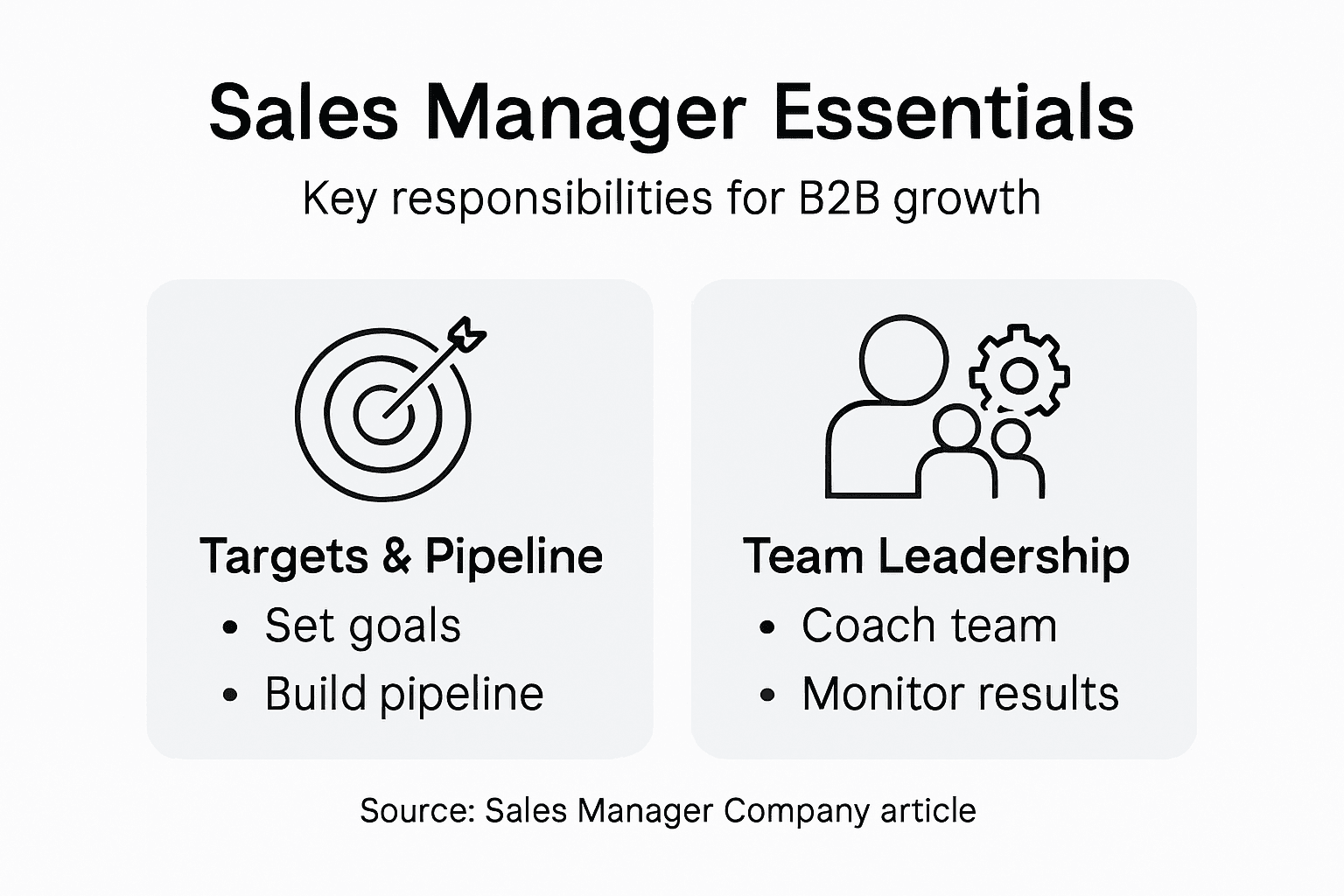
To clarify the distinctions between sales manager core responsibilities, here is a structured overview:
Responsibility Area | Main Focus | Typical Activities | Strategic Impact |
Target Setting & Direction | Aligning sales goals with strategy | Market analysis, target negotiation | Guides team focus and ambition |
Pipeline Generation | Creating consistent revenue flow | Channel evaluation, campaign oversight | Ensures steady opportunity stream |
People Development | Upskilling and motivating staff | Coaching, feedback, mentoring | Builds team capability and morale |
Operational Management | Ensuring process and data discipline | Process monitoring, hiring, analytics | Maintains efficiency and quality |
The specific skills that enable you to execute these responsibilities separate effective managers from struggling ones. You need commercial acumen: the ability to understand your customer’s business, their challenges, their buying process, and their decision criteria. You need strategic thinking: the capacity to diagnose problems, see patterns across the noise, anticipate market shifts, and design approaches accordingly. You need people leadership: the ability to motivate individuals with different personalities, coach them through difficult situations, hold them accountable without creating resentment, and develop their capabilities. You need business acumen: understanding not just sales but how your company makes money, where margin exists, how the P&L works, and how sales decisions ripple through the organisation. You need communication skills: the ability to articulate direction clearly, listen actively to understand what your team is experiencing, and translate complex situations into clear action steps. You need analytical capability: understanding data, identifying trends, spotting anomalies, and making decisions grounded in evidence rather than gut feel. You need emotional intelligence: the self-awareness to understand how your mood and stress affects your team, the empathy to recognise when someone is struggling, and the adaptability to adjust your style to different situations. These skills are not innate; they develop through practice, feedback, and deliberate effort.
What separates managers who drive sustainable growth from those who create burnout or inconsistency is how they balance these responsibilities. Too much focus on short-term targets destroys your team’s capability to build pipeline. Too much focus on process and systems kills energy and creativity. Too much coaching without accountability creates permissiveness. Too much accountability without development creates fear. The skill lies in holding these tensions intentionally. You push for results whilst investing in capability. You enforce standards whilst remaining flexible about approach. You drive activity and rigour whilst creating psychological safety. This balance is difficult to strike, which is why great sales managers are genuinely rare. But this is exactly what your organisation needs from you if they want predictable revenue growth.
Pro tip: Document the five most critical conversations you need to have with your team weekly (pipeline review, deal coaching, performance discussion, skill development, and culture), then protect those time slots religiously; when these conversations happen consistently, everything else follows naturally.
Common Pitfalls and How to Avoid Them
Most sales managers do not set out to underperform. They inherit a role, work hard, and wonder why their team is burning out, deals are stalling, or people keep leaving. The difference between managers who create sustainable, predictable growth and those who struggle often comes down to awareness of common pitfalls and deliberate effort to avoid them. The trap is that many of these pitfalls feel productive in the moment. You are busy, you are taking action, and you can convince yourself that you are doing the right thing. But over time, these patterns compound into dysfunction. Understanding the most dangerous pitfalls allows you to course-correct before they damage your team’s capability and your organisation’s revenue trajectory.
One of the most destructive pitfalls is losing connection with your customers and market. Many managers become so consumed with internal activity, reporting, and team management that they stop spending time with customers. They lose feel for what is happening in the market, which buying patterns are shifting, which competitors are gaining traction, and what customers are actually experiencing. This separation from reality cascades through your team. Your strategic direction becomes disconnected from market truth. Your coaching lacks real customer insight. Your team senses that you do not really understand their world. You then make decisions that sound smart in the boardroom but fail in the field. Additionally, managers often fall into the trap of misaligning sales strategy with broader organisational objectives, creating friction between what sales is trying to achieve and what the rest of the business needs. The antidote is simple but requires discipline: spend time with customers regularly. Not on your calendar as a one-off. As a normal part of your week. Sit in on calls. Visit clients. Attend key meetings. Listen more than you talk. This is not wasted time from a management perspective; it is essential intelligence gathering that makes you a better leader.
Another critical pitfall is poor feedback and inconsistent accountability. Many managers avoid difficult conversations because they feel uncomfortable with conflict or they believe being liked matters more than being effective. They tolerate underperformance, allow inconsistency, and fail to provide clear feedback on what needs to change. Over time, this erodes your team’s respect and performance. Workers with poorly rated managers experience high pressure yet show low willingness to exceed expectations, creating a vicious cycle of low engagement and mediocre results. Your team does not know where they stand. The high performers feel resentful because they are carrying weight that others are not pulling. The struggling performers do not receive clear signals about what they need to improve. Everyone becomes demoralised. The solution requires courage. You must have direct, honest conversations about performance. You must praise specifically when someone delivers. You must correct directly when standards slip. You must follow through consistently on consequences. This is uncomfortable, but it is what separates effective managers from ineffective ones. Your fairness and clarity are what build trust, not your niceness.
A third significant pitfall is failing to invest in your team’s development whilst demanding immediate results. You inherit a team with varying skill levels. You are under pressure to hit targets. So you focus entirely on what they can do today rather than building capability for tomorrow. You do not invest time in coaching. You do not run skill development sessions. You do not have developmental conversations. You simply push for activity and results. This works for a time, but eventually your team runs out of runway. Good people leave because they see no growth. Mediocre performers plateau. Your organisation becomes stuck with what you have. The antidote requires balancing short and long-term thinking. You cannot sacrifice this quarter to build the team for next year. But neither can you ignore capability development in pursuit of immediate targets. The answer is embedding development into regular cadence. Weekly one-to-ones include a developmental element. Monthly team meetings include skill-building. Quarterly reviews focus on growth. When development happens consistently alongside performance accountability, you build a team that improves over time.
Finally, many managers create instability through inconsistency in strategy and priorities. One month you are focused on activity. The next month you are emphasising deal quality. Then you shift focus again. Your incentives do not align with your stated strategy. Your pipeline metrics conflict with your win rate targets. You change processes constantly. Your team never knows what actually matters, so they default to what they think is safest. This whiplash destroys momentum and erodes trust in your leadership. The solution is disciplined clarity. Define your three to five core priorities for the year. Align your metrics, incentives, and coaching around those priorities. Communicate them relentlessly. Stick with them. Allow time for change to take root. This consistency is what allows your team to build genuine capability rather than simply reacting to whatever management says this week.
Here is a comparison of common sales manager pitfalls with their typical consequences and prevention strategies:
Pitfall | Common Consequence | Prevention Strategy |
Losing customer connection | Outdated market insight | Schedule regular client meetings |
Weak feedback & accountability | Declining team performance | Hold direct performance discussions |
Ignoring development for results | Staff turnover, stagnation | Embed skill-building in cadences |
Inconsistent strategy or metrics | Team confusion, lost trust | Clearly define yearly priorities |
Pro tip: Schedule monthly customer meetings on your calendar now, blocking them before any internal meetings can grab that time, and commit to attending sales calls or customer visits every single week, which will immediately improve your market intelligence and your team’s respect for your leadership.
Driving Predictable B2B Growth Starts With Expert Sales Management Support
The challenges outlined in this article highlight the complexities many sales managers face: building qualified pipelines proactively, maintaining rigour in deal qualification, developing teams through coaching and skill-building, and aligning sales strategy with market realities. These are not simple tasks and often lead to unpredictable revenue and inconsistent performance when approached with outdated or generic training methods. The Sales Coach Network understands these pain points intimately and specialises in embedding scalable sales operating systems that target the systemic issues behind stalled deals and fluctuating sales outcomes.
Our proven approach focuses on the core drivers of sales velocity relevant to your role as a sales manager. By increasing pipeline opportunities, improving win rates through advanced qualification frameworks, and accelerating sales cycles with structured cadence, we give sales leaders the tools and methodologies needed to create sustainable growth. We do this through practical, tailored sales training programmes and leadership coaching that empower managers to lead confidently and build results-driven teams. Discover how to transform the challenges of unpredictable revenue into opportunities for predictable success by partnering with The Sales Coach Network.
Are you ready to move beyond short-term fixes towards sustained sales excellence? Explore our comprehensive Sales Leadership Training and targeted Sales Coaching Services designed specifically for complex B2B environments. Visit us today at The Sales Coach Network and take the first step towards driving measurable, scalable revenue growth in your organisation.
Frequently Asked Questions
What are the core responsibilities of a sales manager?
A sales manager is responsible for setting clear sales targets, building and maintaining a pipeline for consistent revenue generation, developing team members through coaching, and managing operational aspects like hiring and process oversight.
How can a sales manager drive predictable revenue growth?
A sales manager can drive predictable revenue growth by implementing a structured approach for pipeline generation, maintaining rigorous qualification processes, and advancing deals through clear, defined steps, supported by consistent coaching and accountability measures.
Why is coaching important for a sales manager?
Coaching is crucial for a sales manager as it helps develop the skills of team members, ensuring they can navigate complex buyer conversations, which ultimately leads to improved performance and achievement of sales targets.
What common pitfalls should sales managers avoid?
Sales managers should avoid losing connection with customers, providing weak feedback and inconsistent accountability, ignoring team development, and being inconsistent in strategy and priorities, as these can lead to declining performance and low team morale.
Recommended