
Sales Business Development Manager: Driving Growth in UK Tech
- The Sales Coach Network
- Jan 10
- 7 min read


Only one in five British technology sales leaders say their pipeline gives them regular revenue predictability. For Sales Directors working in fast-moving UK firms, that means mounting pressure to control long sales cycles and deliver reliable growth. Understanding the evolving role of the Sales Business Development Manager can help strengthen your strategy, sharpen team focus, and transform how you target sustainable revenue gains across the British technology landscape.
Table of Contents
Key Takeaways
Point | Details |
Sales Business Development Managers | They drive strategic growth by identifying market opportunities and establishing partnerships in the UK technology sector. |
Essential Skills Required | A blend of academic credentials and practical expertise is essential, including strong communication and negotiation skills. |
Importance of Continuous Learning | Ongoing professional development is crucial for adapting to industry changes and enhancing job performance. |
Impact on Revenue and Team Performance | They play a pivotal role in shaping revenue strategies and improving team productivity through effective performance tracking. |
Defining the Sales Business Development Manager Role
A Sales Business Development Manager represents a pivotal role in driving strategic growth within the UK technology sector. This professional serves as a critical bridge between potential business opportunities and organisational expansion strategies. Business development managers build relationships with customers, suppliers, and partners to help businesses achieve sustainable growth and competitive advantage.
The core responsibilities of a Sales Business Development Manager encompass identifying new market opportunities, developing strategic partnerships, and creating comprehensive business strategies that align with organisational objectives. These professionals combine analytical thinking with strong interpersonal skills to generate revenue streams and explore innovative business models. They are typically responsible for conducting market research, analysing industry trends, developing business proposals, and negotiating complex commercial agreements that drive organisational performance.
In the dynamic UK technology landscape, Sales Business Development Managers must possess a multifaceted skill set. Strategic planning and market research are fundamental competencies, alongside the ability to generate high-quality leads and manage sophisticated client relationships. They often work closely with sales, marketing, and product development teams to create integrated approaches that maximise business potential and create sustainable competitive advantages.
Professional Insight: Focus on developing a comprehensive understanding of your technology sector’s ecosystem, cultivating strong networks, and maintaining a strategic perspective that goes beyond immediate sales targets.
Core Responsibilities and Day-to-Day Activities
A Sales Business Development Manager’s daily routine involves a complex blend of strategic planning, relationship building, and targeted business growth initiatives. Day-to-day tasks include cold calling to arrange critical meetings, understanding organisational needs, and crafting tailored business proposals that address specific market opportunities. These professionals must demonstrate exceptional communication skills and a nuanced understanding of their technological sector’s dynamics.

The core responsibilities encompass several key strategic activities. These include identifying and researching potential business opportunities, generating high-quality sales leads, and developing comprehensive client relationship management strategies. Business development managers engage in strategic planning, which involves contract negotiations, bid writing for potential grants, and coordinating cross-functional marketing efforts. They are expected to create detailed reports, analyse market trends, and develop innovative approaches to penetrate new market segments.
Technical prowess is equally important in this role. Sales Business Development Managers must leverage advanced digital tools and customer relationship management (CRM) systems to track potential opportunities, manage client interactions, and maintain sophisticated sales pipelines. They frequently collaborate with sales, marketing, and product development teams to create integrated strategies that maximise business potential and drive sustainable revenue growth. Their work requires a delicate balance of analytical thinking, interpersonal skills, and strategic vision.
The following table summarises how core responsibilities translate into tangible business impacts for technology firms:
Responsibility Area | Practical Example | Business Impact |
Market Opportunity Search | Identifying emerging tech trends | Early-mover advantage |
Strategic Partnerships | Forming vendor alliances | Broader solution offerings |
Proposal Development | Creating tailored client pitches | Improved win rates |
CRM Usage | Tracking leads in digital tools | Streamlined sales pipeline |
Cross-functional Teamwork | Coordinating with marketing | Cohesive market messaging |
Professional Insight: Develop a robust digital toolkit and continuously refine your networking skills to transform potential leads into meaningful business relationships.
Essential Skills and Qualifications Needed
Successful Sales Business Development Managers in the UK tech sector require a multifaceted skill set that blends academic credentials with practical expertise. Professional recognition through associations offers critical training and networking opportunities, making continuous professional development a cornerstone of career advancement. While there are no strict formal entry requirements, employers typically seek candidates with strong academic foundations and demonstrable commercial capabilities.
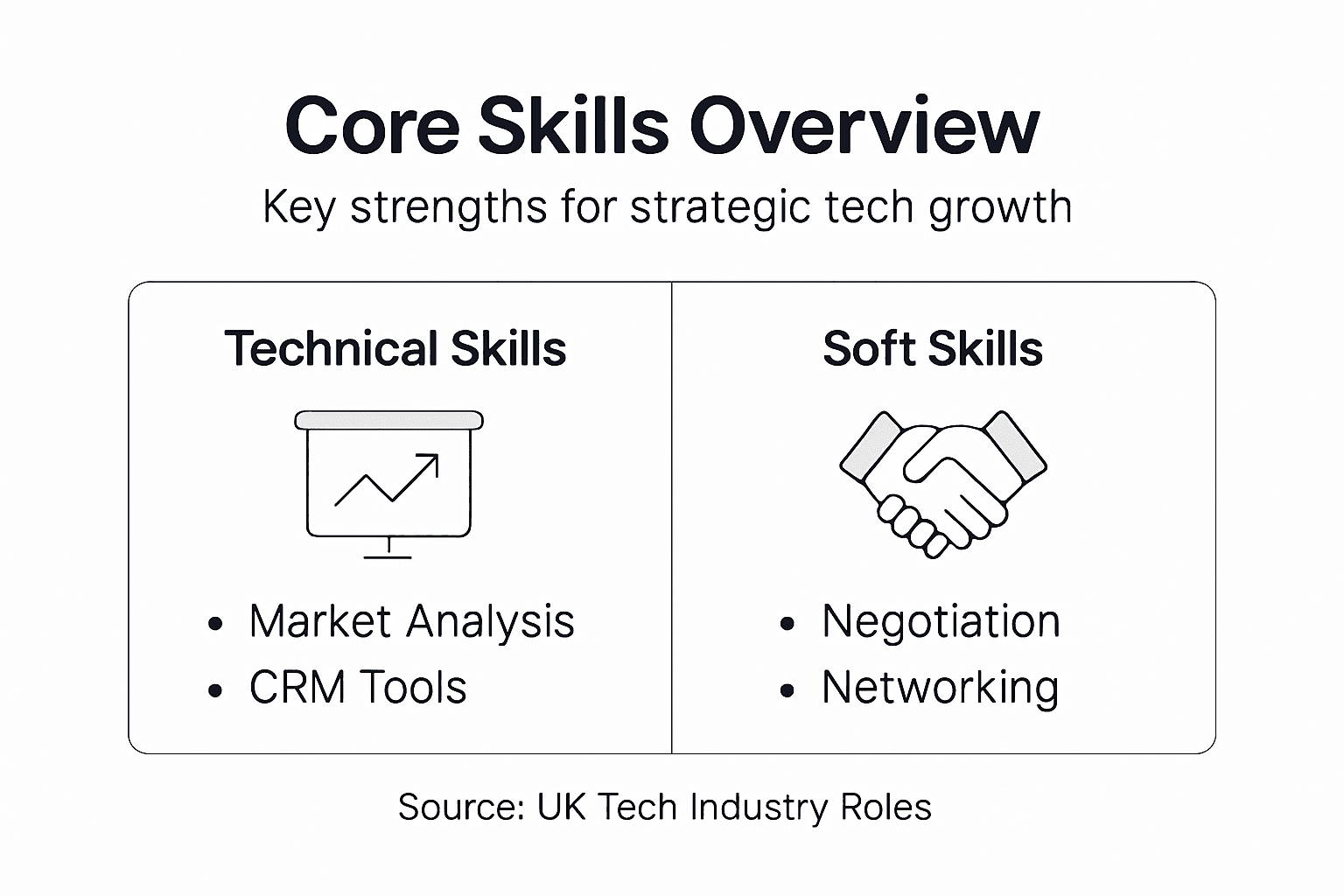
Academic qualifications play a significant role in establishing credibility. Most organisations prefer candidates with a bachelor’s degree in business administration, marketing, economics, or related disciplines. Technical understanding of the specific industry sector is paramount, with employers valuing candidates who can demonstrate strategic thinking, advanced communication skills, and the ability to analyse complex market dynamics. Advanced educational programmes often focus on developing sophisticated skills in strategic partnerships, market research, and comprehensive growth planning.
Beyond academic credentials, the essential skills for a Sales Business Development Manager encompass a wide range of technical and interpersonal competencies. Advanced communication and negotiation skills are critical, alongside proficiency in digital tools, customer relationship management systems, and data analysis platforms. Key competencies include strategic problem-solving, relationship management, commercial acumen, and the ability to develop and execute sophisticated business growth strategies. Practical experience in sales, marketing, or business development can significantly enhance a candidate’s professional profile.
Professional Insight: Invest in continuous learning and seek opportunities that blend theoretical knowledge with practical experience to differentiate yourself in the competitive business development landscape.
Challenges, Pitfalls, and Best Practices
Sales Business Development Managers in the UK tech sector face numerous complex challenges that require strategic navigation and proactive management. Best practices emphasise clearly defining roles and integrating development efforts within broader organisational strategies. The most significant pitfalls emerge from poorly structured processes, misaligned expectations, and a lack of measurable performance indicators that can derail growth initiatives.
One critical challenge is maintaining strategic agility in a rapidly evolving technological landscape. Business development professionals must continuously adapt their approaches, balancing long-term strategic vision with immediate tactical execution. This requires sophisticated skills in market analysis, relationship management, and the ability to anticipate industry shifts. Common pitfalls include over-reliance on traditional sales methodologies, failure to embrace digital transformation, and insufficient investment in continuous professional development.
Successful Sales Business Development Managers mitigate risks by implementing robust performance frameworks, establishing clear communication channels across departments, and developing comprehensive qualification methodologies. Key best practices involve creating sophisticated key performance indicators, fostering cross-functional collaboration, and maintaining a disciplined approach to opportunity assessment. Strategic foresight, combined with rigorous execution and a commitment to ongoing learning, distinguishes exceptional performers in this demanding professional domain.
Professional Insight: Develop a systematic approach to tracking and measuring your business development efforts, ensuring each initiative can be objectively evaluated and refined.
Here is a comparison of common challenges and best practices for Sales Business Development Managers in the UK tech sector:
Challenge | Best Practice Countermeasure | Resulting Benefit |
Process misalignment | Implement strong frameworks | Clearer organisational focus |
Over-reliance on old methods | Adopt digital transformation tools | More agile growth strategies |
Lack of KPIs | Establish performance indicators | Measurable progress |
Communication breakdowns | Foster cross-department dialogue | Improved collaboration |
Skills stagnation | Invest in ongoing training | Sustained individual growth |
Impact on Revenue, Pipeline, and Team Performance
Sales Business Development Managers are critical strategic drivers who directly influence organisational revenue generation and team productivity. Key performance indicators measure strategic impact across multiple dimensions, including revenue growth, qualified lead generation, conversion rates, and market expansion potential. Their role transcends traditional sales functions by establishing a comprehensive approach to business development that aligns tactical execution with long-term strategic objectives.
The impact on revenue generation is multifaceted and extends beyond immediate sales metrics. These professionals create sophisticated pipeline management strategies that transform potential opportunities into sustainable revenue streams. By developing robust qualification methodologies, implementing advanced tracking systems, and fostering cross-functional collaboration, they enable organisations to predict and accelerate growth potential. Their strategic interventions help mitigate risks, optimise resource allocation, and create more predictable revenue generation models.
Team performance is another critical area of influence for Sales Business Development Managers. Tracking collective and individual sales metrics allows for more nuanced performance management, enabling leaders to identify strengths, address skill gaps, and create targeted development programmes. By establishing clear performance expectations, providing strategic guidance, and maintaining a culture of continuous improvement, these professionals drive team productivity and organisational effectiveness.
Professional Insight: Develop a holistic performance tracking system that balances quantitative metrics with qualitative assessments to drive comprehensive team and organisational growth.
Unlock Predictable Growth with Expert Sales Business Development Support
The role of a Sales Business Development Manager in the UK Technology sector demands much more than quick fixes or generic training. Your challenge is to consistently build qualified pipeline, improve win rates, and shorten complex sales cycles while navigating rapid market changes and integrating cross-functional teams. These are exactly the pain points we solve at The Sales Coach Network. We understand that sustainable revenue growth requires more than one-off training events. It calls for embedding scalable, practical sales operating systems that balance strategic direction, enablement, and disciplined execution.
If you want to move beyond reactive selling and embrace a holistic approach to transforming your sales performance, explore our Sales Training Programs and Sales Coaching Services designed specifically for technology teams facing complex growth challenges. Our proprietary frameworks like the Sales Accelerator Method empower your team to develop robust pipelines, lead value-based conversations, and manage sophisticated commercial negotiations successfully. Visit The Sales Coach Network today to start adapting your approach, accelerating your sales velocity, and achieving the consistent growth your organisation deserves.
Frequently Asked Questions
What is the primary role of a Sales Business Development Manager?
The primary role of a Sales Business Development Manager is to drive strategic growth by identifying new market opportunities, establishing partnerships, and developing business strategies that align with organisational goals.
What skills are essential for a successful Sales Business Development Manager?
Essential skills include advanced communication, negotiation abilities, strategic planning, market research expertise, and proficiency in customer relationship management (CRM) systems.
How does a Sales Business Development Manager impact revenue generation?
A Sales Business Development Manager impacts revenue generation by creating and managing sophisticated pipeline strategies, turning potential leads into sustainable revenue streams while optimising resources for predictable growth.
What challenges do Sales Business Development Managers face in the tech sector?
Challenges include maintaining strategic agility in a rapidly evolving landscape, overcoming over-reliance on traditional sales methods, and ensuring effective communication and collaboration across departments.
Recommended