
Enterprise Sales Strategy Guide for Predictable Growth
- The Sales Coach Network
- Jan 1
- 8 min read


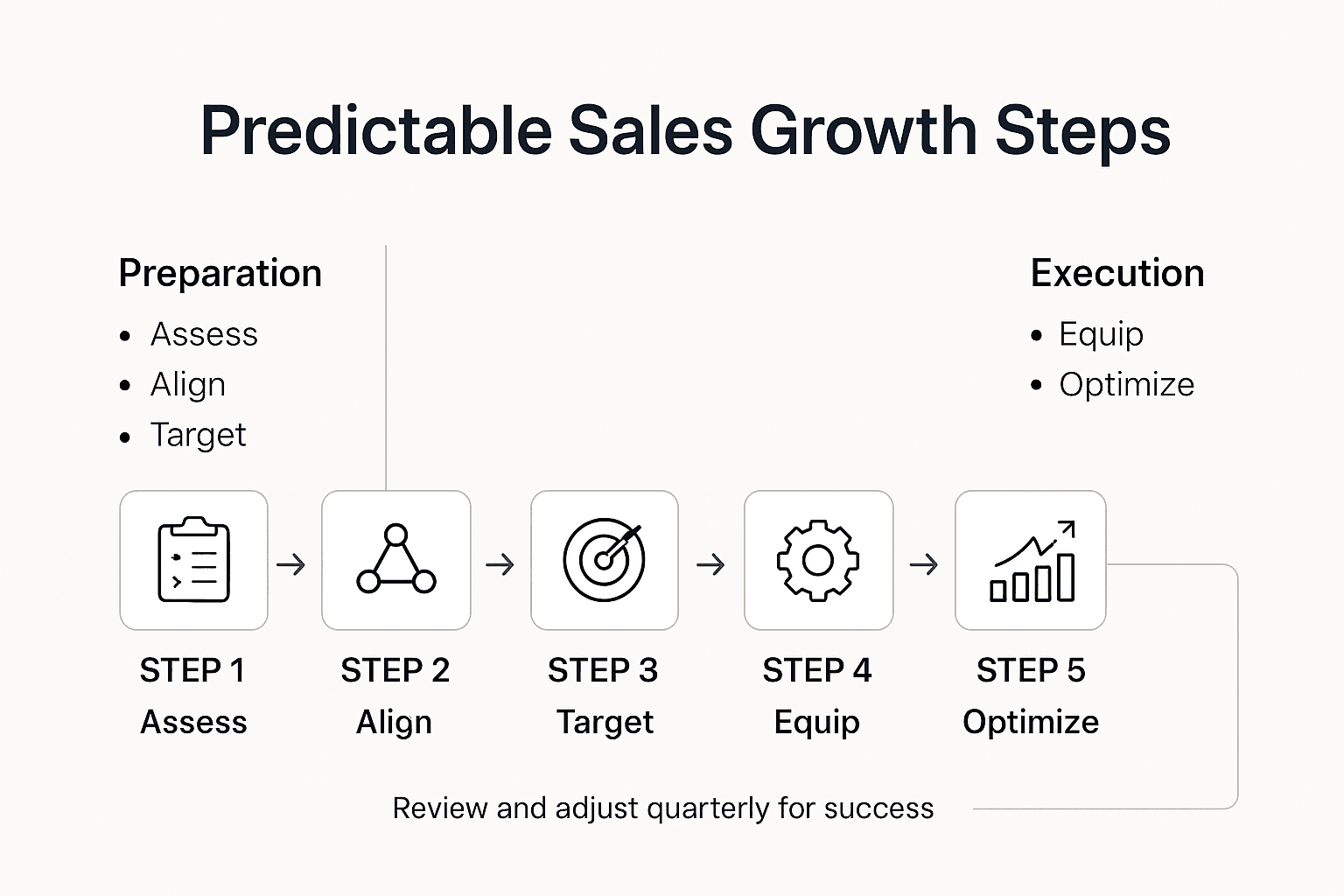
Over 63 percent of British B2B IT leaders say lengthy sales cycles remain their biggest challenge. For CROs and VPs of Sales operating in competitive UK technology markets, sluggish pipelines and complex buying processes can stall growth. This guide breaks down proven steps to assess your sales ecosystem, define clear commercial targets, equip teams with advanced consultative tools, and embed rigorous qualification methods to drive stronger results.
Table of Contents
Quick Summary
Key Point | Explanation |
1. Assess and align sales ecosystem | Systematically evaluate your sales infrastructure to identify strengths, weaknesses, and opportunities for better integration. |
2. Define clear commercial targets | Transform broad business aspirations into specific, measurable revenue goals that align with your overarching strategy. |
3. Equip teams with effective tools | Provide sales teams with strategic resources to enable more personalised, consultative customer interactions. |
4. Implement rigorous qualification | Create a systematic method to evaluate and pursue promising opportunities, distinguishing your organisation from competitors. |
5. Continuously verify and optimise performance | Establish a robust monitoring framework to track progress and adjust strategies for ongoing improvement. |
Step 1: Assess and Align Sales Ecosystem
Assessing and aligning your sales ecosystem represents a strategic foundation for predictable growth. This process involves systematically evaluating your organisation’s sales infrastructure to identify strengths, weaknesses, and opportunities for integration.
Successful sales ecosystem alignment requires a holistic approach that connects people, processes, technology, and strategy. Building resilient organisational ecosystems demands strategic integration across multiple dimensions. Start by conducting a comprehensive audit of your current sales infrastructure, examining how different components interact and support revenue generation.
Begin with a detailed diagnostic process that maps out your current sales capabilities. Evaluate key elements including sales leadership effectiveness, team skills, technological enablement, communication channels, and strategic alignment. Look for potential friction points or disconnects that might impede sales performance. Pay special attention to how different departments and functions interact and whether they support a unified sales approach.

Critical areas to assess include your sales technology stack, training programmes, performance management systems, and collaboration mechanisms. Identify whether these elements work together seamlessly or create unnecessary complexity. The goal is to create a integrated ecosystem where information flows smoothly and sales teams can operate with maximum efficiency.
Below is a summary of critical areas for assessing your sales ecosystem and their potential impact:
Area Assessed | What to Examine | Business Impact |
Sales Technology Stack | Integration and usability | Enhanced efficiency and insight |
Training Programmes | Skill development effectiveness | Improved sales competency |
Performance Management | Metrics and review frequency | Transparent goal tracking |
Collaboration Mechanisms | Cross-team communication | Stronger internal alignment |
Strategic Alignment | Support for organisational aims | Consistent overall direction |
Top tip: Conduct a quarterly ecosystem health check to ensure continuous alignment and identify emerging opportunities for performance improvement.
Step 2: Define Commercial Direction and Targets
Defining your commercial direction and targets is a critical process that establishes the strategic roadmap for your sales organisation. This step transforms broad business aspirations into precise, actionable revenue goals that guide your entire sales strategy.
Strategic sales alignment requires a systematic approach to setting organisational targets that connects high-level business objectives with granular performance expectations. Begin by conducting a comprehensive review of your current market position, competitive landscape, and growth potential. This involves analysing historical performance data, understanding market trends, and identifying realistic yet ambitious revenue opportunities.
The target-setting process demands a multi-dimensional perspective. Break down your overarching revenue goals into specific, measurable targets across different dimensions including geographical markets, product lines, customer segments, and individual sales team performance. Consider both short-term and long-term objectives, ensuring that immediate targets support your broader strategic vision.
Ensure your commercial direction incorporates qualitative and quantitative metrics. Beyond pure revenue numbers, define targets around customer acquisition, market share, product penetration, and customer retention. Align these targets with your organisation’s capabilities, taking into account factors such as existing resources, technological infrastructure, and team skills.
The following table presents quantitative and qualitative sales targets and their strategic benefits:
Target Type | Example Metric | Strategic Benefit |
Quantitative | Quarterly revenue | Objective performance measurement |
Qualitative | Customer retention | Builds long-term business stability |
Quantitative | Market share growth | Demonstrates competitive positioning |
Qualitative | Product adoption rate | Supports innovation and loyalty |
Top tip: Create a dynamic target-setting framework that allows for quarterly recalibration, enabling your sales strategy to remain responsive to changing market conditions.
Step 3: Equip Teams with Consultative Tools
Effectively equipping your sales teams with consultative tools transforms their ability to engage prospects and drive meaningful conversations. This critical step involves providing strategic resources that enable more intelligent, personalised customer interactions.
Advanced sales enablement solutions leverage AI driven insights to enhance buyer engagement and support a more consultative selling approach. Your toolkit should encompass comprehensive technologies that provide real-time customer intelligence, relationship mapping tools, and data-driven conversation guides. Focus on implementing platforms that allow salespeople to understand prospect needs more deeply and craft precisely targeted value propositions.
Consider developing a multifaceted toolkit that includes diagnostic frameworks, interactive presentation materials, value calculators, and industry benchmarking resources. These tools should help your sales team move beyond transactional selling towards meaningful consultative conversations that demonstrate genuine understanding of client challenges. Integrate learning modules that train teams on effectively using these tools, ensuring they can navigate complex sales environments with confidence and strategic insight.
Technology selection matters profoundly. Choose solutions that integrate seamlessly with existing systems, provide intuitive user experiences, and offer actionable insights. Prioritise tools that support collaborative knowledge sharing, enable rapid information retrieval, and facilitate more intelligent client engagement strategies.
Top tip: Conduct regular tool effectiveness reviews, gathering feedback from sales teams to continuously refine and improve your consultative selling resources.
Step 4: Embed Rigorous Qualification and Differentiation
Rigorous qualification and differentiation transform your sales approach from reactive selling to strategic engagement. This critical step focuses on developing a systematic method for identifying and pursuing the most promising opportunities while distinguishing your organisation from competitors.
Understanding how to master the qualification challenge can dramatically improve win rates by ensuring your team spends time on deals with genuine potential. Develop a robust qualification framework that evaluates prospects across multiple dimensions including financial capacity, strategic alignment, decision making authority, and genuine need for your solution.
Implement a structured approach to qualification that goes beyond superficial criteria. Create a comprehensive assessment tool that scores potential opportunities against predetermined criteria. This framework should include both quantitative metrics financial indicators and qualitative assessments such as strategic fit, potential for long term partnership, and alignment with your organisation’s core capabilities.
Differentiation requires a deep understanding of your unique value proposition. Move beyond generic sales pitches by developing a nuanced approach that demonstrates precise understanding of each prospect’s specific challenges. Build a repository of detailed case studies, technical capabilities, and proven outcomes that illustrate your organisation’s distinctive strengths.
Top tip: Create a qualification scorecard that evolves dynamically, allowing your team to continuously refine and improve opportunity assessment criteria based on real world performance.
Step 5: Verify Progress and Optimise Execution
Verifying progress and optimising sales execution represents the critical final stage of transforming strategic planning into measurable revenue growth. This step ensures your carefully developed sales strategy translates into real world performance and continuous improvement.
Strategic sales performance requires comprehensive analytics and adaptive management approaches that enable organisations to track progress and make informed adjustments. Implement a robust monitoring framework that captures granular performance data across multiple dimensions including individual sales representative metrics, team performance, opportunity conversion rates, and revenue generation.
Develop a comprehensive dashboard that provides real time visibility into key performance indicators. This tool should integrate data from multiple sources including customer relationship management systems, financial tracking platforms, and sales engagement technologies. Focus on creating visualisations that highlight both leading and lagging indicators enabling your leadership team to understand current performance and predict future trends.
Establish regular review cycles that go beyond traditional quarterly assessments. Create agile performance management processes that allow for rapid intervention and strategy recalibration. This means developing mechanisms to quickly identify underperforming areas, understand root causes, and implement targeted improvement strategies.
Top tip: Build a continuous feedback loop that connects performance data directly to training and development initiatives, ensuring your sales strategy remains dynamically responsive to emerging challenges.
Unlock Predictable Growth by Aligning Your Enterprise Sales Strategy
The challenges outlined in the Enterprise Sales Strategy Guide for Predictable Growth mirror the obstacles faced by many B2B sales leaders today. From assessing and aligning your sales ecosystem to embedding rigorous qualification and differentiation frameworks, these critical steps highlight the roadblocks that stall predictable revenue and slow sales cycles. If you recognise the frustration of inconsistent pipeline quality or prolonged deal times, you are not alone.
At The Sales Coach Network, we specialise in fixing systemic sales performance problems by embedding scalable sales operating systems. Through our proven Sales Ecosystem Framework and Sales Accelerator Method, we help senior revenue leaders transform strategy into measurable, sustainable growth. Our practical approach equips your teams with consultative tools and advanced qualification techniques you need to accelerate pipeline creation, improve win rates, and reduce sales cycle length.
Are you ready to translate your enterprise sales strategy into consistent revenue outcomes? Discover how our tailored training and coaching services can equip your sales leaders to drive change effectively. Visit The Sales Coach Network now to start building the resilient, high-performance sales organisation your business deserves.
Frequently Asked Questions
How can I assess my current sales ecosystem for predictable growth?
To assess your sales ecosystem, conduct a comprehensive audit of your existing sales infrastructure, identifying strengths, weaknesses, and integration opportunities. Begin by evaluating key elements such as sales leadership effectiveness and technological enablement within the next 30 days.
What metrics should I use to set commercial targets for my sales team?
When defining commercial targets, use both quantitative metrics like quarterly revenue and qualitative measures such as customer retention. Break down these targets across various dimensions to ensure they are realistic and aligned with your organisation’s capabilities.
How do I equip my sales team with effective consultative tools?
To equip your sales team, focus on providing strategic resources like real-time customer intelligence and data-driven conversation guides. Implement a multifaceted toolkit that your team can start using within the first few weeks of the implementation process.
What qualifies as a promising sales opportunity in my qualification framework?
A promising sales opportunity should meet criteria such as financial capacity and strategic alignment with your organisation’s offerings. Develop a scoring system to evaluate opportunities, aiming for regular updates based on real-world performance to enhance accuracy.
How can I verify progress in my sales strategy’s execution?
To verify progress, implement a robust monitoring framework that captures detailed performance data including conversion rates and individual metrics. Create a comprehensive dashboard and establish review cycles to adapt your strategy effectively, ideally within a quarterly timeframe.
What key areas should I focus on for my sales ecosystem health check?
Focus on areas such as your sales technology stack, training programmes, and collaboration mechanisms. Conduct a health check every quarter to ensure continuous alignment and identify opportunities for performance improvements.
Recommended