Sales Leadership
Sales Director Job Description: Winning B2B Talent
The Sales Coach Network21 min read


Defining the Sales Director role in B2B IT is no simple task when the stakes include not just revenue targets, but the long-term strength and agility of your sales organisation. In competitive business centres such as London, Manchester, and Birmingham, attracting the right sales leaders means you must articulate both strategic expectations and leadership accountability in your job descriptions. This guide shares practical steps for capturing the unique blend of strategic selling, team development, and commercial acumen demanded at the top of the United Kingdom’s B2B IT market.
Table of Contents
Key Takeaways
Point | Details |
Sales Director Role | The Sales Director in B2B IT is a strategic leader focused on long-term growth, team development, and customer-centric sales strategies. |
Account Management | Building executive relationships is critical for maintaining and growing strategic accounts, ensuring sustainable revenue. |
Leadership Capability | Effective Sales Directors must possess strong team leadership skills to develop sales talent and improve overall organisational performance. |
Performance Metrics | Success should be measured by sustainable revenue growth and customer satisfaction, rather than just sales quotas. |
Defining the Sales Director Role in B2B IT
The Sales Director in a B2B IT environment sits at a critical intersection between strategic business leadership and hands-on revenue generation. This role extends far beyond hitting quarterly targets. A Sales Director functions as a senior business leader responsible for shaping customer-centric sales strategies, building high-performing teams, and driving sustainable revenue growth that aligns with broader organisational objectives. In the UK’s competitive B2B IT sector, particularly across business hubs like London, Manchester, and Birmingham, the Sales Director must balance multiple responsibilities simultaneously. You’re selling complex technology solutions to enterprise clients, conducting rigorous sector research, analysing competitor positioning, generating qualified pipeline opportunities, and nurturing strategic customer relationships that often span years rather than weeks. This demands both strategic thinking and operational excellence.
What sets the Sales Director role apart from other sales positions is the leadership accountability dimension. You’re not just managing a sales quota; you’re accountable for building organisational capability that sustains performance beyond your own efforts. This means recruiting talent that fits your culture, coaching managers to develop their teams effectively, and embedding the systems and disciplines that separate predictable revenue growth from feast-and-famine cycles. The complex range of responsibilities includes managing client relationships at executive level, negotiating significant contracts, leading teams under pressure, and leveraging digital tools to create competitive advantage. Your sales team looks to you to translate market opportunities into achievable strategies, whilst your C-suite peers expect you to deliver predictable, scalable growth. You’re managing competing demands constantly, working to meet targets and deadlines whilst maintaining the relationships and culture that make your organisation attractive to high-performing talent.
In B2B IT specifically, the Sales Director role demands deep commercial acumen alongside technical credibility. Your clients are senior decision makers evaluating solutions that represent substantial investments and carry real business risk. They expect you to understand their sector challenges, articulate how your technology creates measurable business impact, and lead sophisticated buying committee conversations. This requires coaching your team on consultative selling techniques rather than transactional approaches. You need to build a sales organisation capable of conducting proper needs analysis, developing compelling business cases, and differentiating your offering in crowded markets. The role also demands that you stay current with digital transformation trends, emerging technology adoption patterns, and how these shift buying behaviour. Your competitive advantage comes partly from having the smartest, most disciplined sales team in your market.
What’s particularly important to understand is that Sales Directors in B2B IT operate within a structured revenue machine. You’re responsible for managing the entire sales cycle: originating new qualified opportunities, advancing deals through defined stages, winning competitive pursuits, and then defending and growing existing accounts. Each stage requires different skills from your team, different metrics to track, and different coaching interventions from you as a leader. Many organisations struggle here because they treat the Sales Director role as simply “best salesperson gets promoted”. That approach fails spectacularly. The role demands leadership capability, strategic thinking, and the ability to scale yourself through others. Your success is measured not by deals you personally close, but by the sustainable revenue your organisation generates and the leadership bench strength you build.
Here is a summary of how a Sales Director adds value at different stages of the B2B IT sales cycle:
Sales Cycle Stage | Director’s Key Focus | Typical Challenge | Strategic Value Added |
Opportunity Origination | Market mapping, pipeline build | Identifying true prospects | Focus on quality, not just quantity |
Deal Advancement | Coaching, deal inspection | Navigating complex buying groups | Shortens cycles, improves win rates |
Winning Competitive Deals | Differentiation, negotiation | Overcoming competitor advantages | Maximises solution value, margin |
Account Growth | Executive relationships, upsell | Retaining and growing key customers | Secures long-term revenue, loyalty |
Pro tip When defining your Sales Director role on the job specification, explicitly describe the strategic contributions you expect (not just revenue targets), the team leadership requirements, and the organisational capability the successful candidate must build. This signals to strong candidates that you’re serious about sustainable growth, not just short-term heroics.
Key Responsibilities and Leadership Scope
The Sales Director role sits at the intersection of three distinct domains: strategic commercial leadership, operational sales management, and team development. Your responsibilities span far beyond managing a sales team or hitting revenue targets. You own the entire revenue system, from how pipeline gets generated all the way through to how accounts are nurtured and defended. This breadth is what makes the role both challenging and rewarding. On the strategic side, you’re responsible for developing client-centric, value-driven sales strategies that align with organisational goals and reflect market realities. This means conducting rigorous competitor analysis, understanding shifts in customer buying behaviour, and translating these insights into differentiated go-to-market approaches. You’re not simply executing a corporate strategy handed down from above; you’re actively shaping it. Your sales perspective should influence how the entire organisation thinks about customer value and competitive positioning.

Operationally, your scope includes managing sales targets, driving team performance metrics, and ensuring that your organisation maintains sustainable growth momentum. But here’s where most job descriptions get it wrong. Managing sales targets isn’t about cracking the whip and demanding results from your team. It’s about building the systems, disciplines, and capabilities that make hitting targets inevitable rather than miraculous. This encompasses establishing clear sales methodologies that your team follows consistently, embedding qualification frameworks that prevent wasted effort on unwinnable deals, and creating cadence and accountability structures that keep deals moving. You’re accountable for how your organisation pursues business: the quality of conversations your salespeople have, the rigour applied to opportunity assessment, the sophistication of proposals submitted, and the outcomes achieved. Many struggling sales organisations have talented salespeople but lack the structural discipline required to convert that talent into consistent results.
The leadership and team development dimension often receives the least attention in job descriptions, yet it’s arguably your most important responsibility. You must identify, recruit, and develop sales talent capable of thriving in complex B2B IT environments. This means investing time in coaching your frontline managers, creating a culture where strong performers want to stay, and building the next generation of sales leadership within your organisation. You’re responsible for leading through change and building resilience and agility as market conditions shift rapidly. Your team watches how you respond to setbacks, whether you panic when quarterly targets slip, and whether you stick to your principles or abandon them under pressure. Your behaviour sets the tone for how your entire sales organisation approaches challenges and adapts to evolving customer needs. Additionally, you must maintain awareness of technological changes affecting your customers and how these create new selling opportunities for your organisation.
Your scope also encompasses key customer relationship management at the executive level. Whilst your salespeople manage day-to-day client interactions, you typically own relationships with the largest, most strategic accounts and serve as an executive point of contact for critical customer issues. These relationships require different skills: political awareness, ability to influence without authority, understanding of complex organisational dynamics, and credibility to engage at C-suite level with your customers. You need to conduct sophisticated negotiations on major contracts, manage customer escalations, and identify expansion opportunities within existing accounts. The combination of strategic thinking, operational rigour, and leadership capability is what separates effective Sales Directors from those simply managing by crisis. Your success depends on building an organisation that performs predictably, not one that relies on your personal heroics or heroic efforts from a small group of star performers.
Pro tip When documenting your Sales Director responsibilities, explicitly separate strategic contributions (sales strategy, competitive positioning, revenue model definition) from operational requirements (team targets, pipeline management, deal progression) and leadership expectations (team development, manager coaching, culture building). This clarity attracts candidates who understand the full scope and prevents hiring people who expect to spend 80 percent of their time on personal selling.
Essential Skills, Experience, and Qualifications
Hiring a Sales Director requires looking beyond a candidate’s résumé to assess whether they possess the constellation of skills and experience that translate to sustainable revenue growth. The role demands a unique blend of capabilities that aren’t typically found in junior sales managers or individual contributors. Strategic selling sits at the foundation of what you need. This isn’t transactional selling or closing individual deals. Strategic selling involves understanding customer economics, identifying multi-year revenue opportunities, building relationships across buying committees, and positioning solutions to address executive-level business challenges. Your candidate must demonstrate experience winning large, complex deals where the sales process spanned multiple quarters and involved navigating organisational politics. They should be comfortable engaging with C-suite executives, speaking their language, and earning credibility through commercial acumen rather than product knowledge alone. Equally important is customer management capability. The best Sales Directors view accounts as strategic business portfolios, not just revenue targets. They understand account planning, can identify expansion opportunities within existing customers, and manage the risk of customer attrition. Look for candidates who have grown accounts systematically over time, not those who simply inherited large relationships.
The experience dimension matters significantly. You’re looking for candidates with demonstrated commercial growth success, ideally in B2B IT or complex technology sales environments. Minimum five to seven years in sales roles is typical, but more important is the trajectory and breadth of that experience. Has the candidate sold to different customer segments? Have they built pipeline from scratch, or do they only know how to manage inherited territories? Have they managed teams of varying sizes? Have they been exposed to different sales methodologies and sales leadership approaches? One particularly valuable indicator is key account management experience. A candidate who has managed strategic accounts, coordinated cross-functional teams to deliver customer value, and built long-term partnerships brings credibility when discussing account strategy with your organisation. Additionally, seek evidence of experience developing client-centric sales propositions. This isn’t about glossy presentations or marketing collateral. It’s about a candidate who understands how to translate customer problems into your solution value, who can articulate why your offering matters to specific customer segments, and who has influenced how their previous organisation approached customer conversations. Strong candidates will discuss specific examples of how they repositioned their organisations or their teams around customer value rather than product features.
Team leadership capability is another critical skill area often underestimated in hiring. Many organisations promote their best salesperson without assessing whether they can actually build and develop teams. Your Sales Director candidate should demonstrate experience hiring talent, coaching individuals to improve performance, managing underperformance, and creating cultures where strong performers stay. Ask detailed questions about how they’ve developed their team members. Have they promoted people from within? Have they identified skill gaps and built training programmes to address them? Do they understand the difference between managing performance and developing capability? Additionally, assess their digital tool proficiency. Modern sales organisations operate through customer relationship management systems, pipeline analytics tools, and sales enablement platforms. Your candidate needs to be comfortable with technology and understand how to leverage it to drive visibility and accountability rather than viewing it as bureaucracy. Look for candidates who’ve successfully implemented new sales systems or optimised existing ones.
Whilst formal qualifications matter, they’re less important than demonstrated capability. Many effective Sales Directors lack formal business degrees, though advanced qualifications in business management, sales leadership, or related fields can be valuable. What matters most is that your candidate has completed relevant advanced sales or management training programmes and can discuss how specific methodologies or frameworks have shaped their approach. Questions around sales qualification methodologies, pipeline management approaches, and customer value frameworks will reveal whether they’ve invested in continuous learning. One often-overlooked qualification is resilience and adaptability. Sales Directors in B2B IT navigate rapidly changing market conditions, economic uncertainty, and evolving customer buying behaviour. Your candidate should demonstrate experience adapting to market shifts, leading through uncertainty, and maintaining performance momentum during challenging periods. Finally, integrity and authenticity matter profoundly. You’re hiring someone who will set the cultural tone for your entire sales organisation. Assess whether they operate with transparency, whether they take responsibility for failures, and whether they treat people with respect even when delivering difficult feedback.
Pro tip Create a structured interview process that specifically assesses strategic selling capability, team leadership experience, and customer-centric mindset separately from basic sales competencies. Use scenario-based questions (for example, ask how they would reposition a struggling territory or develop an underperforming manager) rather than relying solely on historical job descriptions. The candidate who articulates a thoughtful approach to these challenges, acknowledges complexity, and demonstrates learning from past experiences is likely stronger than the one with the most impressive title.
Performance Metrics and Reporting Expectations
Defining the right performance metrics for your Sales Director role is deceptively complex. Get it wrong, and you’ll drive behaviours that feel productive but lead nowhere. Get it right, and you create clarity around what success looks like and build accountability into your organisation. The mistake most companies make is conflating activity metrics with outcome metrics. Your Sales Director should be measured primarily on outcomes that matter to your business, not the inputs that theoretically lead to those outcomes. Revenue growth remains the fundamental expectation, but it cannot stand alone. You need a balanced framework that captures different dimensions of performance. Establishing clear objectives aligned with organisational strategy ensures your Sales Director understands how their performance connects to broader business goals. This means defining what revenue growth target is realistic given market conditions and company resources, but also what it means to “grow sustainably” versus chasing revenue at any cost. You should measure customer acquisition metrics alongside customer retention and expansion metrics. A Sales Director who brings in new customers but loses them just as quickly is creating short-term revenue spikes, not building a scalable business. Win rate percentage matters. If your Sales Director’s team is winning 20 percent of opportunities whilst competitors win 40 percent, something is fundamentally wrong with your qualification, positioning, or deal management discipline.
Beyond pure revenue metrics, consider pipeline quality and velocity. These are leading indicators that predict future revenue. A Sales Director managing a pipeline full of unqualified opportunities will inevitably miss forecast. Conversely, a Sales Director with a tightly managed, clearly qualified pipeline creates predictability. You should track average deal size as a separate metric because it reveals whether your organisation is moving upmarket or becoming increasingly dependent on smaller transactions. Sales cycle length matters too. If your B2B IT sales cycles have extended from six months to twelve months without corresponding increases in deal size, your Sales Director needs to diagnose what’s changed in the market or in your sales approach. Team performance metrics matter significantly because your Sales Director’s success is ultimately measured by how well their organisation performs. Are your frontline managers hit their targets? Are individual contributors achieving quota? What’s the attrition rate amongst your salespeople, and does it suggest your Sales Director is building a culture where talent wants to stay? Key performance indicators should be meaningful, measurable, and aligned with company goals, which means avoiding vanity metrics that look impressive but don’t actually predict business success.
The table below compares leading and lagging indicators for measuring Sales Director success:
Indicator Type | Example Metrics | What It Reveals | Business Impact |
Leading | Pipeline quality, deal velocity | Predicts future results | Enables proactive leadership |
Lagging | Revenue, win rate, retention | Shows historical performance | Informs strategy adjustment |
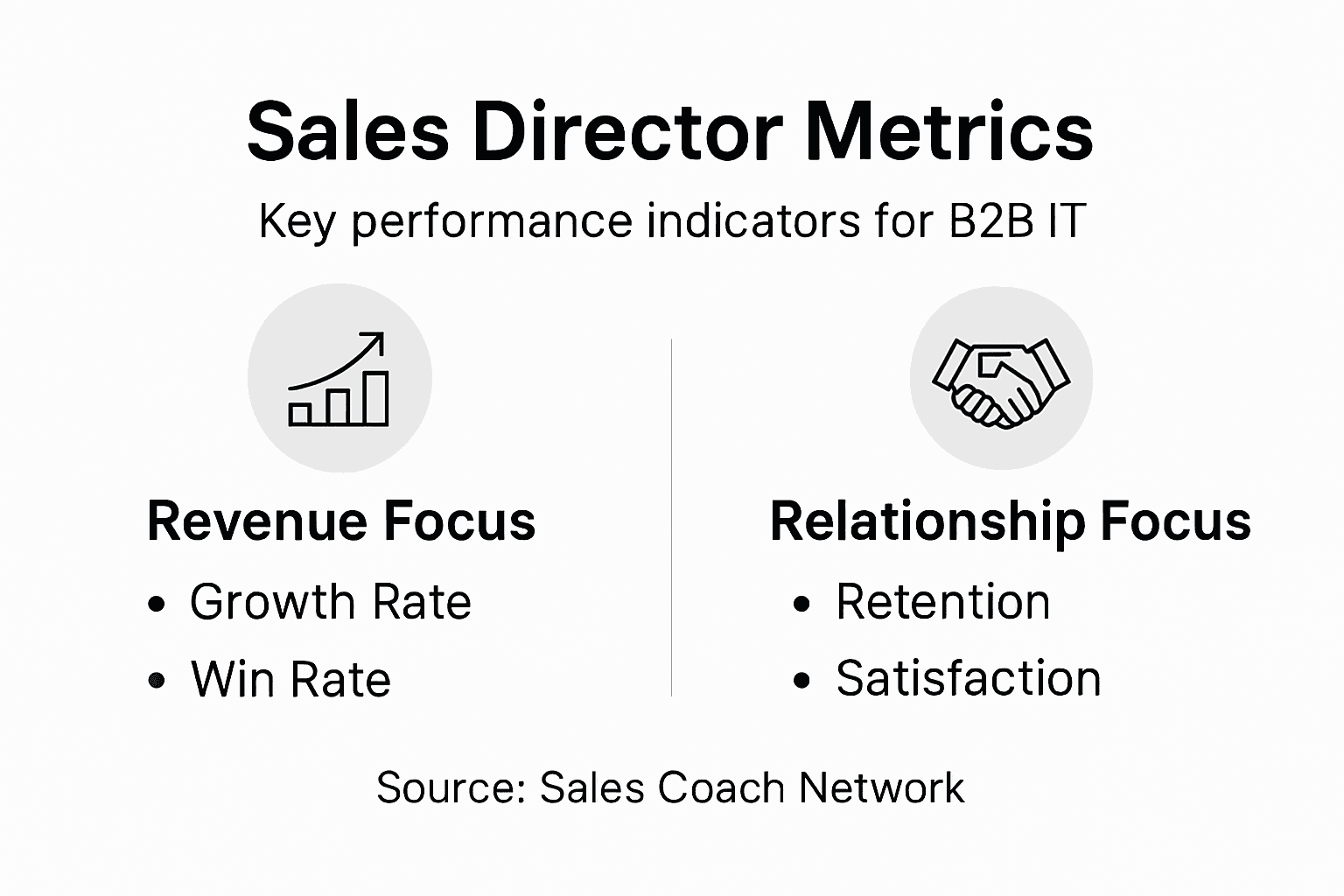
Customer satisfaction and account health metrics reveal whether your Sales Director is building relationships that generate long-term value. Net Promoter Score amongst customers you’ve sold to, customer retention rates, and upsell success all indicate whether your organisation is creating genuine customer value or simply transacting. Market expansion metrics matter if your strategic objective includes entering new vertical markets or geographic regions. Is your Sales Director actively pursuing these opportunities, or are they comfortable working within existing territory patterns? One critical metric that deserves more attention is talent development capability. How many of your Sales Director’s direct reports have been promoted internally? How many have improved their performance through coaching and development? This reveals whether your Sales Director views their role as hitting this year’s number or building next year’s capacity. Your reporting expectations should reflect this balance. Monthly financial reporting obviously matters. Your Sales Director needs to provide transparent reporting on revenue performance, pipeline status, and progress against targets. However, your reporting cadence should also include quarterly strategic reviews where you examine longer-term trends, competitive positioning, and the health of your sales organisation. This isn’t just about what happened; it’s about what it means and what changes might be required.
The reporting framework itself should encourage data-driven decision making rather than excuse-making. A Sales Director who consistently explains away missed targets but never changes approach is unlikely to improve. Conversely, a Sales Director who analyzes what’s working and what isn’t, then adapts strategy accordingly, demonstrates the learning mindset you need. Consider implementing regular review cycles where you review performance data together, discuss implications, and identify specific actions to improve. This creates accountability not just for hitting targets but for understanding performance drivers and taking proactive steps to improve. Be explicit about what metrics you will not tolerate, even if they initially drive revenue. For instance, high-pressure sales tactics that damage customer relationships, aggressive forecasting that creates false reporting, or team turnover caused by unsustainable pressure. These behaviours might produce short-term results, but they undermine the sustainable growth you’re building. Your reporting expectations should communicate that Sales Director success means balancing multiple dimensions of performance: revenue growth, customer value creation, team development, and ethical business practices.
Pro tip Create a simple one-page performance dashboard that your Sales Director updates monthly, showing the five to seven metrics that truly matter to your organisation. Include both lagging indicators (revenue, win rate) and leading indicators (pipeline quality, average deal size trend). Review this together regularly and use it as the foundation for conversations about what’s working and what needs to change. This focus prevents the dashboard from becoming a compliance exercise and makes performance expectations transparent.
Legal Criteria and Employment Essentials in the UK
When crafting your Sales Director job description and recruitment process, legal compliance isn’t optional or secondary. It’s the foundation upon which everything else rests. UK employment law sets specific requirements that protect both your organisation and candidates, and ignoring them creates significant legal and reputational risk. The first critical area is non-discriminatory recruitment practice. This means assessing every candidate fairly, without bias related to age, health, disability, gender, race, religion, sexual orientation, or any other protected characteristic. Your job description itself should avoid language that inadvertently discriminates. For instance, specifying “energetic and youthful” as requirements could discourage older candidates, creating age discrimination even if unintentional. Similarly, listing physical requirements like “must be able to work standing all day” without genuine business justification could exclude candidates with disabilities when reasonable adjustments could accommodate them. Non-discriminatory recruitment practices ensure candidates are assessed fairly based on genuine role requirements and capabilities. Your selection process should evaluate every candidate against the same criteria using consistent methods. If you interview some candidates with a panel and others one-to-one, you’re introducing inconsistency that could be challenged. If you conduct background checks or reference calls for some candidates but not others, you’re creating potential legal exposure. Consistency throughout your recruitment process demonstrates fairness and protects your organisation.
Another crucial element is the reasonable adjustments obligation for candidates with disabilities. UK law requires employers to make reasonable adjustments to recruitment processes to ensure disabled candidates aren’t disadvantaged. This might mean allowing extra time for written assessments, providing documents in alternative formats, permitting candidates to bring support workers to interviews, or adjusting venues to ensure physical accessibility. What’s “reasonable” depends on circumstances, but the principle is clear: disability shouldn’t be a barrier to fair consideration if adjustments can be made without undue burden. Your job description should explicitly state that reasonable adjustments will be made, signalling to disabled candidates that your organisation takes this seriously. Beyond recruitment, UK employment law requires you to provide clear contracts of employment outlining critical terms before or on the first day of work. This written statement of employment particulars must include job title, duties, pay, working hours, leave entitlements, notice periods, and other essential terms. Many employers assume a verbal offer and informal discussion suffice; they don’t. Failing to provide written particulars within two months creates legal risk and demonstrates poor employment practice. For a Sales Director role, your contract should clearly specify base salary, any variable pay or commission structure, expectations around targets and performance, notice periods, and any post-employment restrictions like non-compete or non-solicitation clauses. These restrictions must be reasonable in scope, duration, and geographic area; overly broad restrictions are unenforceable.
References and background checks require careful handling. Your organisation has the right to seek references to verify a candidate’s suitability, but you must obtain the candidate’s written consent before requesting references. References should be factually accurate and fair. An employer who provides a deliberately misleading negative reference, knowing it will damage a candidate’s prospects, can face legal liability. Similarly, if you dismiss a candidate based on information from a reference without giving them opportunity to respond, you could face claims of unfair dismissal. Consider your approach to criminal record checks. For a Sales Director role managing teams and potentially customer relationships, criminal record checks are often justified, but you must follow the proper process through the Disclosure and Barring Service in England and Wales (or equivalent in Scotland and Northern Ireland). You cannot simply reject candidates based on historical convictions without considering the relevance, seriousness, and age of the offence. Whistleblower protection is another important legal consideration. Candidates and employees cannot be subjected to detriment for raising concerns about illegal activity, health and safety issues, or other matters in the public interest. Your recruitment and onboarding process should make clear that your organisation welcomes reporting of concerns and takes them seriously. Trade union membership is similarly protected; you cannot discriminate against candidates or employees because of trade union involvement or activities.
Once you’ve hired your Sales Director, employment law continues to apply. Employment contracts must outline terms including job duties, working hours, pay, and leave entitlements, and employers must comply with statutory requirements around dismissal, redundancy, and workplace conditions. Your Sales Director is entitled to statutory annual leave (minimum 5.6 weeks including bank holidays), statutory sick pay if ill, parental leave if applicable, and protection from unlawful deduction of wages. If you structure bonus or commission payments, ensure the contract clearly specifies how these are calculated and when they’re paid. Vague language like “discretionary bonus” can create disputes. Performance management must be fair and follow proper procedures. If you need to address underperformance, you must give your Sales Director clear feedback, opportunity to improve, and fair hearing if dismissal is considered. Dismissal without following proper procedure, even for genuine performance issues, creates claims for unfair dismissal. Managing sales teams often involves pressure and targets, but ensure your Sales Director isn’t encouraged to drive unethical behaviours or breach employment law within their team. Your organisation can be liable for harassment or discrimination committed by employees if you failed to take reasonable steps to prevent it. Finally, keep employment records. You’re legally required to maintain payroll records, holiday records, and documentation around any disciplinary or capability matters. These records protect both your organisation and your employee if disputes arise.
Pro tip Before finalising your Sales Director job description and recruitment process, have your employment law documentation reviewed by an employment solicitor or HR specialist familiar with UK law. This modest investment prevents costly legal disputes later. Ensure your job description specifies genuine role requirements without discriminatory language, your recruitment process is consistent and documented, your contracts are clear and legally compliant, and your managers understand their legal obligations when managing performance and conduct.
Unlock Sustainable Sales Leadership Success in B2B IT
The article highlights the critical challenge of transforming a Sales Director role from simply a high performer to a strategic leader who builds predictable growth, manages complex sales cycles, and develops high-performing teams. If you are facing frustrations like unpredictable revenue, stalled pipelines, or long sales cycles, you are not alone. The solution lies in embedding scalable sales operating systems that focus on increasing pipeline quality, deal size, and win rates while reducing sales cycle time.
At The Sales Coach Network, we partner with senior sales leaders in B2B IT and technology sectors to solve exactly these problems. Our customised sales training programmes and leadership coaching equip Sales Directors to lead with strategic clarity and operational rigour. We help you implement proven methodologies such as the Sales Accelerator Method and VALID Differentiation Framework that drive sustainable revenue and build resilient sales cultures.
Ready to elevate your sales leadership and transform your organisation’s revenue performance? Explore how our targeted interventions at sales leadership training and embedded coaching can equip your teams to win bigger deals faster with consistent pipeline quality. Don’t wait until the next quarter slips away. Visit The Sales Coach Network now to start building the predictable, scalable sales organisation your market demands.
Frequently Asked Questions
What are the main responsibilities of a Sales Director in a B2B IT environment?
A Sales Director is responsible for developing client-centric sales strategies, managing the entire sales cycle, leading and coaching sales teams, and maintaining executive-level client relationships to drive revenue growth.
What skills and experience are essential for a successful Sales Director?
Key skills include strategic selling, customer management, team leadership, and digital tool proficiency. Candidates should have a proven track record in B2B IT sales, experience with complex deals, and the ability to develop talent within their teams.
How should performance metrics for a Sales Director be defined?
Performance metrics should focus on outcome-based measures like revenue growth, customer retention, win rates, and pipeline quality. Balancing leading and lagging indicators ensures clarity around success and accountability.
What legal criteria must be considered when hiring a Sales Director in the UK?
Employers must adhere to non-discriminatory recruitment practices, provide clear contracts outlining terms of employment, and ensure reasonable adjustments are made for candidates with disabilities. Additionally, compliance with employment laws regarding performance management and workplace conditions is essential.
Recommended