
Sales Qualification Workflow for Predictable Revenue Growth
- The Sales Coach Network
- Dec 8, 2025
- 7 min read


Over 60 percent of British B2B sales teams say wasted time on poorly qualified leads drains their revenue potential. Refining your approach to finding and prioritising the right clients can make or break your success in the crowded British market. This guide reveals how to build and qualify ideal client profiles, map decision makers, diagnose business needs, and validate real sales opportunities that drive truly sustainable growth.
Table of Contents
Quick Summary
Key Point | Explanation |
1. Define Ideal Client Profiles | Identify specific client attributes to enhance revenue generation and pipeline efficiency. Focus on both quantitative and qualitative factors. |
2. Map Stakeholders Effectively | Understanding decision-making roles within client organisations is crucial for navigating complex sales. Engage in genuine dialogue to validate your stakeholder map. |
3. Diagnose Business Needs Thoroughly | Uncover deeper strategic challenges through comprehensive discussions, aiming to understand clients’ true motivations and aspirations. |
4. Prioritise Opportunities Systematically | Develop a rigorous assessment framework for evaluating potential deals, considering multiple dimensions like strategic alignment and resource requirements. |
5. Validate Qualifications Regularly | Implement structured reviews to assess opportunity potential objectively, ensuring you remain responsive to evolving market dynamics. |
Passo 1: Define Ideal Client Profiles and Qualification Criteria
Defining precise client profiles sits at the heart of predictable revenue generation. By identifying the most valuable potential clients who match your service ecosystem, you dramatically improve pipeline efficiency and conversion potential.
To craft an effective ideal client profile, focus on strategic attributes that signify genuine potential. Industry niche and business size become critical markers. You want organisations with demonstrated growth trajectory, financial stability, and alignment with your service capabilities. Consider factors like annual revenue, employee headcount, technological infrastructure, and strategic objectives.
The most powerful profiles combine quantitative and qualitative characteristics. Beyond basic metrics, assess client attributes such as willingness to invest fully in transformative solutions. Look for organisations that value strategic partnerships, demonstrate openness to innovation, and possess internal complexity matching your service sophistication. These organisations will likely become long term, high value clients who understand the true worth of comprehensive sales performance improvement.
Your profile should include precise parameters like:
Annual turnover range
Organisational complexity
Current sales performance challenges
Technology adoption level
Strategic growth ambitions
Remember that an ideal client profile is not static. Regularly review and refine your criteria as market dynamics shift, ensuring your qualification workflow remains sharp and responsive.
Passo 2: Map Stakeholders and Uncover Decision Dynamics
Understanding the intricate web of stakeholders is crucial for navigating complex sales environments. Your goal is to reveal the true decision making architecture within potential client organisations, moving beyond surface level interactions.
Effective stakeholder mapping requires systematic analysis of power dynamics and decision making authority. Start by identifying all individuals involved in the purchasing process. This means looking beyond formal titles to understand informal influence networks. Map out roles such as economic buyers, technical evaluators, champions, gatekeepers, and ultimate decision makers.
Assess each stakeholder’s perspective, interests, and potential conflicts to develop a nuanced understanding. Consider their individual motivations technical requirements professional goals. Create a detailed stakeholder grid that captures:
Levels of power and influence
Potential alignment or resistance to your solution
Personal and organisational objectives
Communication preferences and preferred engagement styles
Pro tip: Always validate your stakeholder map through direct conversations. No organisational chart or preliminary research can replace genuine dialogue with potential client representatives. Your goal is to build a living, dynamic understanding of the decision ecosystem that evolves with each interaction.
Passo 3: Diagnose Business Needs and Value Drivers
Diagnosing business needs goes far beyond surface level conversations. Your mission is to uncover the deeper strategic challenges and opportunities that truly motivate organisational change and investment.

Comprehensive stakeholder mapping provides critical insights into organisational dynamics, revealing the underlying motivations and constraints driving business decisions. Conduct in depth interviews that explore not just operational challenges but strategic ambitions. Ask probing questions that illuminate the broader context such as: What strategic objectives are currently out of reach? What internal barriers prevent your organisation from achieving its full potential?
Leverage decision mapping techniques to explore multiple perspectives and uncover hidden value drivers. Create a multidimensional assessment that captures both quantitative metrics and qualitative insights. Focus on understanding:
Performance gaps and improvement opportunities
Financial and operational constraints
Competitive pressures and market challenges
Leadership priorities and transformation goals
Remember that true value diagnosis requires empathy and deep listening. Your goal is not to pitch a solution but to demonstrate a profound understanding of the client’s unique business context. The most powerful insights emerge when you help clients articulate challenges they might not have fully recognised themselves.
Passo 4: Assess Deal Viability and Prioritise Opportunities
Successful sales teams transform opportunity assessment from a subjective guessing game into a strategic, data driven process. Your objective is to develop a rigorous framework that objectively evaluates potential deals and allocates resources with surgical precision.
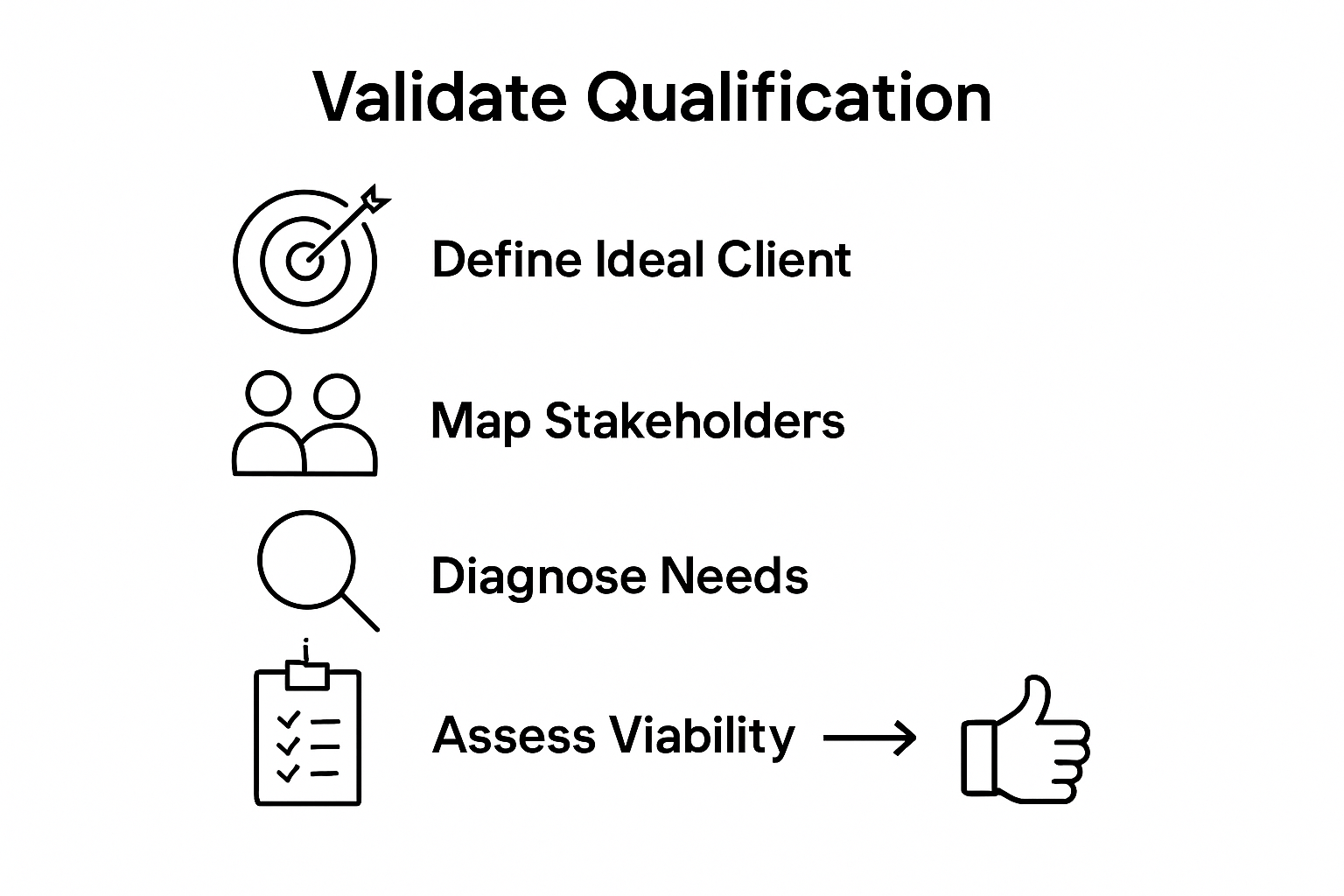
Establishing transparent decision making frameworks enables more effective opportunity evaluation. Create a comprehensive scoring system that considers multiple dimensions beyond traditional metrics. Analyse each potential opportunity through lenses such as strategic alignment, revenue potential, probability of closure, required investment, and long term client value.
Engage key stakeholders to assess the influence and interest levels associated with each potential deal to enhance your prioritisation accuracy. Develop a multifaceted assessment matrix that includes:
Potential deal value and profit margins
Alignment with organisational strategic objectives
Client stakeholder engagement levels
Competitive landscape complexity
Internal resource requirements
Estimated time to closure
Pro tip: Treat your opportunity assessment as a dynamic process. Regularly review and recalibrate your scoring criteria to ensure they remain responsive to evolving market conditions and organisational capabilities.
Passo 5: Validate Qualification with Structured Review
Qualification validation is not a passive administrative task but a critical strategic intervention that separates successful sales organisations from mediocre performers. Your goal is to create a robust, objective assessment framework that scrutinises potential opportunities with surgical precision.
Structured stakeholder review processes enable comprehensive evaluation of opportunity potential through systematic analysis and collaborative assessment. Implement a multidimensional qualification review that goes beyond surface level metrics. Convene cross functional teams to critically examine each potential opportunity against predefined criteria, ensuring a holistic and unbiased perspective.
Develop a rigorous stakeholder mapping approach to assess influence levels and engagement potential across multiple organisational dimensions. Your validation framework should incorporate:
Comprehensive stakeholder power mapping
Detailed decision making pathway analysis
Objective scoring against strategic fit criteria
Risk assessment and mitigation strategies
Clear evidence of client commitment and readiness
Pro tip: Treat your qualification review as a living process. Schedule regular recalibration sessions to refine your assessment criteria, ensuring they remain responsive to evolving market dynamics and organisational capabilities.
Drive Predictable Revenue by Mastering Sales Qualification
The article highlights the critical challenges faced by sales leaders in defining precise client profiles, mapping stakeholders, diagnosing business needs, and rigorously qualifying deals to fuel predictable revenue growth. Many senior revenue leaders struggle with inconsistent pipeline quality, undefined decision dynamics, and opportunity prioritisation – all obstacles that stall growth and inflate sales cycles. By adopting a structured sales qualification workflow, organisations can dramatically increase win rates and reduce time-to-close through disciplined execution.
At The Sales Coach Network, we specialise in solving these exact challenges for complex B2B sales teams. Our proven frameworks and expert coaching equip your sales leadership to embed scalable qualification systems that improve pipeline quality, stakeholder engagement, and opportunity assessment. With tailored sales training and operational methodologies like our Sales Accelerator Method and Client Value Framework, your teams will lead impactful conversations and prioritise deals that truly align with strategic growth ambitions.
Are you ready to fix the systemic issues that block predictable revenue growth? Explore how our Sales Training Programs and Sales Coaching Services provide practical, holistic solutions designed for senior revenue leaders. Begin your journey to transforming sales performance today by visiting The Sales Coach Network. Take decisive action now to accelerate your qualification workflows and achieve sustainable revenue success.
Frequently Asked Questions
How do I define ideal client profiles for my sales qualification workflow?
Defining ideal client profiles involves identifying specific attributes such as industry niche, business size, and organisational complexity. Start by outlining criteria like annual turnover range and sales performance challenges to ensure you target the most valuable potential clients.
What steps should I take to map stakeholders involved in decision-making?
To effectively map stakeholders, begin by identifying all individuals involved in the purchasing process, including their roles and influence. Create a stakeholder grid that captures their perspectives, interests, and potential conflicts, which will inform your engagement strategy.
How can I uncover business needs and value drivers during the qualification process?
To uncover business needs, conduct in-depth interviews that explore both operational challenges and strategic ambitions. Ask open-ended questions about organisational barriers and opportunities, and look for insights that highlight the client’s deeper motivations for investment.
What criteria should I use to assess deal viability in my sales qualification workflow?
Assessing deal viability requires a scoring system that evaluates strategic alignment, revenue potential, and probability of closure. Consider both quantitative and qualitative factors, and regularly review these criteria to ensure they adapt to changing market conditions.
How can I validate client qualification effectively in my sales process?
To validate client qualification, implement a structured review process that involves cross-functional teams. Convene regular sessions to scrutinise opportunities against predefined criteria, ensuring a comprehensive and objective evaluation of each potential client.
Recommended