Selling Skills
When Everyone Sounds the Same: The Sales Skills AI Can't Replace
Les Bailey6 min read

Are your sellers using the same AI tools, the same research, and the same language as every competitor your clients meet? Are more of your deals stalling, slipping or ending in no decision, even though your team has never had more information at its fingertips?
If so, you’re in the right place.
In this article, you’ll learn why AI is levelling the field in B2B selling, and why that leaves trust and human capability deciding who wins. It draws on our new point of view paper, When Everyone Sounds the Same, Your People Are the Difference, which sets out the 12 capabilities your sales team needs to win more business in the age of AI. You can download the paper free from our Learning Centre.
What AI changes in a seller’s job
AI is taking the research and the first drafts off a B2B seller’s desk, and buyers still want a person to test what it tells them. Gartner found that 69% of B2B buyers turn to sales reps to validate AI-generated insights. So the seller’s job is moving towards judgement and the conversation itself.
Bain & Company has a name for the seller who lets AI prepare the ground. Bain describes the super seller as someone who spends nearly all of their working hours on the parts of selling that truly matter: “judgment, relationships, and deal strategy.”
Candidly, we use these tools ourselves. Most AI investment in sales so far has gone into efficiency: more activity, more automation, more content, faster. Those gains are real, but your competitors get them too. The return on that investment now depends on effectiveness: what your people do with the time AI gives back, in the conversations where deals are won and lost.
Why AI makes every seller sound the same
The tools are now everywhere. Bain & Company found that more than 90% of commercial organisations have already scaled at least one AI use case. Buyers use them too: Forrester’s 2026 research found that 94% of business buyers use AI during their buying process, and that risk-averse buyers now “demand proof, not promises.”
Put those together and you get the problem in the paper’s title. Your sellers and your competitors’ sellers now arrive with the same account insights, the same point of view, and the same polished follow-up email. When buyers ask the same AI tools about every supplier, and sellers use the same AI to write their pitches, the sameness only gets worse. AI makes sellers more efficient. On its own, it doesn’t make them more effective.
When every supplier sounds alike, the safest choice for a buyer is often to wait. Buying has become harder, and the biggest competitor is no decision. Our guide to why sales teams fail looks at how deals end up there, and we keep more of the research on our AI in sales statistics page.
The sales skills AI can’t replace
The paper sets out 12 capabilities that decide which B2B sales teams win when every team has the same AI. They fall into two groups. Five are commercial capabilities: how your team chooses, builds and wins the right opportunities. Seven are human skills: how each seller behaves in the conversation itself. The common thread is the quality of your sellers’ conversations with buyers.
Commercial Capabilities: How Your Team Wins the Right Deals
- Commercial Acumen. Connecting what you sell to the way your client’s organisation operates and makes money.
- Qualification. Consistency and rigour in deciding which deals to pursue.
- Navigating the Organisation. Building consensus across many stakeholders, each with their own agenda and each able to say no.
- AI Fluency. Knowing what to delegate to AI tools and agents, and how to interrogate what comes back.
- Continuous Improvement. Keeping your team competent and relevant as the market moves.
Human Skills: How Your People Earn the Right to Win
- Storytelling and the Case for Change. Most buying decisions are made in rooms your sellers never enter. The case for change must be memorable enough for the buyer to repeat it accurately to colleagues.
- Building and Restoring Trust. Staying client-centric so critical information keeps flowing.
- Judgement. AI will give a seller 20 insights about an account. The buyer only needs the three that matter.
- Curiosity and Diagnosis. Diagnose before you prescribe. Buyers arrive with a self-diagnosis shaped by their own research and AI, and sellers who accept it at face value risk solving the wrong problem.
- Active Listening. Responding to the conversation you’re in, not the one you prepared.
- Constructive Challenge. The courage and evidence to challenge a buyer’s thinking when it matters.
- Handling Difficult Conversations. Price, risk, delays, and bad news are part of every complex sale. Handled in a client-centric way, they build trust rather than diminish it.
For each of the 12, the paper shows what good looks like in a real sales conversation, so you can judge where your own team stands.
Download the paper to see what good looks like for each capability
Why trust comes before differentiation
Buyers only value differences they can see and that matter to them. Everything else is noise. You can only find out what matters when the buyer tells you, and buyers only open up when they feel safe. That’s why trust comes first.
We teach the Trust Equation under our formal partnership with Trusted Advisor Associates. Trusted Advisor Associates’ Trust Equation, first set out in The Trusted Advisor (Maister, Green and Galford, 2000), breaks trustworthiness into four elements. The four are Credibility, Reliability, Intimacy and Self-Orientation.
More than 400,000 professionals have completed Trusted Advisor Associates’ Trust Quotient (TQ) assessment. Ironically, most professionals work hardest on the part of trust they’re already good at, rather than working on what they need to improve. The paper names the element that does most for overall trustworthiness, with the figures on how rarely it shows up as a strength.
Differences only count if the buyer values them, and buyers only tell you what they value when they trust you. The paper shows how trust and value work together in a sales conversation, and sets out the test we use to check whether a differentiator counts in the buyer’s eyes.
How a sales team builds these skills
Each of the 12 capabilities is a set of behaviours, and behaviours can be learned, practised and measured. Many leaders believe great sellers are born, not made. Our experience says otherwise. Even trust can be measured: the Trust Quotient gives every seller a personal baseline, and gives you a view across your team of where trust is strong and where it’s weak.
Most sales training fails because of how it’s delivered, not what it contains. One-off events with too much theory rarely survive the first busy week back in the market, and leaders are left with a cost and no change in results. Capabilities stick when sellers learn the principle, then the process that supports it, then practise it on live opportunities, with coaching from their managers, until it becomes routine. That’s why our sales skills training is built around applying the skills to live deals.
Where to start
The paper is free to download from our Learning Centre. Inside, you’ll find:
- what good looks like for each of the 12 capabilities in a real sales conversation
- the Trust Quotient findings on the part of trust that’s rarest, and why it carries so much weight
- how trust and value work together in a sales conversation, and the test we use to decide whether a difference counts
- an example of two sellers with the same AI briefing, pursuing the same Chief Operating Officer, and why only one of them wins
- five questions to ask about your own sales organisation before you decide whether it needs to change
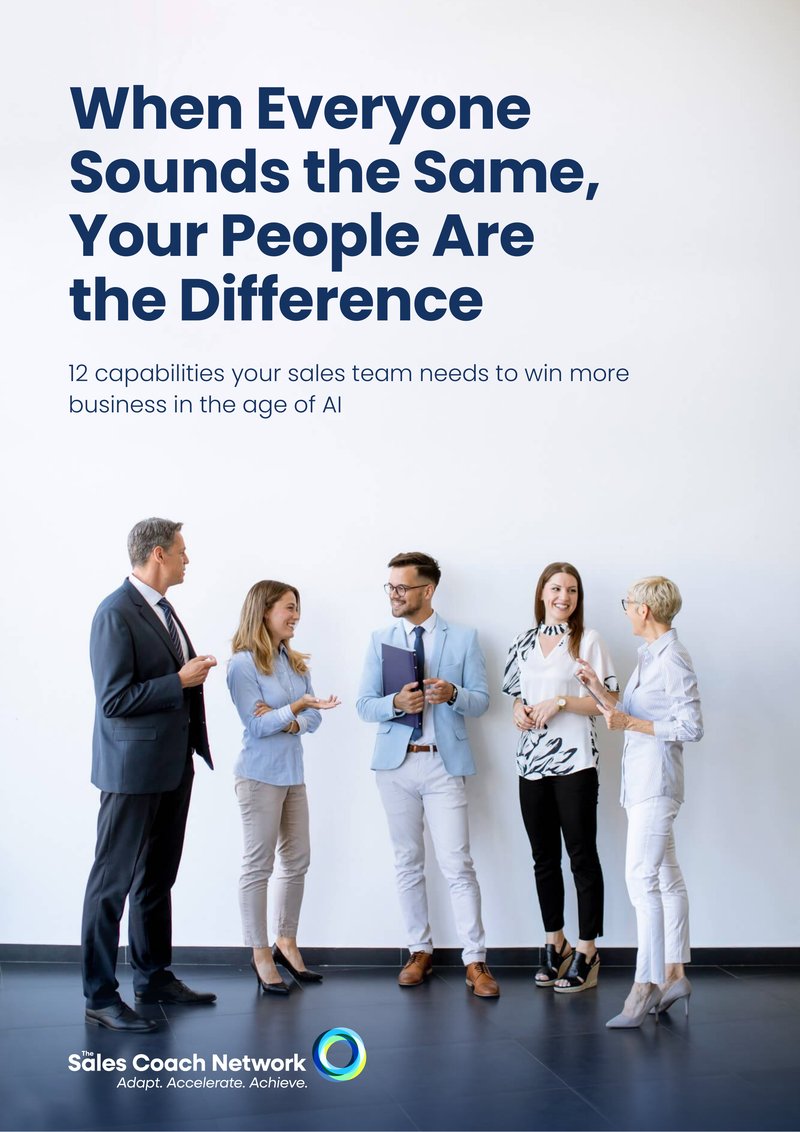
Download When Everyone Sounds the Same, Your People Are the Difference
If you’d like a view of your own team first, the Sales Team Self-Assessment takes a few minutes and shows where the gaps sit. And if any of this sounds like your pipeline, book a call and we can talk it through.
Les Bailey is CEO and Founder of The Sales Coach Network.