

Over 60 percent of british B2B sales teams report that lengthy sales cycles make it difficult to drive consistent revenue growth. For Sales Training Managers, these challenges highlight the urgent need for smarter strategies that increase team agility and long-term impact. This article unpacks the evolving responsibilities, critical skills, and assessment methods british firms are adopting to position their sales training leaders at the core of organisational success.
Table of Contents
Key Takeaways
Point | Details |
Role of Sales Training Manager | They develop and manage sales training programmes to enhance team performance and drive revenue growth. |
Importance of Tailored Training | Training should address specific skill gaps and align with organisational goals to ensure effective outcomes. |
Continuous Assessment | Regular evaluation of training effectiveness through performance metrics and feedback is crucial for ongoing improvement. |
Avoiding Short-Term Focus | Successful managers prioritise sustainable growth strategies over immediate sales results to maintain team morale and productivity. |
Defining the Sales Training Manager Role
A Sales Training Manager is a strategic professional responsible for developing, implementing, and managing comprehensive sales training programmes that enhance team performance and drive organisational revenue growth. Sales managers organise and lead sales representatives towards achieving critical business targets, combining leadership skills with deep market expertise.
The role encompasses multiple critical responsibilities, including curriculum design, performance assessment, skills development, and coaching. Sales Training Managers must possess a nuanced understanding of both sales methodologies and adult learning principles. They analyse team performance data, identify skill gaps, and create targeted training interventions that address specific organisational challenges. Their work goes beyond traditional training by developing robust learning ecosystems that support continuous professional development.
Key responsibilities typically include developing comprehensive training materials, conducting workshops, providing individual and group coaching, tracking performance metrics, and collaborating with sales leadership to align training programmes with strategic objectives. Successful Sales Training Managers understand that effective training is not about delivering content, but about facilitating meaningful behavioural change that translates directly into improved sales performance.
Pro tip: Continuously update your training approach by regularly speaking with top-performing sales representatives to understand emerging market challenges and skill requirements.
Key Responsibilities in Large B2B Teams
In large B2B sales environments, the Sales Training Manager plays a pivotal role in driving team performance through strategic oversight and targeted development initiatives. Sales managers are responsible for coaching and leading teams towards achieving complex organisational targets, requiring a multifaceted approach to team management and skill enhancement.
The core responsibilities encompass several critical dimensions of sales team development. This includes designing and implementing comprehensive training programmes that address specific skill gaps, developing tailored learning resources, and creating assessment frameworks that measure individual and collective performance. Sales Training Managers must also collaborate closely with senior leadership to align training strategies with broader business objectives, ensuring that development initiatives directly contribute to revenue generation and market expansion.
Operationally, the role demands exceptional communication and analytical skills. Responsibilities include conducting performance reviews, identifying high-potential team members, designing career progression pathways, and creating mentorship programmes that support continuous professional growth. They must also stay abreast of emerging sales methodologies, market trends, and technological innovations that can enhance team effectiveness in increasingly complex B2B sales landscapes.

Pro tip: Implement a quarterly skills audit to systematically identify and address evolving competency requirements across your sales team.
Essential Skills and Qualifications Needed
Successful Sales Training Managers require a sophisticated blend of technical knowledge, interpersonal skills, and strategic capabilities. Professional qualifications in business sales provide a strong foundation for those aspiring to excel in this complex role. These professionals must demonstrate exceptional leadership abilities, combining deep sales expertise with advanced training and coaching competencies.
The technical skillset involves profound understanding of sales methodologies, advanced digital literacy, and data analysis capabilities. Candidates typically need extensive experience in B2B sales environments, with a proven track record of achieving challenging revenue targets. Key competencies include advanced communication skills, the ability to develop comprehensive training curricula, performance management expertise, and a strategic approach to team development. Emotional intelligence plays a critical role, enabling managers to understand individual team member motivations and design personalised development pathways.
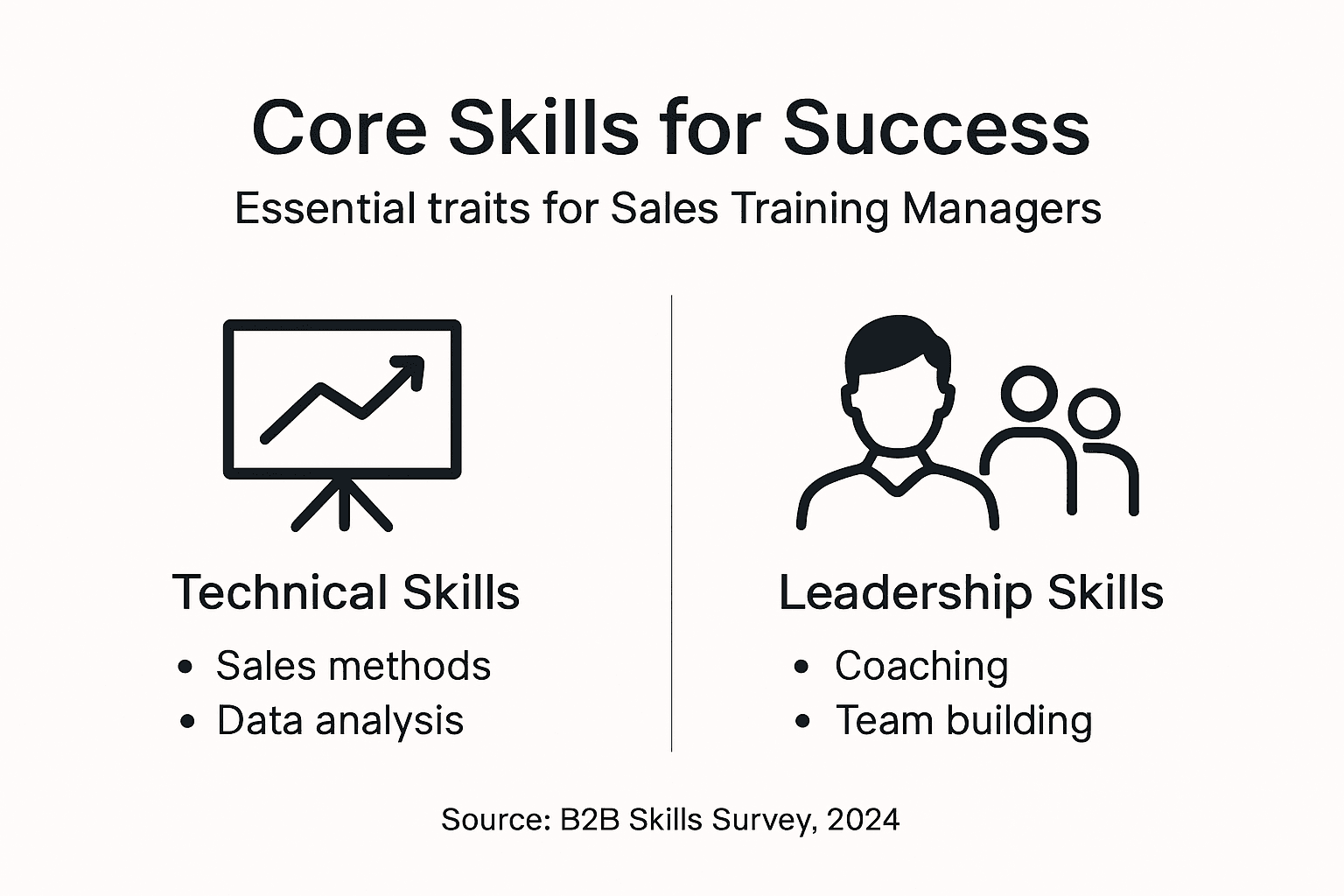
Qualifications often range from undergraduate business degrees to specialised sales leadership programmes, with many organisations valuing practical experience over formal academic credentials. Professional certifications in sales training, coaching methodologies, and leadership development can significantly enhance a candidate’s profile. Successful Sales Training Managers must also demonstrate adaptability, continuous learning mindset, and the capacity to navigate complex organisational dynamics while driving meaningful performance improvements.
Here is a summary of the critical skills and relevant qualifications for Sales Training Managers:
Skill/Qualification | Description | Business Impact |
Advanced sales expertise | Deep knowledge of B2B sales methodologies | Increases team win rates |
Leadership and coaching | Ability to motivate and mentor staff | Boosts performance and retention |
Data analysis proficiency | Interprets sales and training metrics | Enables informed decision-making |
Professional certifications | Accredited training and leadership awards | Enhances industry credibility |
Pro tip: Invest in continuous professional development by attending industry conferences and completing advanced sales leadership certification programmes.
Methods for Assessing Training Effectiveness
Evaluating the impact of sales training requires a comprehensive and strategic approach that goes beyond traditional measurement techniques. Assessment methods must align with learning objectives to provide meaningful insights into training programme effectiveness. Sales Training Managers need a multifaceted framework that captures both quantitative performance metrics and qualitative behavioural changes.
The most robust assessment strategies incorporate several key dimensions of evaluation. These include pre and post-training performance comparisons, direct sales performance metrics, behavioural observation, participant feedback surveys, and longitudinal tracking of individual and team outcomes. Quantitative measures might involve analysing sales volume, deal closure rates, average deal value, and pipeline conversion rates before and after training interventions. Qualitative assessments can include structured observations of sales interactions, peer and management feedback, and self-reflection exercises that capture individual skill progression.
Advanced assessment techniques also leverage data analytics and performance management tools to create nuanced, holistic evaluations. This involves developing sophisticated tracking mechanisms that connect training interventions directly to business outcomes, using key performance indicators that demonstrate tangible returns on training investments. Successful Sales Training Managers use a combination of real-time performance data, skills assessments, and strategic feedback loops to continuously refine and improve their training methodologies.
Pro tip: Implement a 90-day post-training tracking system that measures specific behavioural changes and performance improvements across multiple dimensions.
Leadership, Coaching and Revenue Impact
Sales Training Managers play a pivotal role in driving organisational revenue through strategic leadership and targeted coaching interventions. Workplace coaching demonstrates substantial performance impact by creating a culture of continuous improvement and skill development. This approach transforms traditional management practices into dynamic, performance-focused leadership strategies.
Effective coaching goes beyond conventional performance management, focusing on individual potential, skill enhancement, and holistic team development. Sales Training Managers must leverage sophisticated leadership techniques that combine emotional intelligence, strategic thinking, and data-driven performance insights. This involves creating personalised development pathways, providing constructive feedback, and establishing clear performance expectations that align with broader organisational objectives.
The connection between leadership coaching and revenue generation is profound and multifaceted. By investing in targeted coaching programmes, organisations can unlock significant performance improvements, reduce sales team turnover, and create a more adaptable, resilient workforce. Successful Sales Training Managers understand that coaching is not a one-size-fits-all approach but a nuanced process of understanding individual motivations, addressing skill gaps, and creating an environment of continuous learning and professional growth.
Pro tip: Develop a structured coaching framework that includes quarterly individual development plans and regular performance feedback sessions.
Common Pitfalls and How to Avoid Them
Sales Training Managers frequently encounter complex challenges that can significantly impact team performance and organisational effectiveness. Managing pressure to meet sales targets requires strategic approaches that balance immediate performance needs with long-term team development objectives.
One critical pitfall is overemphasising short-term sales results at the expense of sustainable growth strategies. This myopic approach can lead to burnout, decreased team morale, and inconsistent performance. Successful Sales Training Managers must develop holistic performance frameworks that integrate individual skill development, motivational techniques, and clear career progression pathways. This involves creating nuanced coaching strategies that address both individual and collective team needs, ensuring that performance expectations are challenging yet achievable.
Another significant challenge involves maintaining team motivation and engagement during periods of market volatility or organisational change. Effective leaders must cultivate resilience, foster open communication, and develop adaptive leadership strategies that can quickly respond to emerging challenges. This requires a sophisticated understanding of team dynamics, individual psychological needs, and the ability to create a supportive learning environment that encourages continuous professional growth and skill enhancement.
Below is a comparison of common pitfalls and effective solutions for Sales Training Managers:
Challenge | Consequence | Effective Solution |
Overemphasis on short-term targets | Staff burnout and low morale | Implement long-term development |
Poor team motivation | Reduced engagement | Foster open communication |
Lack of adaptability | Missed market opportunities | Develop flexible strategies |
Pro tip: Implement a monthly peer review and coaching system that allows team members to share challenges, provide mutual support, and collectively develop problem-solving strategies.
Empower Your Sales Training Management for Measurable B2B Success
The role of a Sales Training Manager is complex, balancing leadership, detailed performance analysis, and the creation of sustainable behavioural change. This article highlights the challenges of developing targeted training programmes that increase pipeline, win rates, and team engagement within large B2B sales teams. If you recognise the pressure to deliver predictable revenue growth while elevating your sales managers’ coaching capabilities, you know generic training will not suffice.
At The Sales Coach Network, we specialise in partnering with senior sales leaders to embed scalable sales operating systems that address these exact challenges. Through our leadership sales training and advanced sales coaching services, we apply a holistic methodology focused on strategy, enablement, and disciplined execution. Our proven frameworks such as the Sales Ecosystem Framework and Sales Accelerator Method help organisations like yours avoid common pitfalls like short-term target overemphasis and low team motivation, ensuring long-term, measurable uplift in sales velocity.
If you want to move beyond one-off programmes and build a high-performing B2B sales force led by empowered sales training managers, explore how to enhance your team’s skills and results by visiting Sales Training Solutions. Discover our tailored leadership sales training designed for real-world impact and start transforming your sales performance today.
Frequently Asked Questions
What are the primary responsibilities of a Sales Training Manager?
A Sales Training Manager is responsible for developing and managing sales training programmes, conducting workshops, coaching sales teams, and tracking performance metrics to drive organisational revenue growth.
What skills are essential for becoming a successful Sales Training Manager?
Successful Sales Training Managers require advanced sales expertise, strong leadership and coaching abilities, data analysis proficiency, and emotional intelligence to effectively support and develop their sales teams.
How can the effectiveness of sales training be measured?
The effectiveness of sales training can be measured through pre and post-training performance comparisons, sales performance metrics, participant feedback surveys, and longitudinal tracking of skills and team outcomes.
What common challenges do Sales Training Managers face?
Common challenges include balancing short-term sales targets with long-term development goals, maintaining team motivation during market changes, and ensuring adaptability in training strategies to meet evolving needs.
Recommended