Sales Management
The Essential Guide to the Role of Manager Coaching
The Sales Coach Network7 min read


Over 60 percent of british sales managers now prioritise coaching over traditional supervision, reshaping how sales teams achieve results. As sales environments grow more complex, many leaders find that adapting their approach is not just helpful but essential. Understanding the shift towards manager coaching helps sales professionals and organisations keep pace, develop new skills, and build high-performing teams built on collaboration and growth.
Table of Contents
Key Takeaways
Point | Details |
Manager Coaching Transforms Leadership | This approach shifts from traditional management to a collaborative, developmental method that enhances performance and supports growth. |
Diverse Coaching Styles | Adapting coaching styles—directive, supportive, collaborative, developmental, and performance-focused—helps meet individual team members’ needs. |
Core Responsibilities | Effective manager coaching involves creating a safe learning environment, providing personalised feedback, and encouraging self-reflection for professional growth. |
Avoiding Common Pitfalls | Managers should be cautious of generic advice and ensure frequent, consistent coaching interactions to support effective development. |
Defining Manager Coaching in Sales Leadership
Manager coaching represents a fundamental transformation in sales leadership, shifting from traditional directive management towards a collaborative, developmental approach. According to research from Sussex University, managers can employ coaching skills to enhance individual performance, support professional growth, and systematically address performance challenges within sales teams.
At its core, manager coaching is a strategic interaction where sales leaders actively guide, support, and develop their team members’ capabilities. As highlighted by Imperial College London, this approach integrates coaching directly into managerial responsibilities, creating a more collaborative and performance-driven sales environment. The objective goes beyond mere performance monitoring; it focuses on empowering individual sales professionals to unlock their potential and achieve sustainable improvement.
Effective manager coaching encompasses several critical dimensions:
Personalised performance guidance
Continuous skill development
Constructive feedback mechanisms
Proactive problem-solving strategies
Individual capability enhancement
By embracing this nuanced leadership approach, sales organisations can transform traditional hierarchical structures into dynamic, learning-oriented ecosystems. Sales Coaching for Managers: Complete Expert Guide provides deeper insights into implementing these sophisticated coaching methodologies that drive meaningful organisational growth.
Key Approaches and Coaching Styles Explained
Sales leadership coaching encompasses multiple sophisticated approaches that enable managers to drive performance and develop their teams effectively. Understanding these diverse coaching styles allows sales leaders to adapt their strategies to individual team members’ unique needs, learning preferences, and professional development trajectories.
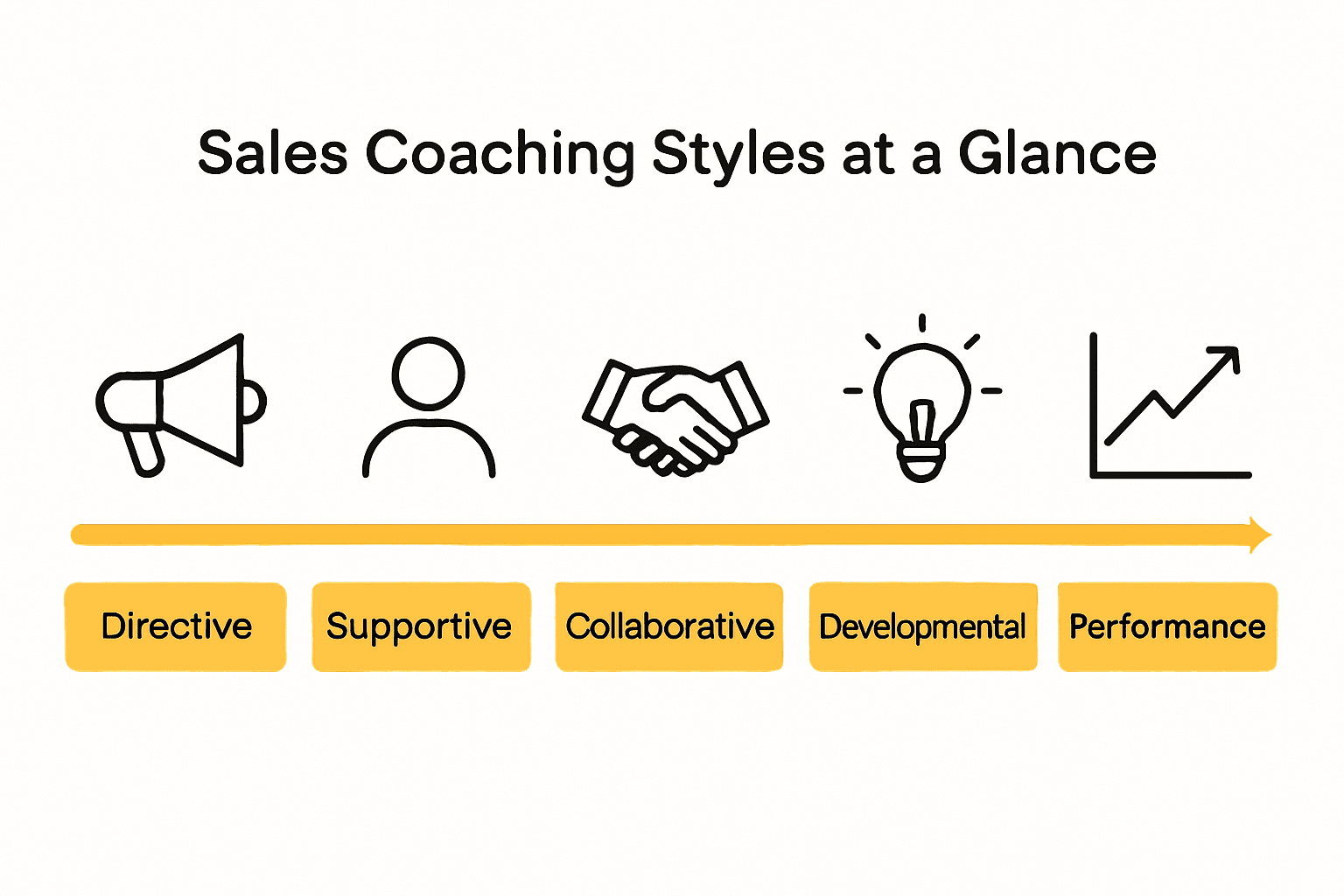
Five primary coaching approaches emerge as critical in modern sales leadership:
Directive Coaching: Providing specific, prescriptive guidance and clear instructions
Supportive Coaching: Offering emotional support and encouragement
Collaborative Coaching: Working alongside team members to jointly solve challenges
Developmental Coaching: Focusing on long-term skill progression and career growth
Performance Coaching: Targeting immediate performance improvement and skill refinement
Each coaching style serves a distinct purpose in developing sales professionals. Some team members might require more structured, directive approaches, while others thrive under collaborative, exploratory coaching methods. Why Coaching Beats Training: Complete Guide for UK Leaders provides deeper insights into selecting the most appropriate coaching approach for different sales team scenarios.
Successful sales managers understand that flexibility is key. They must seamlessly transition between these coaching styles, recognising that effective leadership involves reading individual team dynamics, understanding personal motivations, and tailoring their approach to maximise each sales professional’s potential. The goal is not just performance improvement, but creating a culture of continuous learning, personal growth, and collective achievement.
How Manager Coaching Drives Sales Performance
Manager coaching represents a transformative approach to driving sales performance by systematically addressing individual and team capabilities. According to StudySmarter, personalised coaching plans can significantly enhance sales outcomes by aligning individual goals with broader business objectives through sophisticated methodologies like the GROW model and situational leadership techniques.
Effective sales performance coaching involves several critical mechanisms:
Identifying individual performance gaps
Developing targeted skill enhancement strategies
Creating personalised development pathways
Implementing regular performance feedback loops
Establishing measurable performance improvement objectives
TSW Training highlights specific coaching techniques that directly impact performance, such as the ‘Five Whys’ method and ‘Unpacking-Priorities’ approach. These strategies enable managers to address performance issues systematically, improve time management, and create a more accountable sales environment.
Ultimately, manager coaching transforms traditional performance management from a punitive process into a collaborative, growth-oriented dialogue. Role of Sales Managers in Coaching: Complete Guide provides deeper insights into how this approach creates a culture of continuous improvement, where sales professionals are empowered to recognise their potential, overcome challenges, and consistently exceed performance expectations.

Manager Coaching Responsibilities and Best Practices
Manager coaching demands a sophisticated approach to leadership that goes beyond traditional performance management. According to Sussex University, managers must master effective questioning techniques and provide constructive feedback to support meaningful employee development and systematically address performance challenges.
Key responsibilities of a manager coach include:
Creating a psychologically safe learning environment
Developing individualised performance improvement plans
Conducting regular, structured coaching conversations
Providing timely and actionable performance feedback
Supporting professional skill development
Encouraging self-reflection and personal accountability
Imperial College London emphasises that integrating coaching into managerial roles is crucial for inspiring team growth and fostering genuine collaboration. This approach transforms managers from mere supervisors into developmental partners who actively invest in their team’s professional progression.
Successful manager coaching requires a delicate balance of support and challenge. How to Coach Sales Teams for Predictable Growth offers deeper insights into creating a coaching culture that empowers sales professionals to consistently exceed expectations while maintaining their motivation and professional dignity.
Risks, Pitfalls and Mistakes to Avoid
Manager coaching is a nuanced discipline fraught with potential missteps that can undermine its effectiveness. Oxford Brookes University reveals a critical insight: many managers engage in coaching without following formalized processes, creating significant discrepancies between organizational expectations and actual coaching practices.
Common pitfalls in manager coaching include:
Providing generic, one-size-fits-all guidance
Failing to establish clear performance expectations
Neglecting individual learning preferences
Avoiding difficult performance conversations
Inconsistent or infrequent coaching interactions
Treating coaching as a punitive rather than developmental process
TSW Training warns that managers frequently overlook critical elements such as addressing root performance issues and helping employees effectively prioritise tasks. These oversights can significantly impede business growth and team development.
Navigating these challenges requires a deliberate, structured approach. Strengthen Leadership with Targeted Sales Coaching Now provides comprehensive strategies for managers to transform potential coaching pitfalls into opportunities for meaningful professional development and organisational performance enhancement.
Elevate Your Sales Leadership with Expert Manager Coaching
The article highlights how manager coaching transforms sales leadership by moving beyond generic instructions to personalised development and sustained performance improvement. Many sales leaders struggle with inconsistent coaching practices, lack of tailored feedback, and difficulties embedding a coaching culture that truly empowers their teams. At The Sales Coach Network we understand these challenges and specialise in turning manager coaching from a good intention into a powerful, measurable growth driver.
Our approach aligns perfectly with the article’s emphasis on flexible coaching styles and structured feedback by embedding manager-led coaching into your sales organisation. We partner with senior sales leaders facing complex revenue challenges to design and deliver bespoke sales training for managers and leadership sales coaching programmes. These solutions equip managers with practical tools to overcome common pitfalls such as generic advice and inconsistent follow-up. By embedding our proven coaching frameworks we help clients build a culture of accountability and sustained sales velocity improvement.
Ready to move beyond traditional management and harness the full potential of manager coaching? Discover how to empower your sales managers to drive consistent results with tailored sales coaching services. Act now to secure a competitive advantage through structured leadership development and unlock predictable, scalable growth. Visit The Sales Coach Network to start your transformation today.
Frequently Asked Questions
What is manager coaching in sales leadership?
Manager coaching in sales leadership is a collaborative, developmental approach where sales leaders guide and support their team members to enhance their capabilities and performance. It focuses on empowering individual sales professionals to unlock their potential and achieve sustained improvement.
What are the key responsibilities of a manager coach?
Key responsibilities of a manager coach include creating a psychologically safe learning environment, developing individualised performance improvement plans, conducting regular coaching conversations, providing timely feedback, supporting professional development, and encouraging self-reflection.
What coaching styles are commonly used in sales leadership?
Common coaching styles in sales leadership include directive coaching, supportive coaching, collaborative coaching, developmental coaching, and performance coaching. These styles help managers tailor their approach based on individual team members’ needs and learning preferences.
What are some common pitfalls in manager coaching?
Common pitfalls in manager coaching include providing generic guidance, failing to set clear performance expectations, neglecting individual learning preferences, avoiding difficult conversations, and treating coaching as a punitive process instead of a developmental one.
Recommended