
Sales Cycle Explained: Driving Predictable Revenue Growth
- The Sales Coach Network
- Dec 5, 2025
- 7 min read


Over 60 percent of british companies report that sales cycles are getting longer every year. Navigating the modern sales cycle is now more complex and competitive than ever. As organisations adapt to this reality, understanding the key stages and hidden challenges becomes essential for revenue growth. This guide brings clarity to what sets high-performing sales teams apart, providing insights grounded in expert research and proven strategies.
Table of Contents
Key Takeaways
Point | Details |
Understanding the Sales Cycle | The modern sales cycle is an intricate, non-linear process that requires a consultative approach and continuous adjustment for optimal results. |
Key Stages | The sales cycle consists of essential stages including Prospecting, Qualification, Discovery, and Closing, each demanding specific skills and strategies. |
Sector Variability | Sales strategies should adapt to the unique demands of different B2B sectors, as each presents distinct characteristics that affect the sales cycle. |
Common Pitfalls | To shorten sales cycles, organisations must recognise and address common mistakes such as poor qualification of leads and ineffective communication strategies. |
Defining the Modern Sales Cycle
The modern sales cycle represents a strategic framework that guides organisations through the complex journey of converting potential prospects into committed customers. Understanding this cycle is critical for revenue leaders seeking predictable and scalable growth. While traditional sales approaches focused on transactional interactions, today’s sophisticated sales cycle demands a more nuanced, consultative approach.
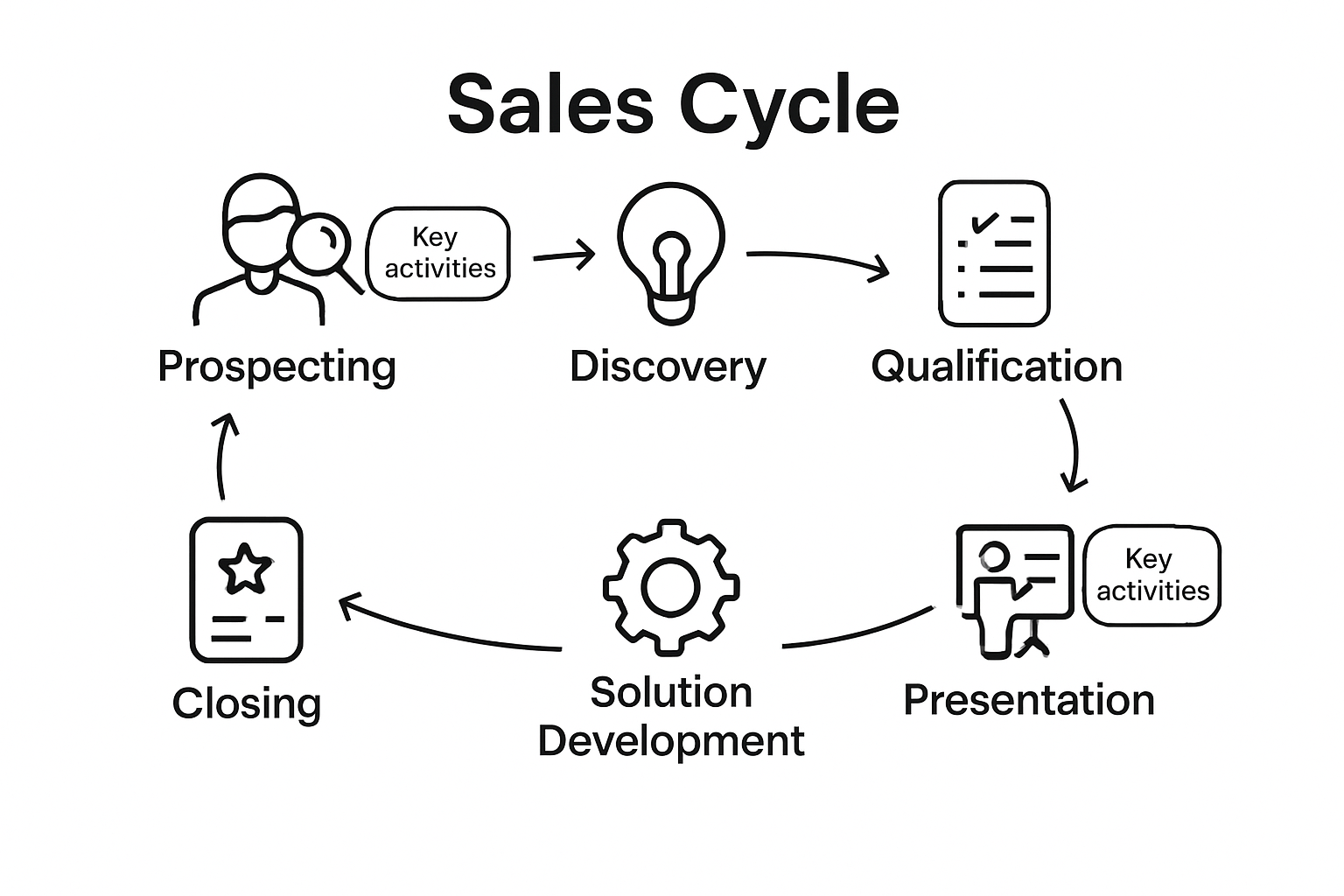
Modern sales cycles typically comprise several interconnected stages that require precision and strategic navigation. Sales team enablement becomes paramount in mastering these stages effectively. Based on comprehensive research from sales performance experts, the typical modern sales cycle includes key stages:
Initial Prospecting: Identifying and researching potential client opportunities
Qualification: Determining whether a prospect matches ideal customer criteria
Discovery: Understanding the prospect’s specific business challenges and objectives
Solution Development: Crafting tailored proposals addressing client needs
Negotiation: Discussing commercial terms and addressing potential concerns
Closing: Securing commitment and finalising the transaction
Post-Sale Management: Ensuring customer satisfaction and exploring future opportunities
Successful sales teams recognise that the sales performance improvement process requires continuous adaptation. Each stage demands specific skills, from targeted prospecting techniques to sophisticated negotiation strategies. Professional sales organisations increasingly view the sales cycle not as a linear progression, but as a dynamic, iterative system that requires ongoing refinement and strategic intelligence.
Key Stages and Core Activities
Understanding the key stages and core activities of the sales cycle is fundamental to developing a robust revenue generation strategy. Effective sales approaches demand a systematic and strategic method of moving potential clients through each critical phase.
Based on comprehensive research, the sales cycle encompasses several core stages, each requiring specific skills and targeted activities:
Prospecting and Lead Generation
Identifying potential customer segments
Conducting targeted market research
Developing initial contact strategies
Qualification
Assessing prospect’s potential value
Determining alignment with ideal customer profile
Evaluating purchasing authority and budget constraints
Initial Contact and Discovery
Scheduling initial consultative meetings
Understanding client’s business challenges
Mapping organisational decision-making processes
Solution Design
Developing tailored value propositions
Creating comprehensive proposal frameworks
Demonstrating potential return on investment
Presentation and Negotiation
Delivering compelling product/service demonstrations
Addressing potential client objections
Negotiating commercial terms
Closing
Securing final commitment
Finalising contractual agreements
Managing final transaction processes
Post-Sale Relationship Management
Ensuring client onboarding satisfaction
Establishing ongoing communication channels
Identifying opportunities for future expansion
Successful sales professionals recognise that sales leadership training is crucial for mastering these stages. Each phase requires nuanced skills, from sophisticated communication techniques to strategic problem-solving. Modern sales organisations increasingly view these stages not as rigid checkpoints, but as an interconnected ecosystem that demands continuous learning, adaptation, and refinement.
Variations Across B2B Sectors
The sales cycle is not a monolithic process but a dynamic framework that adapts significantly across different B2B sectors. Sales leadership strategies must recognise the nuanced approaches required in diverse industries, from technology and professional services to manufacturing and healthcare.
Each sector presents unique characteristics that dramatically influence the sales cycle:
Technology Sector
Typically longer sales cycles (6-18 months)
Heavy emphasis on technical demonstrations
Multiple stakeholder involvement
Complex solution selling
Significant focus on ROI and technical compatibility
Professional Services
Relationship-driven sales approach
Consultative selling techniques
Extended discovery and qualification phases
Higher dependency on personal credibility
Customised solution development
Manufacturing
More transactional sales processes
Longer procurement cycles
Strong emphasis on technical specifications
Rigorous vendor evaluation processes
Cost and operational efficiency paramount
Healthcare
Highly regulated sales environment
Extended decision-making processes
Multiple institutional stakeholders
Compliance and risk mitigation critical
Detailed technical and regulatory documentation required
The complexity of these sectoral variations underscores why understanding sales team dynamics is crucial. Successful organisations develop sector-specific sales strategies that acknowledge these unique contextual demands, recognising that a one-size-fits-all approach will inevitably result in suboptimal performance. Sales leaders must remain agile, continuously adapting their methodologies to match the intricate landscape of different B2B environments.
Critical Factors Affecting Cycle Length
Understanding the nuanced factors that influence sales cycle duration is crucial for revenue leaders seeking predictable growth. Sales performance improvement strategies must account for the complex variables that can significantly extend or contract the time required to close a deal.

Key critical factors impacting sales cycle length include:
1. Product/Solution Complexity
Highly technical products require longer evaluation periods
Complex solutions demand more extensive stakeholder consultations
Advanced technological offerings necessitate deeper technical demonstrations
2. Decision-Making Structures
Number of stakeholders involved in purchase decision
Hierarchical complexity of organisational approval processes
Internal bureaucratic procedures
Formal procurement requirements
3. Market and Economic Conditions
Economic uncertainty
Budget constraints
Competitive landscape
Organisational risk tolerance
Prevailing industry investment patterns
4. Sales Team Capabilities
Quality of initial lead qualification
Depth of product knowledge
Sophistication of consultative selling techniques
Speed of response and follow-up
Ability to build trust rapidly
Sales leadership training becomes instrumental in mitigating these cycle-extending challenges. Successful organisations develop adaptive strategies that proactively address these factors, recognising that cycle length is not a fixed constant but a variable that can be strategically managed through intelligent interventions and refined sales methodologies.
Common Mistakes Slowing Sales Cycles
Sales cycles can become frustratingly protracted when organisations consistently repeat counterproductive behaviours. Understanding common sales mistakes is crucial for revenue leaders seeking to accelerate their sales performance and reduce unnecessary friction in the buying process.
The most prevalent mistakes that significantly extend sales cycles include:
1. Poor Prospect Qualification
Pursuing unqualified leads
Insufficient initial discovery
Failing to assess genuine buying potential
Wasting time on prospects without real purchase intent
Neglecting comprehensive needs assessment
2. Ineffective Communication
Slow response times
Lack of personalised engagement
Inconsistent follow-up strategies
Failure to address client concerns promptly
Insufficient stakeholder management
3. Inadequate Value Proposition
Generic presentation materials
Inability to articulate unique solution benefits
Weak return on investment demonstrations
Lack of compelling business case
Failure to differentiate from competitors
4. Complex Internal Processes
Overcomplicated approval mechanisms
Inefficient internal collaboration
Lack of clear decision-making frameworks
Redundant bureaucratic steps
Poor interdepartmental communication
Sales coaching interventions represent a critical strategy for addressing these systemic challenges. Successful organisations recognise that reducing sales cycle length requires a holistic approach, focusing not just on individual performance but on creating streamlined, customer-centric sales ecosystems that prioritise efficiency and genuine value creation.
Best Practices for Accelerating Sales
Revenue leaders seeking to compress sales cycle timelines must adopt a strategic, multifaceted approach that transforms traditional selling methodologies. Sales training best practices become instrumental in developing the sophisticated capabilities required to accelerate revenue generation.
Key best practices for driving sales velocity include:
1. Advanced Prospect Qualification
Implement rigorous initial screening processes
Develop comprehensive ideal customer profiles
Use predictive analytics for lead scoring
Create multi-dimensional qualification frameworks
Rapidly disqualify low-potential opportunities
2. Technology-Enabled Efficiency
Integrate customer relationship management systems
Automate repetitive administrative tasks
Utilise artificial intelligence for insights
Streamline communication workflows
Implement real-time collaboration platforms
3. Consultative Engagement Strategies
Focus on value-driven conversations
Develop deep industry and prospect understanding
Create tailored presentation materials
Address potential objections proactively
Demonstrate measurable business impact
4. Continuous Skills Development
Regular sales methodology training
Role-specific skill enhancement programmes
Performance coaching and feedback mechanisms
Knowledge sharing platforms
Incentivise continuous learning
Sales accelerator methods represent the pinnacle of strategic sales transformation. Successful organisations recognise that accelerating sales is not about working harder, but working smarter through intelligent systems, sophisticated skills development, and a relentless focus on creating genuine customer value.
Accelerate Your Sales Cycle to Drive Predictable Revenue Growth
Understanding the challenges of lengthy and inconsistent sales cycles is the first step towards achieving reliable revenue. This article highlights critical pain points such as poor lead qualification, complex internal processes, and ineffective communication that often stall deals and frustrate revenue leaders. If you want to compress your sales cycle while increasing qualified pipeline and win rates, it is essential to adopt a holistic and scalable sales operating system tailored for complex B2B environments.
At The Sales Coach Network, we specialise in embedding proven frameworks like the Sales Accelerator Method and delivering practical sales leadership training that equip your team to reduce friction, build trust faster, and advance deals systematically. Discover how our targeted coaching and enablement solutions fix systemic issues behind unpredictable revenue. Transform your sales cycle today by partnering with us. Visit The Sales Coach Network for expert guidance and start accelerating your path to measurable growth.
Frequently Asked Questions
What are the key stages of the modern sales cycle?
The modern sales cycle typically includes seven key stages: Initial Prospecting, Qualification, Discovery, Solution Development, Negotiation, Closing, and Post-Sale Management.
How can companies improve their sales cycle efficiency?
Companies can improve sales cycle efficiency by implementing advanced prospect qualification, leveraging technology for efficiency, adopting consultative engagement strategies, and ensuring continuous skills development among their sales teams.
What factors can lengthen the sales cycle?
Factors that can lengthen the sales cycle include product or solution complexity, the number of stakeholders involved, decision-making structures within organisations, and external market conditions.
What are common mistakes that slow down the sales cycle?
Common mistakes that slow down the sales cycle include poor prospect qualification, ineffective communication, inadequate value propositions, and complex internal processes that hinder decision-making.
Recommended