Sales Leadership
Sales Kick-Off Planning for 2027: Why the Kick-Off Is the Easy Part
Les Bailey6 min read
Does your sales kick-off land well on the day, then fade from view before the end of the first quarter? Do you suspect your agenda reflects who asked for time, more than what your sellers need to do differently with clients?
If so, you’re in the right place.
In this article, you’ll learn why so much sales kick-off planning stops at the event, and how Forty-20-40™ connects the work before, during and after your 2027 sales kick-off (SKO). It draws on our new point of view paper by Les Bailey, The Kick-Off Is the Easy Part. You can download the paper free from our Learning Centre.
We’ve worked with more than 100 B2B sales teams and see this pattern repeatedly: planning concentrates on the event, with too little preparation or coaching afterwards.
Why sales kick-offs fade after the event
A sales kick-off represents a significant investment in your people and the year ahead. Alongside travel, venue and production costs are the days spent away from clients. The challenge is turning that investment into changes people can use when they return to work. Count the full cost, including the days away from clients, and compare it with the value of one extra late-stage deal won. That’s the return worth designing for.
We call this the ‘Event Trap’. The kick-off gets treated as the thing that changes performance, when it’s only the part everyone sees. The preparation that makes it relevant and the coaching that makes it stick get whatever time and budget are left over.
Sales leaders already recognise the problem. Gartner found that 82% of sales leaders say their enablement content or delivery must change significantly if they’re to meet their revenue goals over the next five years.
Sales teams are also living with constant change. Gartner found that sales organisations completed an average of four transformations in the previous 12 months. An SKO that launches one more, without the work either side, simply adds to the pile.
Four sales kick-off planning mistakes
The same four problems come up in our work again and again.
- The agenda is built from requests. Every function wants time with the whole sales team. Until someone agrees what sellers must do differently with clients, there’s no basis for saying no, and the agenda fills before that question has been asked.
- Nobody owns the outcome. Enablement owns the content and each function owns its session, but often nobody owns what the team does differently three months later. If the CRO isn’t accountable for that, it doesn’t get planned.
- Practice gets squeezed. It’s the first thing cut when presentations overrun, and it’s often scheduled last, when people are tired and thinking about the journey home.
- Managers arrive as guests. Managers have considerable influence over whether a new behaviour survives its first busy week. Yet they may arrive with no more preparation than their teams, then return to familiar coaching routines.
The real test of an SKO is what your sellers do differently with clients three months later.
How to plan a sales kick-off with Forty-20-40™
Forty-20-40™ is a framework for planning sales behaviour change. The numbers broadly represent the balance of effort required to achieve sustained change, with preparation and follow-through each needing more effort than the event itself.
Candidly, none of that makes the day itself matter less. An excellent event is central to the approach, and its value grows when people arrive prepared and receive support afterwards.
- Before: Performance Enablers. Diagnose where sales execution is holding growth back, and prepare managers and participants.
- During: Strategic Intervention(s). Run an event worth attending, practise the priorities on situations people recognise, and send them home with plans they’ll use.
- After: Disciplined Execution. Managers coach the new behaviours inside the routines you already run, and leaders remove what gets in the way.
Plan all three stages together and give the CRO ownership of the outcome. Decide what happens after the event while you’re still deciding what goes into it.
Planning before, during and after your SKO
The paper turns each stage into practical guidance you can plan against, section by section.
Before the event
Two sections cover the preparation. The first shows how to agree what must improve, starting from real deals rather than a revenue target, and how to check whether capability is the real issue before you build a workshop around it. The second brings the buyer into the plan, including the clients you’d normally leave out of the research, and shows how to prepare managers before anyone else.
During the event
Two more cover the kick-off itself: how to make the event count for the people in the room, and how to build practice that sellers recognise from their own client work. Practice should build the capabilities your priorities call for.
Our paper When Everyone Sounds the Same, Your People Are the Difference explores 12 capabilities relevant to complex selling, from qualification to constructive challenge.
After the event
The final section covers coaching on live opportunities inside the routines your managers already run, and how to keep managers supported once the event is over. It’s the same principle behind our sales skills training, where sellers practise on live deals with coaching from their own managers.
Download the paper for the full before, during and after guidance
How to tell whether your sales kick-off worked
The paper follows one illustrative example through all three stages. Consider a professional services business that wants to grow its strategic accounts, but whose client partners mainly discuss current projects with existing contacts. You’ll see what each account team brings to the SKO, what they practise on the day, and what has changed six months on.
It also sets out how to check what changes in three areas: experience, behaviour and results. Each answers a different question. The paper shows what evidence to look for in each, and how to judge progress when a long buying cycle means revenue takes time to follow.
Before you approve the agenda, ask what your people should be doing differently with clients three months from now, and whether you’ve designed the work that gets them there.
What’s inside the paper
The Kick-Off Is the Easy Part is free to download from our Learning Centre. Inside, you’ll find:
- practical guidance for each stage of your SKO, from agreeing priorities to coaching on live opportunities
- how to judge every agenda request against the changes you want to see with clients
- how to prepare managers so they can coach the new behaviours from the first week back
- a worked example of a professional services business using Forty-20-40™ to grow its strategic accounts
- how to check what changes in experience, behaviour and results, and how to read each one
- the full SKO planning checklist, with 17 items to confirm before you approve the programme
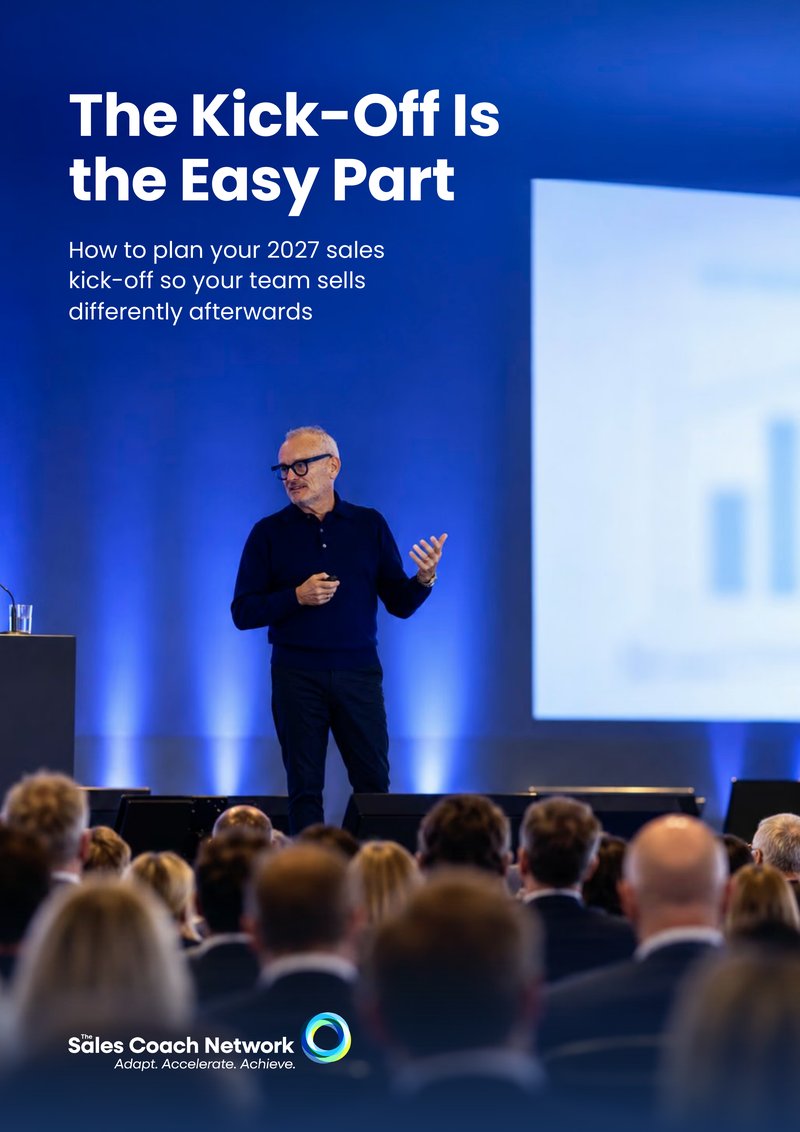
Download The Kick-Off Is the Easy Part
The Sales Coach Network can help you plan your SKO, develop relevant sessions and prepare managers to coach the changes afterwards. Les has experience in large events up to 600 people where there is a need to challenge thinking, change mindsets, and motivate teams towards new behaviours.
If you’d like a view of your own team first, the Sales Team Self-Assessment takes a few minutes and shows where the gaps sit. And if your 2027 kick-off is already in the diary, book a call and we can talk it through.
Les Bailey is CEO and Founder of The Sales Coach Network.