Selling Skills
Client Value in B2B Sales: Unlocking Profitable Growth
The Sales Coach Network11 min read


Most british B2B IT firms are missing out on measurable growth because they underestimate how complex client value can be. Research from Harvard Business Review shows that true client value includes more than forty elements that go far beyond price or product features. Understanding these deeper expectations is critical for CROs and VPs of Sales aiming to improve pipeline quality and close rates, giving their teams a competitive edge in demanding markets.
Table of Contents
Key Takeaways
Point | Details |
Understanding Client Value | Client value in B2B sales goes beyond product features and pricing, encompassing functional, emotional, and strategic dimensions. Effective sales strategies recognise this complexity and focus on meaningful dialogues that demonstrate genuine impact. |
Pillars of Client Value Creation | Sales professionals should address five pillars of client value: table stakes, functional value, ease of doing business, individual value, and inspirational value to differentiate in competitive markets. |
Measuring Client Lifetime Value | A comprehensive measurement of client lifetime value involves both quantitative and qualitative metrics to assess long-term potential and relationship health, ensuring sustained business growth. |
Avoiding Value Assessment Pitfalls | Organisations must avoid overemphasis on pricing and features, instead adopting a multi-dimensional value assessment framework to capture broader client needs and expectations. |
Defining Client Value in B2B Sales
Client value in Business-to-Business (B2B) sales represents a sophisticated, multidimensional construct that transcends simple transactional considerations. While many organisations traditionally focus on product features and pricing, contemporary sales strategies recognise that client value encompasses a broader, more nuanced set of expectations and outcomes.
Research from Harvard Business Review reveals that B2B client value comprises forty discrete elements spanning functional, emotional, and strategic dimensions. These elements range from fundamental operational requirements like product performance and price to more sophisticated considerations such as innovation potential, reputation enhancement, and organisational productivity. Understanding this comprehensive framework enables sales professionals to move beyond superficial feature discussions and engage in more meaningful value-based dialogues.
Customer value models provide a structured approach to articulating and quantifying these multifaceted value propositions. By systematically mapping client problems, solutions, and measurable outcomes, organisations can develop more compelling sales narratives that demonstrate genuine business impact. This approach shifts conversations from technical specifications to strategic value creation, helping clients understand the holistic benefits of a proposed solution.
Key dimensions of client value typically include:
Business value: Tangible financial and operational improvements
Solution value: How specifically the offering addresses unique challenges
Individual value: Professional and personal benefits for decision makers
Provider value: Reputation, trustworthiness, and long term partnership potential
Pro tip: Develop a structured value assessment framework that comprehensively documents client-specific value across these four critical dimensions, enabling more targeted and impactful sales conversations.
Key Pillars of Client Value Creation
Client value creation in B2B sales is a strategic approach that demands a sophisticated understanding of organisational and individual needs. Comprehensive research from marketing experts reveals that successful value creation extends far beyond traditional transactional considerations, encompassing a multilayered framework of interconnected value dimensions.
The Harvard Business Review highlights five critical pillars of client value creation that sales professionals must systematically address. These pillars form a hierarchical structure moving from baseline requirements to transformative impact: table stakes, functional value, ease of doing business, individual value, and inspirational value. Each pillar represents an increasingly sophisticated approach to understanding and delivering client benefits, enabling organisations to differentiate themselves in competitive markets.

Understanding these pillars requires a nuanced approach. Table stakes represent fundamental operational requirements that must be met as a minimum standard. Functional value focuses on demonstrable economic and performance outcomes, addressing specific business challenges. Ease of doing business considers the overall interaction experience, including communication efficiency, responsiveness, and administrative simplicity. Individual value targets professional and personal benefits for key decision makers, while inspirational value represents the highest level of client engagement by connecting with broader organisational vision and potential.
Key strategic considerations for implementing these value creation pillars include:
Here is a structured comparison of the five pillars of client value creation and their impact on B2B relationships:
Pillar | Focus Area | Example Impact | Strategic Benefit |
Table Stakes | Minimum requirements | Product reliability | Ensures baseline trust |
Functional Value | Operational outcomes | Cost reduction | Drives business efficiency |
Ease of Doing Business | Interaction quality | Fast issue resolution | Builds customer loyalty |
Individual Value | Professional outcomes | Career advancement | Influences buying decisions |
Inspirational Value | Vision alignment | Innovation partnership | Enables long-term growth |
Developing deep client understanding beyond surface-level requirements
Creating tailored value propositions that address specific organisational contexts
Building capabilities to articulate and quantify value across multiple dimensions
Investing in relationships that extend beyond transactional interactions
Pro tip: Conduct regular value mapping workshops with client stakeholders to continuously refine and validate your understanding of their evolving value expectations and organisational priorities.
Types of Client Value and Their Roles
Client value represents a complex, multidimensional construct that extends far beyond simplistic transactional considerations. Research from leading business experts reveals a nuanced hierarchy of value types that organisations must strategically navigate to differentiate themselves in competitive markets.
The B2B value landscape comprises five fundamental value types, each serving a critical role in client engagement: table stakes, functional value, ease of doing business, individual value, and inspirational value. These types form a progressive framework where lower-level requirements must be consistently met before advancing to more sophisticated value propositions. Table stakes represent baseline operational expectations such as product reliability and competitive pricing. Functional value focuses on demonstrable economic outcomes and specific performance improvements that directly address organisational challenges.
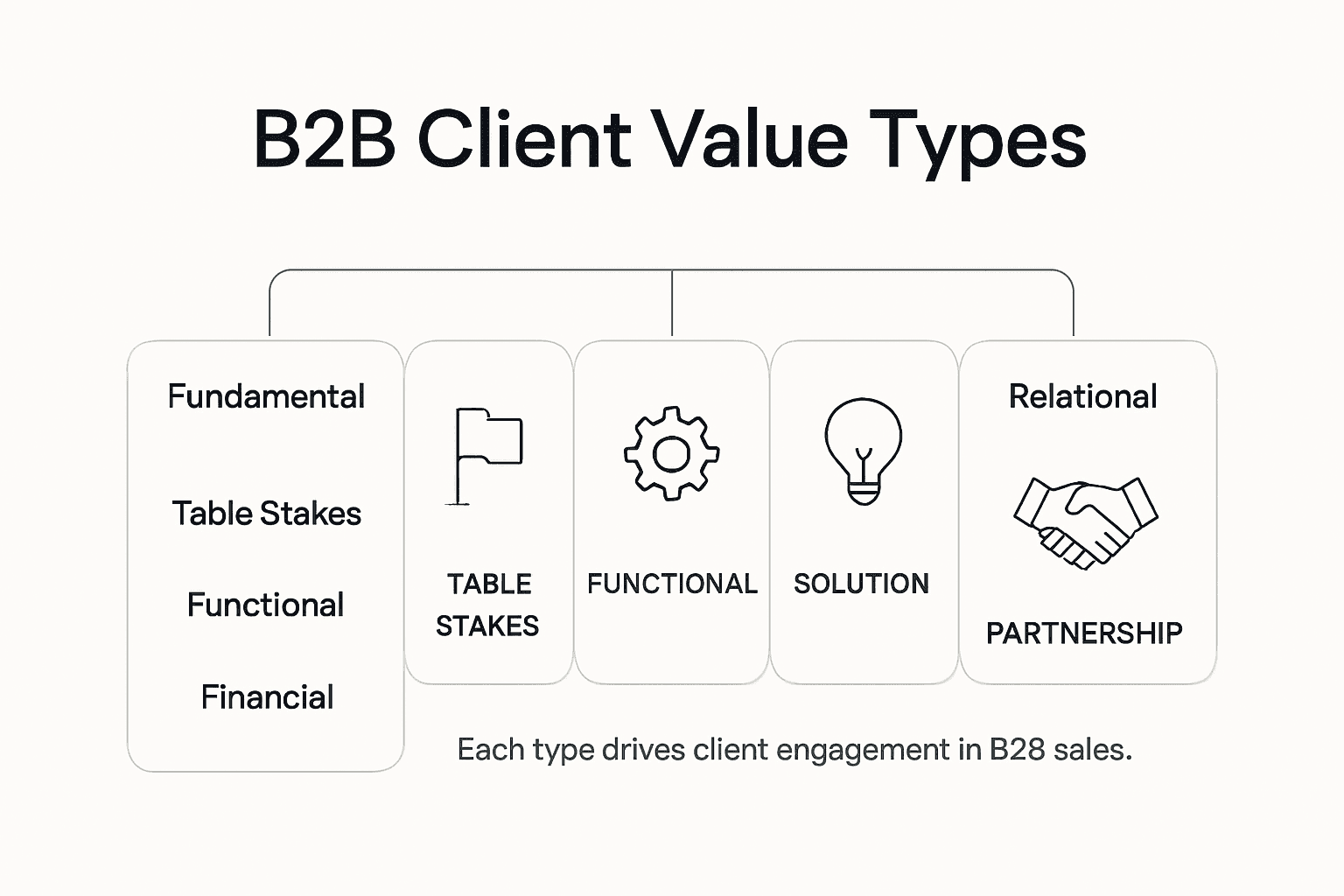
The value pyramid framework illuminates how organisations can systematically elevate their client value proposition by moving beyond mere transactional interactions. Ease of doing business considers the overall quality of interaction, including communication efficiency, responsiveness, and administrative simplicity. Individual value targets professional and personal benefits for key decision makers, addressing their career aspirations and personal risk mitigation. Inspirational value represents the pinnacle of client engagement, connecting with broader organisational vision and potential transformational impact.
Key characteristics of each value type include:
Table Stakes: Minimum operational requirements
Functional Value: Measurable economic and performance outcomes
Ease of Doing Business: Quality of interaction and relationship management
Individual Value: Professional and personal benefits for stakeholders
Inspirational Value: Strategic alignment with organisational vision
Pro tip: Develop a comprehensive value assessment matrix that systematically maps and scores your organisation’s capabilities across each value type, enabling targeted improvements and strategic differentiation.
Measuring and Maximising Client Lifetime Value
Client lifetime value represents a sophisticated strategic framework for understanding and optimising long-term business relationships. Comprehensive research reveals the nuanced approach to quantifying a client’s total potential value, moving beyond simplistic transactional assessments to a more holistic, forward-looking perspective.
Measuring client lifetime value requires a multidimensional analysis that encompasses several critical components. Financial metrics provide the foundational quantitative assessment, calculating the projected total revenue a client will generate over the entire relationship. However, truly sophisticated organisations recognise that monetary value represents only one dimension of client potential. Predictive models must incorporate qualitative factors such as strategic alignment, potential for expansion, reference potential, and overall relationship health.
Strategic approaches to nurturing B2B client relationships demand continuous monitoring and proactive engagement, ensuring sustained value creation. This involves developing comprehensive measurement frameworks that track not just current revenue, but future growth potential, likelihood of renewal, and opportunities for strategic collaboration. Key performance indicators should include metrics like customer satisfaction scores, rate of repeat business, expansion of service scope, and the client’s strategic importance to the organisation.
Critical elements for measuring client lifetime value include:
The following table summarises key metrics for measuring and maximising client lifetime value in B2B contexts:
Measurement Dimension | Example Metric | Why It Matters |
Financial Contribution | Total projected revenue | Assesses revenue potential |
Relationship Health | Satisfaction score | Indicates loyalty and renewal |
Strategic Potential | Referral likelihood | Expands business opportunities |
Growth Opportunity | Service expansion rate | Reveals future business value |
Total projected revenue across relationship duration
Probability of contract renewal
Potential for service or product expansion
Strategic alignment and referral potential
Cost of client acquisition and maintenance
Margin contribution and profitability
Pro tip: Implement a dynamic client value scoring system that continuously updates based on real-time performance data, enabling proactive relationship management and strategic resource allocation.
Common Mistakes When Assessing Value
Value assessment in B2B sales is a complex process fraught with potential pitfalls that can significantly undermine an organisation’s revenue strategy. Extensive research highlights the critical errors organisations frequently make when evaluating client value, demonstrating that many businesses remain trapped in superficial evaluation approaches.
One of the most prevalent mistakes is an overemphasis on product features and pricing, while neglecting the broader spectrum of client needs and expectations. Sales teams often default to technical specifications and cost comparisons, inadvertently overlooking the nuanced, multilayered value dimensions that truly drive client decision making. This narrow perspective fails to capture the holistic value proposition that modern B2B buyers seek, which extends far beyond immediate transactional considerations.
Academic research underscores the importance of understanding deeper client motivations and challenges when assessing value. Common critical errors include relying on generic, one-size-fits-all solutions rather than developing tailored value propositions, misinterpreting client requirements, and failing to establish a dynamic feedback mechanism for continuous value refinement. Sophisticated organisations recognise that value assessment is an iterative process requiring constant recalibration based on evolving client expectations.
Key mistakes to avoid in value assessment include:
Focusing exclusively on price and product features
Neglecting qualitative relationship factors
Using static, inflexible evaluation models
Ignoring individual stakeholder perspectives
Failing to quantify broader business impact
Overlooking potential future value opportunities
Pro tip: Develop a comprehensive, multi-dimensional value assessment framework that systematically captures financial, operational, and strategic value elements, enabling a more holistic and accurate evaluation of client potential.
Practical Strategies to Enhance Client Value
Client value enhancement requires a strategic, multifaceted approach that goes beyond traditional sales methodologies. Cutting-edge research emphasises the critical importance of proactive relationship management in developing sustainable, high-value client partnerships that transcend transactional interactions.
Successful organisations recognise that value creation is an ongoing process demanding continuous attention and adaptation. This involves implementing comprehensive strategies that address multiple dimensions of client experience. Advanced approaches include personalising solutions, leveraging technology for efficient service delivery, and maintaining transparent communication channels that build trust and demonstrate genuine commitment to the client’s strategic objectives.
Key strategic approaches for enhancing client value encompass a holistic framework of interconnected initiatives. Sales teams must develop deep insights into client business models, anticipate potential challenges, and proactively offer solutions that extend beyond immediate product or service offerings. This requires cultivating a consultative mindset where understanding the client’s broader business context becomes paramount. Effective value enhancement strategies involve cross-functional collaboration, ensuring that insights from sales, service, and account management teams are systematically integrated to create a comprehensive value proposition.
Practical strategies for client value enhancement include:
Implementing account-based marketing techniques
Developing personalised engagement models
Creating continuous feedback mechanisms
Investing in advanced client intelligence technologies
Establishing regular strategic review processes
Building multi-level organisational relationships
Pro tip: Develop a dynamic client value scorecard that tracks both quantitative performance metrics and qualitative relationship indicators, enabling data-driven insights for continuous value improvement.
Unlock Sustainable Growth by Mastering Client Value in B2B Sales
Understanding and delivering comprehensive client value is the cornerstone of thriving in complex B2B environments. This article highlights critical challenges such as overcoming superficial feature-driven sales approaches and building multi-dimensional value propositions that resonate with business, individual, and strategic needs. If you are a senior sales leader frustrated by unpredictable revenue or stalled deals, you recognise the urgency of adopting structured frameworks that go beyond price and product features to unlock true client lifetime value.
At The Sales Coach Network, we specialise in embedding practical, scalable sales systems designed to fix these systemic value communication gaps. Our Client Value Framework helps your team confidently articulate the four pillars of client value across business, individual, solution, and provider perspectives. By integrating our proven Sales Accelerator Method and the VALID Differentiation Framework, your sales teams will engage in meaningful conversations that drive higher win rates and larger deal sizes. If you are ready to transform your sales approach by delivering holistic client value and achieving predictable, scalable revenue growth, explore how we partner with B2B leaders at The Sales Coach Network today.
Take the next step towards embedding a client value-driven sales model that accelerates your team’s performance and propels profitable growth. Visit our website to discover tailored sales training and coaching solutions that turn client value insights into measurable business impact.
Frequently Asked Questions
What is client value in B2B sales?
Client value in B2B sales refers to a multi-dimensional construct that encompasses not only product features and pricing but also broader expectations and outcomes that clients seek from their business relationships.
How can businesses measure client lifetime value?
To measure client lifetime value, businesses should assess total projected revenue over the entire relationship, incorporate qualitative factors such as strategic alignment and expansion potential, and track key performance indicators like customer satisfaction and renewal probabilities.
What are the key dimensions of client value creation?
The key dimensions of client value creation include business value, solution value, individual value, and provider value. Each dimension focuses on different aspects of the benefits provided to the client, ranging from financial impacts to personal and strategic alignment.
What common mistakes do organisations make when assessing client value?
Common mistakes include an overemphasis on product features and pricing, neglecting qualitative relationship factors, using static evaluation models, and failing to consider the broader business impacts and individual stakeholder perspectives.
Recommended