
Master Enterprise Sales Process Workflow for Predictable Growth
- The Sales Coach Network
- Jan 12
- 8 min read


More than 60 percent of British enterprises report workflow inefficiencies as a major barrier to predictable sales growth. Senior revenue leaders know that old systems rarely deliver the consistency their teams need in fast-paced UK technology markets. This article outlines actionable strategies to sharpen enterprise sales process workflows, providing direct solutions for achieving reliable and scalable results in British B2B tech environments.
Table of Contents
Quick Summary
Key Takeaway | Explanation |
1. Define measurable sales objectives | Focus on continuous improvement and align objectives to corporate goals, motivating the sales team effectively. |
2. Map stakeholder roles clearly | Use the Power/Interest Grid to identify stakeholder engagement levels, prioritising communication based on their influence and interest. |
3. Implement scalable workflows | Create flexible systems that evolve with organisational needs, ensuring efficient independent operations and clear communication. |
4. Embed disciplined execution routines | Establish standard operating procedures and accountability checkpoints to ensure consistent sales performance aligned with objectives. |
5. Regularly measure sales outcomes | Develop a metric dashboard to track key performance indicators, enabling data-driven decision making and continuous improvement. |
Step 1: Define strategic sales objectives
Defining strategic sales objectives transforms passive strategies into active frameworks that drive organisational performance. The process requires a systematic approach that aligns individual efforts with overarching corporate goals through clear and measurable objectives.
Successful strategic objectives focus on continuous improvement rather than isolated activities. They should articulate specific outcomes that motivate your sales team and provide clear direction. For instance, an authentic objective might be “Increase enterprise customer acquisition by 25% through targeted engagement strategies” rather than “Implement a new CRM system”. This distinction matters because true objectives describe ongoing performance enhancements, not finite project milestones.
The table below contrasts typical project milestones and strategic sales objectives to clarify why strategic objectives drive stronger organisational growth:
Characteristic | Project Milestone | Strategic Sales Objective |
Duration | Finite timeline | Continuous improvement |
Focus | Completion of task | Ongoing performance gains |
Measurement | Task completion | Measurable business outcome |
Motivation | Finishing steps | Inspiring team achievement |
Alignment | Limited to project | Tied to company vision |
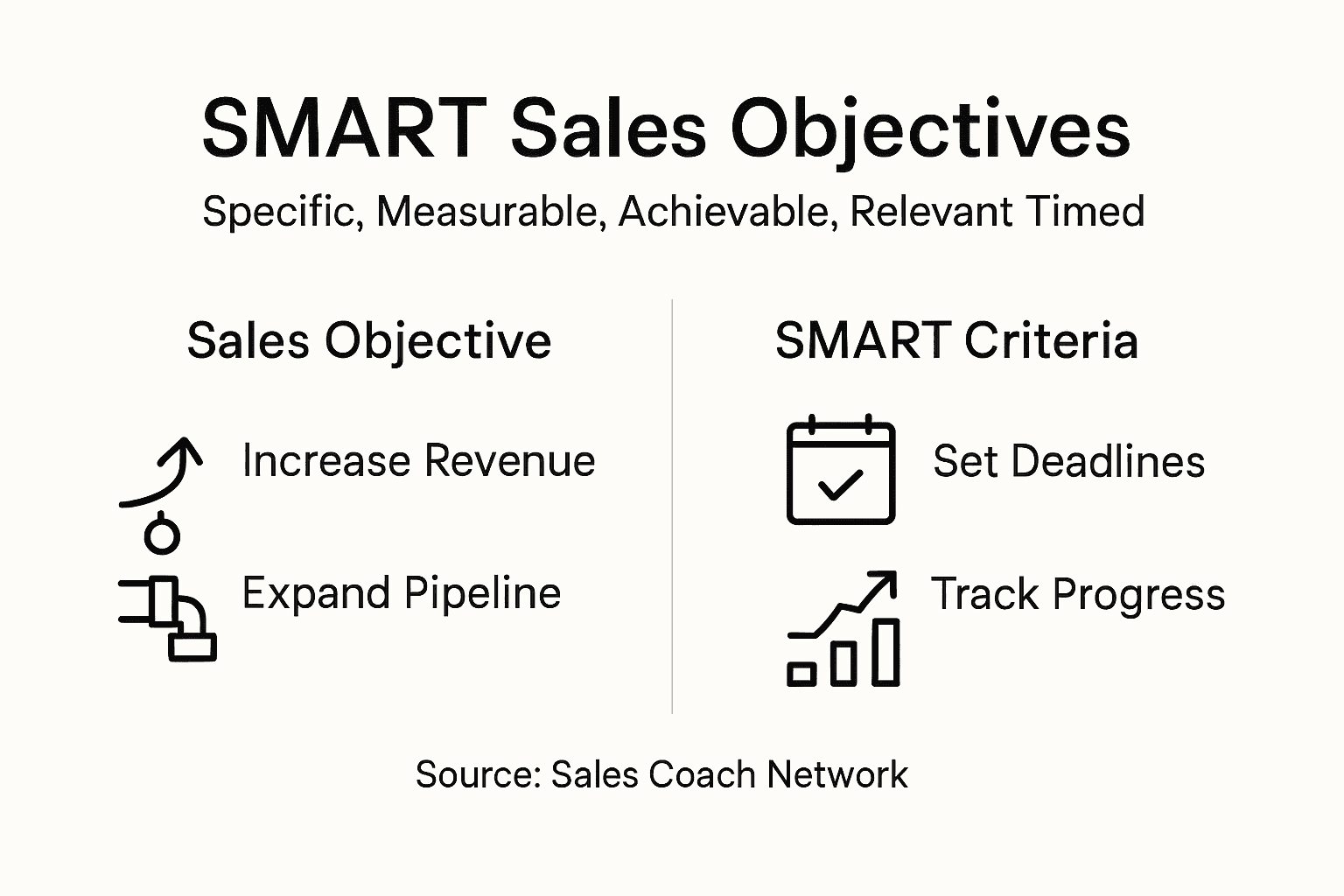
To craft effective strategic sales objectives, apply the SMART framework: ensure each objective is Specific, Measurable, Achievable, Relevant, and Time-bound. This means moving beyond vague statements to precise, actionable targets that your sales team can understand and pursue. Break down broader organisational goals into granular, team-level objectives that create a clear line of sight between individual activities and strategic outcomes.
Insider advice: Always validate your strategic sales objectives against your organisation’s primary revenue growth targets to ensure absolute alignment and maximum impact.
Step 2: Map and align stakeholder roles
Mapping and aligning stakeholder roles is a critical strategy for ensuring seamless collaboration and effective enterprise sales workflow. This process involves systematically identifying and categorising stakeholder engagement to create a comprehensive understanding of their potential impact and involvement.

The Power/Interest Grid provides an exceptional framework for stakeholder mapping. By plotting stakeholders across power and interest dimensions, you can develop targeted communication strategies that match each group’s unique characteristics. High-power and high-interest stakeholders require close engagement and frequent communication, while low-power and low-interest groups might need minimal but strategic touchpoints. This approach helps you prioritise interactions, allocate resources efficiently, and ensure that key decision makers remain informed and involved throughout the sales process.
To effectively map stakeholder roles, begin by conducting a comprehensive stakeholder analysis. List all potential stakeholders, including executive sponsors, technical evaluators, financial decision makers, and operational influencers. Assess each stakeholder’s potential contribution, potential barriers, and strategic significance. Create detailed profiles that outline their motivations, concerns, and potential roles in the sales workflow. This granular approach enables your sales team to develop personalised engagement strategies that address individual stakeholder needs and align with broader organisational objectives.
Insider advice: Regularly update your stakeholder mapping document as relationships evolve and organisational dynamics shift to maintain an accurate and responsive engagement strategy.
Step 3: Implement scalable workflow systems
Implementing scalable workflow systems is crucial for enterprise sales teams seeking predictable and adaptable performance. This process involves creating flexible infrastructure for independent operations that can evolve with your organisation’s changing needs and growth trajectories.
A successful scalable workflow system requires strategic integration of technological tools, data management processes, and collaborative frameworks. Begin by conducting a comprehensive audit of existing workflows, identifying bottlenecks, redundancies, and opportunities for streamlining. Focus on designing systems that enable independent functional units to operate efficiently while maintaining seamless communication and data sharing. This approach ensures that your sales ecosystem remains agile, responsive, and capable of supporting rapid organisational expansion.
To implement an effective scalable workflow, prioritise technologies and platforms that offer modular design, robust integration capabilities, and real-time reporting mechanisms. Select solutions that can adapt to changing business requirements without requiring complete system overhauls. Create clear standardised processes that can be easily replicated across different sales teams and geographic regions. Document each workflow step meticulously, ensuring that new team members can quickly understand and adopt the established systems. Regularly review and refine these workflows based on performance data, technological advancements, and emerging market dynamics.
Insider advice: Invest in comprehensive training programmes that help your sales team understand and effectively utilise the new workflow systems to maximise their potential and ensure smooth adoption.
Step 4: Embed disciplined execution routines
Embedding disciplined execution routines transforms sales team performance from inconsistent efforts to predictable, structured outcomes. This critical process involves establishing systematic procedures for consistent performance that align individual actions with broader organisational objectives.
Successful disciplined execution requires creating clear, repeatable processes that guide sales team behaviour. Develop comprehensive standard operating procedures that detail expectations for each stage of the sales workflow. These procedures should include specific metrics, reporting requirements, and accountability checkpoints. Implement regular performance reviews that assess adherence to established routines, providing constructive feedback and recognition for teams and individuals who consistently demonstrate disciplined execution. Create visual dashboards and tracking mechanisms that make performance expectations transparent and easily understood by all team members.
To effectively embed these routines, focus on creating a culture of accountability and continuous improvement. Train sales managers to become coaches who can reinforce disciplined execution through daily interactions, performance conversations, and targeted skill development. Integrate technology platforms that support routine tracking, provide real-time performance insights, and enable rapid intervention when deviations from established procedures occur. Regularly review and refine your execution routines based on team feedback, changing market conditions, and emerging best practices to ensure ongoing relevance and effectiveness.
Insider advice: Build routine review sessions into your quarterly planning to continuously evaluate and adapt your disciplined execution framework, ensuring it remains dynamic and responsive to organisational needs.
Step 5: Measure and optimise sales outcomes
Measuring and optimising sales outcomes is a strategic imperative for enterprise sales teams seeking predictable growth. This process requires developing a comprehensive framework for tracking meaningful performance indicators that provide actionable insights into sales team effectiveness.
Create a robust metrics dashboard that captures multiple dimensions of sales performance. Key indicators should include pipeline velocity, average deal value, win rates, customer acquisition costs, and revenue progression. Go beyond surface level metrics by implementing advanced tracking mechanisms that reveal underlying trends and potential improvement opportunities. Utilise both quantitative and qualitative data points to build a nuanced understanding of your sales ecosystem. This means integrating numerical performance metrics with contextual information about customer interactions, market dynamics, and competitive positioning.
Here is a summary of essential sales performance metrics and their strategic importance:
Metric | What It Measures | Strategic Impact |
Pipeline velocity | Speed of moving deals | Forecasts revenue timing |
Average deal value | Typical sale amount | Assesses profitability |
Win rate | Deals won vs. lost | Evaluates team effectiveness |
Customer acquisition cost | Cost per new client | Manages investment efficiency |
Revenue progression | Growth over time | Tracks business expansion |
To optimise sales outcomes, establish a continuous improvement cycle that transforms data into strategic action. Regularly conduct deep dive analyses into your performance metrics, identifying patterns of success and areas requiring intervention. Develop targeted training programmes, refine sales processes, and adjust resource allocation based on empirical evidence. Implement a feedback loop that allows rapid adaptation of your sales strategy, ensuring your team remains agile and responsive to changing market conditions. Cultivate a culture of data driven decision making where every team member understands how their individual performance contributes to broader organisational objectives.
Insider advice: Schedule monthly performance review sessions that transform raw metrics into strategic insights, ensuring your sales team remains focused on continuous improvement and predictable growth.
Accelerate Your Enterprise Sales Workflow for Predictable Growth
Mastering the complexities of the enterprise sales process workflow is essential for achieving consistent revenue growth. This article highlights key challenges such as setting strategic sales objectives, aligning stakeholders, embedding disciplined execution routines, and measuring sales outcomes. If you recognise struggles like unpredictable revenue, stalled deals, or inconsistent team performance, you are not alone. These obstacles often arise from systemic issues that generic training fails to address.
At The Sales Coach Network, we specialise in embedding scalable sales operating systems that resolve the root causes of these challenges. Our proven frameworks, including the Sales Ecosystem Framework, empower senior revenue leaders to increase pipeline quality, improve win rates, and reduce sales cycle time by focusing on strategy, enablement, and disciplined execution. Ready to move beyond motivational fluff and one-off training events? Explore how our tailored Sales Training Programs and expert Sales Coaching Services can help your enterprise sales teams adapt, accelerate, and achieve sustainable growth.
Don’t let complex sales workflows stall your business performance. Act now to build predictable sales momentum with a partner who understands the intricate demands of large B2B organisations. Visit The Sales Coach Network today to start transforming your enterprise sales process into a reliable engine for growth.
Frequently Asked Questions
How can I define effective strategic sales objectives for my team?
Defining effective strategic sales objectives involves creating clear, measurable goals that align with your organisation’s corporate targets. Ensure that your objectives are specific, measurable, achievable, relevant, and time-bound (SMART) to guide your sales team’s performance and drive continuous improvement.
What is the Power/Interest Grid, and how can it help in stakeholder mapping?
The Power/Interest Grid is a framework that helps you categorise stakeholders based on their level of power and interest in the sales process. Use this grid to prioritise engagement strategies, ensuring that high-power and high-interest stakeholders receive focused communication and support, which can enhance collaboration.
What steps should I take to implement scalable workflow systems for my sales team?
To implement scalable workflow systems, start with a thorough audit of your existing processes to identify inefficiencies. Then, design flexible infrastructure that integrates suitable technologies and establishes clear standardised procedures, allowing for easy adaptation as your organisation grows.
How do I develop disciplined execution routines within my sales team?
To develop disciplined execution routines, create standard operating procedures that detail expectations for every stage of the sales process. Implement regular reviews to assess adherence to these procedures, and encourage accountability by fostering a culture of continuous improvement and performance tracking.
What key performance metrics should I track to measure sales outcomes effectively?
Key performance metrics to track include pipeline velocity, average deal value, win rate, customer acquisition cost, and revenue progression. Focus on developing a robust metrics dashboard that captures these indicators, allowing you to analyse performance and identify areas for improvement regularly.
How often should I review and optimise my sales outcomes to ensure predictable growth?
Schedule monthly performance review sessions to evaluate your sales outcomes systematically. Analyse the data collected to identify patterns and opportunities for growth, ensuring that your sales strategy remains agile and responsive to changing market conditions.
Recommended