
How to Reduce Sales Cycle for Predictable Revenue Growth
- The Sales Coach Network
- Jan 18
- 8 min read


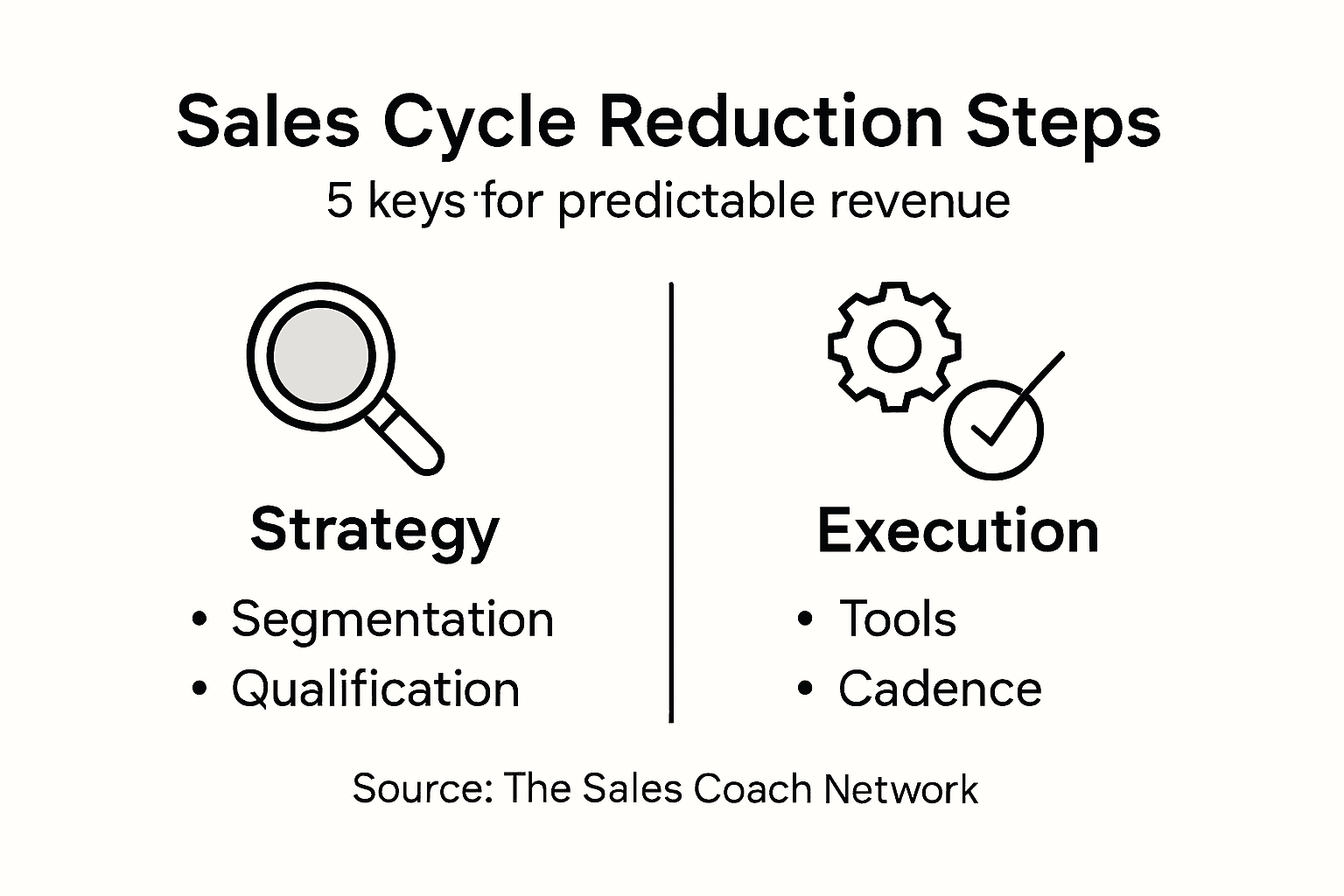
Prolonged sales cycles remain a stubborn challenge for senior leaders in British IT and professional services firms, often causing unpredictable revenue streams and missed growth targets. The pressure to deliver consistent results drives the need for a precise commercial strategy that aligns with complex client demands and internal priorities. By adopting a disciplined, data-driven approach—anchored in rigorous qualification frameworks and reinforced by sales acceleration technologies—leaders can create a foundation for faster, more predictable revenue outcomes.
Table of Contents
Quick Summary
Key Insight | Explanation |
1. Define a Precise Commercial Strategy | Craft a targeted plan that aligns with customer needs for efficient sales conversion. |
2. Use Advanced Deal Acceleration Tools | Implement technology that automates tasks and enhances sales processes, increasing speed and efficiency. |
3. Establish Rigorous Qualification Frameworks | Create clear criteria for assessing sales opportunities to ensure focus on high-potential deals. |
4. Implement a Structured Sales Cadence | Develop a well-defined communication plan to engage prospects strategically, maintaining momentum in the sales process. |
5. Continuously Validate and Refine Processes | Regularly analyse sales performance to identify areas for improvement, fostering a culture of adaptability and innovation. |
Step 1: Define a Precise Commercial Strategy
Defining a precise commercial strategy provides the critical roadmap for reducing your sales cycle and achieving predictable revenue growth. This strategic approach transforms how your sales team identifies, pursues, and converts opportunities with remarkable efficiency.
To craft an effective commercial strategy, start by conducting strategic sales opportunity analysis. This involves systematically mapping your target market segments, understanding their unique challenges, and aligning your sales approach to deliver demonstrable value. Your strategy must transcend generic sales tactics and focus on building profitable relationships that address specific customer needs.
Begin by segmenting your potential customer base according to criteria such as industry vertical, company size, current technology infrastructure, and strategic priorities. Develop detailed customer personas that go beyond surface demographic information and dive deep into their business goals, pain points, and decision making processes. This granular understanding enables your sales team to craft precisely targeted value propositions that resonate with each prospect’s specific context.
Next, design a structured approach for opportunity qualification that ensures your team focuses exclusively on high probability deals. Implement rigorous qualification criteria that assess not just the potential deal value, but also the strategic alignment, likelihood of conversion, and long term relationship potential. This disciplined method prevents sales teams from chasing low probability opportunities that consume valuable resources.
Practical Tip: Create a detailed ideal customer profile scorecard that allows rapid, objective assessment of potential opportunities, dramatically reducing wasted time and effort.
Step 2: Equip Teams with Effective Deal Acceleration Tools
Equipping your sales team with powerful deal acceleration tools transforms how they identify, pursue, and close opportunities with unprecedented speed and precision. By implementing strategic technological solutions, you can dramatically reduce your sales cycle and create a more predictable revenue generation process.

Start by leveraging advanced sales acceleration technologies that integrate artificial intelligence and predictive analytics into your sales workflow. These sophisticated tools automate routine tasks, provide real-time insights, and enable your team to focus on high value interactions with potential clients. Look for platforms that offer comprehensive features such as intelligent lead scoring, automated communication tracking, and integrated customer relationship management systems.
Carefully evaluate sales enablement tools that streamline prospecting, qualification, and deal progression. Prioritise solutions that offer seamless CRM integration, robust analytics dashboards, and advanced communication tracking capabilities. Your selected tools should provide granular visibility into each stage of the sales pipeline, enabling managers to identify bottlenecks and coach teams more effectively. Consider platforms that offer features like automated follow up sequences, proposal management, and predictive deal health scoring to support your sales representatives in making data driven decisions.
Implement a structured approach to tool adoption that includes comprehensive training and ongoing performance measurement. Ensure your team understands not just how to use these technologies, but how to leverage them strategically to accelerate deal velocity. Regularly review tool performance metrics and be prepared to adjust your technological stack as your sales processes evolve.
Practical Tip: Select sales acceleration tools that integrate smoothly with your existing technology infrastructure and provide clear, measurable improvements in sales productivity.
Step 3: Embed Rigorous Qualification and Prioritisation Frameworks
Embedding robust qualification and prioritisation frameworks is crucial for transforming your sales team’s efficiency and dramatically reducing the overall sales cycle. These structured approaches enable your organisation to systematically evaluate and focus on the most promising opportunities with precision and strategic intent.
Begin by implementing comprehensive sales qualification frameworks that provide a consistent methodology for assessing potential deals. Traditional models like BANT (Budget, Authority, Need, Timing) offer a foundational approach, but modern sales teams require more nuanced evaluation criteria. Develop a custom framework that goes beyond basic metrics and incorporates strategic fit, potential long term value, and alignment with your organisation’s core capabilities.
Here’s a concise comparison of classic versus modern sales qualification frameworks:
Criterion | Traditional (e.g., BANT) | Modern Custom Framework |
Evaluation Focus | Budget, Authority, Need, Time | Strategic alignment, potential value |
Level of Detail | Basic metrics only | Multi-dimensional, weighted scoring |
Technology Integration | Minimal | Embedded in CRM, automated scoring |
Impact on Sales Efficiency | Provides consistency | Enables targeted, data-driven decisions |
Create a multi dimensional scoring system that objectively ranks potential opportunities across key dimensions. This should include financial potential, strategic alignment, likelihood of conversion, and resource requirements. Assign weighted scores to each dimension to ensure a holistic assessment that prevents teams from chasing low probability deals. Integrate this scoring mechanism directly into your customer relationship management system to provide real time visibility and enable data driven decision making.
Establish clear gatekeeping processes that require rigorous validation at each stage of the sales pipeline. Implement mandatory qualification checkpoints where deals must meet predefined criteria to progress. This approach ensures that only the most promising opportunities receive significant investment of time and resources. Train your sales team to be ruthlessly objective about opportunity assessment, rewarding disciplined qualification over mere pipeline volume.
Practical Tip: Regularly review and refine your qualification framework, treating it as a living document that evolves with your market and organisational capabilities.
Step 4: Implement Disciplined Deal Advancement Cadence
Implementing a disciplined deal advancement cadence transforms your sales approach from reactive to strategic, enabling your team to systematically progress opportunities through the sales pipeline with unprecedented precision and efficiency.
Developing a structured sales engagement sequence requires meticulous planning and consistent execution. Your cadence should outline precise communication touchpoints across multiple channels, specifying the optimal timing, frequency, and communication method for each interaction. This approach ensures that every prospect receives timely, relevant engagement that maintains momentum and builds genuine connection.
Design a multi channel cadence that balances different communication methods, including targeted emails, strategic telephone conversations, personalised social media interactions, and carefully timed follow up messages. Each touchpoint must serve a specific purpose, moving the prospect closer to a purchasing decision while demonstrating clear value and understanding of their unique business challenges. Map out a detailed timeline that specifies the exact sequence of interactions, including waiting periods between communications to avoid overwhelming potential clients.
Establish clear accountability mechanisms that track and measure the effectiveness of your sales cadence. Implement robust reporting systems that capture key metrics such as response rates, conversation progression, and time spent in each pipeline stage. Regularly analyse these metrics to refine your approach, identifying which communication strategies generate the most meaningful engagement and adjusting your cadence accordingly.
Practical Tip: Continuously experiment with your sales cadence, treating it as a dynamic strategy that requires ongoing refinement and adaptation to changing market conditions.
Step 5: Validate Results and Refine Processes
Validating results and refining sales processes is the critical final stage in creating a predictable revenue growth strategy that continuously adapts and improves based on empirical insights and performance data.
Implementing rigorous performance measurement systems enables your organisation to transform raw sales data into actionable strategic intelligence. Establish comprehensive analytics frameworks that track key performance indicators across multiple dimensions including conversion rates, average deal value, sales cycle duration, and customer acquisition costs. These metrics provide a granular understanding of your sales ecosystem, revealing precise opportunities for strategic intervention and process optimization.
Below is a summary of key sales performance indicators for process validation:
KPI | Description | Business Relevance |
Conversion Rate | Percentage turning to closed deals | Reflects sales effectiveness |
Average Deal Value | Mean value of completed sales | Indicates revenue generation |
Sales Cycle Duration | Time from initial contact to close | Tracks efficiency and speed |
Customer Acquisition Cost | Total costs per new client | Measures profitability and scaling |
Develop a systematic approach to process refinement that goes beyond surface level analysis. Create feedback loops where sales team members actively contribute insights about workflow challenges, customer interaction patterns, and potential improvement areas. Implement quarterly review sessions that critically examine your sales methodology, using data driven evidence to challenge existing practices and introduce incremental enhancements. Leverage advanced technological tools such as artificial intelligence and machine learning algorithms to identify subtle patterns and predictive trends that human analysis might overlook.
Ensure that your validation and refinement process remains dynamic and responsive. Treat your sales strategy as a living system that requires continuous adaptation rather than a static set of procedures. Encourage a culture of experimentation where calculated risks are valued and learning from both successes and failures is considered a fundamental aspect of organisational growth. Build mechanisms for rapid prototyping and testing of new sales approaches, allowing your team to quickly assess and integrate innovative strategies.
Practical Tip: Create a standardised template for capturing and evaluating sales process improvements, ensuring that every insight is systematically documented and considered for implementation.
Accelerate Your Sales Cycle with Expert Strategy and Execution
Reducing the sales cycle to achieve predictable revenue growth is a challenge many senior revenue leaders face. This article highlights the need for disciplined qualification frameworks, structured deal advancement cadences, and effective commercial strategies to overcome stalled deals and inefficient pipelines. If your team struggles with long sales cycles, low win rates, or inconsistent performance, it is critical to embed scalable systems that tackle these pain points head-on.
At The Sales Coach Network, we specialise in partnering with B2B organisations to fix systemic issues that create unpredictable revenue. Our practical methodology focuses on increasing pipeline opportunities, improving average deal values, boosting win rates, and crucially, reducing sales cycle time through disciplined execution. Explore how our sales training programmes and sales coaching services can equip your teams with the right skills, tools, and accountability to transform sales velocity.
Ready to transform your sales performance and reduce your sales cycle now Discover how our expert practitioners help you adapt to market changes and achieve sustainable, measurable growth. Visit The Sales Coach Network today and take the first step towards accelerating your revenue growth.
Frequently Asked Questions
How can I define a precise commercial strategy to reduce the sales cycle?
Defining a precise commercial strategy involves conducting a detailed analysis of your target market segments and their unique challenges. Start by creating detailed customer personas that outline their business goals and pain points, allowing your sales team to tailor their approach for maximum impact.
What tools can I use to accelerate deals and reduce the sales cycle?
Utilising advanced sales acceleration tools, such as those that integrate artificial intelligence and predictive analytics, can significantly speed up your sales process. Focus on tools that automate routine tasks and provide insights into customer interactions, aiming to see improvements in deal velocity within 30 days.
How can I implement a robust qualification framework for my sales team?
To implement a robust qualification framework, begin by using a customised scoring system that evaluates opportunities based on strategic alignment and potential value, not just basic metrics. This approach ensures your team focuses on high-potential deals, which can lead to a reduction in sales cycle time by up to 25%.
What steps should I take to establish a disciplined deal advancement cadence?
Developing a structured sales engagement sequence involves planning each communication touchpoint meticulously to maintain momentum with prospects. Create a timeline that specifies the optimal timing and methods for each interaction, and regularly review these strategies for effectiveness, adapting as necessary.
How can I validate results and refine my sales processes for continuous improvement?
Establishing a robust performance measurement system will help you validate results and identify areas for refinement. Regularly review key performance indicators such as conversion rates and sales cycle duration, and create feedback loops with your team to encourage ongoing improvements based on their insights.
Recommended