
Sales Approach: How It Transforms B2B Performance
- The Sales Coach Network
- Jan 24
- 13 min read


Win rates are slipping and sales cycles feel longer than ever. For any senior sales executive in a major UK technology firm, this is more than a passing frustration—it is a threat to predictable growth and pipeline stability. The complexity of modern B2B buying now means that a well-defined, adaptable sales approach is not a nice-to-have but a necessity. In this guide, you will find the deliberate system behind sales excellence, blending compliance, process rigour, and a buyer-centric mindset to regain control and drive sustainable improvement.
Table of Contents
Key Takeaways
Point | Details |
Defined Sales Approach | A structured and coherent sales approach is crucial for navigating complex B2B sales cycles and maintaining focus on viable opportunities. |
Engagement Strategy | Tailored engagement based on the buyer’s behaviour and preferences can significantly enhance the effectiveness of sales efforts. |
Core Elements | Key elements such as a well-articulated value proposition and rigorous qualification criteria underpin a successful sales approach. |
Avoiding Misconceptions | Addressing common misconceptions about B2B sales can help teams focus on building trust and understanding the buyer’s world rather than merely pushing products. |
Defining a Sales Approach in Modern B2B
A sales approach in B2B is not simply a generic playbook. It is a deliberate, documented system that defines how your sales team generates opportunities, qualifies prospects, builds trust with decision-makers, and advances deals toward close. The distinction matters because B2B sales cycles are complex, involve multiple stakeholders, and demand far more rigour than transactional selling. Without a clearly defined approach, sales teams drift. They pursue every lead equally. They fumble conversations with executives. They miss signals that deals are stalling. The result is unpredictable revenue, inconsistent pipeline, and a management team that cannot forecast with confidence.
Modern B2B environments have fundamentally shifted the playing field. Buyers are more informed, decision-making committees are larger, and purchasing decisions now reflect broader corporate strategy rather than isolated department needs. Your sales approach must account for these realities. For instance, B2B sales engagement now requires understanding how direct marketing practices are governed by privacy regulations and compliance frameworks that shape how you prospect and build your initial relationships. Additionally, a coherent sales approach should reflect alignment with your organisation’s broader commercial strategy. Rather than allowing sales to operate in isolation, your approach integrates with business objectives that prioritise agility, customer-centric operations, and sustainable growth. This means your team needs a clear methodology for originating qualified opportunities, having consultative conversations that uncover genuine business problems, and building compelling cases that justify investment.
Defined sales approaches typically address four critical dimensions. First, they establish a common language and framework that every team member understands and follows. Second, they specify the behaviours and activities that drive results, not just output metrics like calls made or emails sent. Third, they embed qualification criteria that enable your team to invest time on deals they can actually win. Fourth, they create a structured cadence for advancing opportunities through the pipeline and managing complex buying committees. When these elements are woven together intentionally, sales becomes predictable. Managers can coach to measurable standards. New hires onboard faster. Win rates improve. Cycles compress. Most critically, your leadership team gains visibility into what will close, not just what might.
Pro tip: Before designing your approach, audit your current pipeline and closed deals to identify the patterns that distinguish your wins from your losses. This foundation ensures your approach reflects what actually works in your market, rather than copying a competitor’s methodology.
Key Types of Sales Approaches Explained
Not all sales approaches are created equal. The method that works brilliantly for one B2B organisation might fail spectacularly for another. The difference lies in understanding which approach aligns with your market, your buyers, and your competitive position. Modern B2B sales has moved well beyond the old transactional model where a single salesperson pushed product features at a purchasing manager. Today’s environment demands sophistication. Your buyers are informed, autonomous, and sceptical of traditional hard-sell tactics. They want to work with suppliers who understand their business problems, not vendors pushing inventory. This shift has spawned several distinct sales approach types, each with its own methodology, tooling, and team structure.
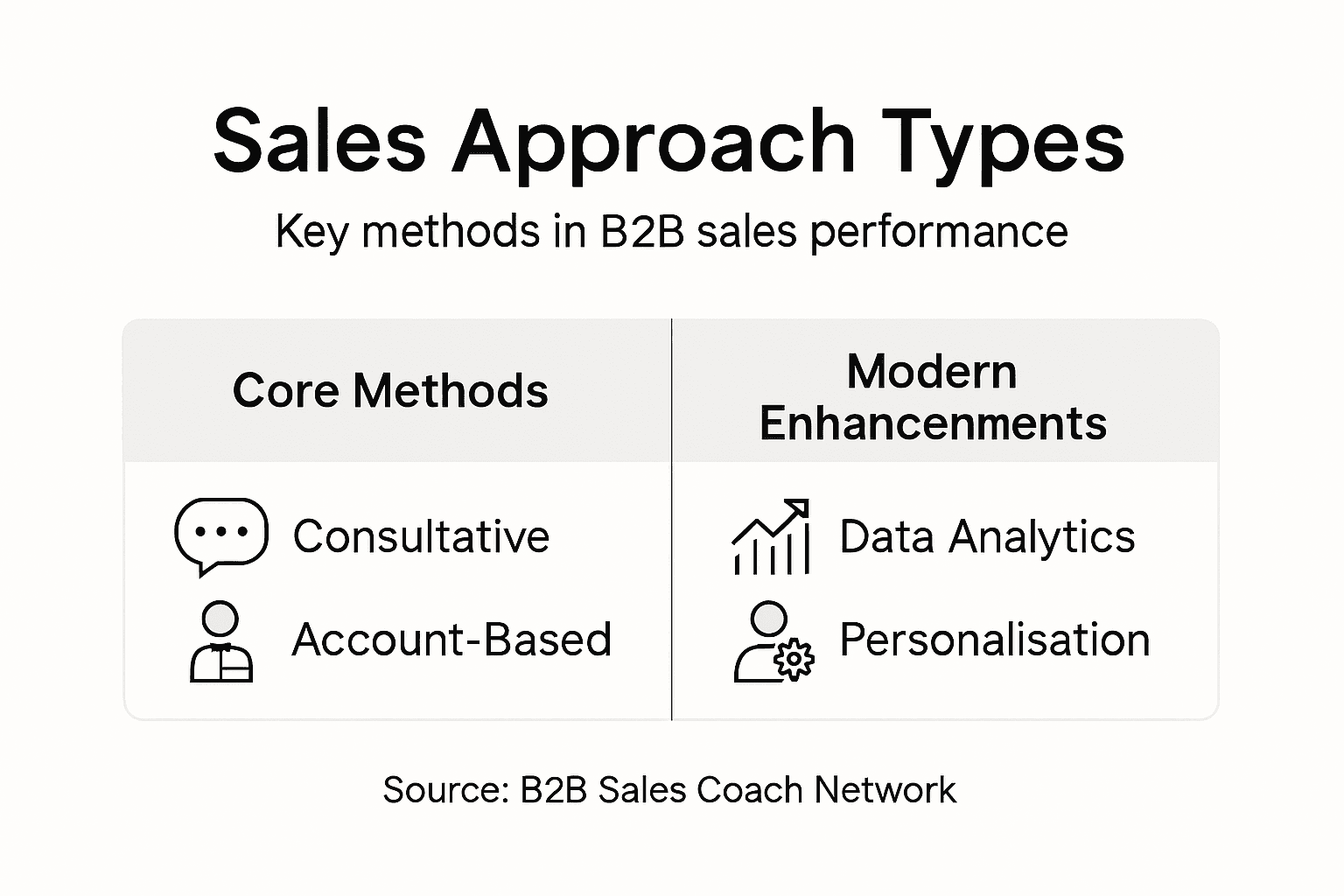
Consultative selling remains the gold standard for complex B2B deals. Rather than leading with your solution, consultative sellers ask diagnostic questions, listen actively, and build a compelling business case around the prospect’s actual challenges. This approach works because it positions you as a trusted adviser rather than a salesperson. It typically involves longer relationship building, deeper stakeholder engagement, and a focus on demonstrating clear return on investment. For enterprise deals where purchasing committees evaluate multiple suppliers, this method separates winners from also-rans. Another powerful approach is account-based selling, where you treat high-value prospects as individual markets. Instead of casting a wide net, you orchestrate a coordinated, multi-threaded campaign targeting specific accounts with tailored messaging, aligned across marketing and sales. This requires discipline, coordination, and patience, but when executed well, it compresses sales cycles and dramatically improves win rates. Value-based selling takes a different angle entirely. Rather than discussing price or features, this approach anchors conversations on the economic impact and strategic value your solution delivers. Your sellers quantify outcomes, connect solutions to business outcomes, and position pricing as an investment rather than a cost.
Modern B2B sales excellence increasingly demands combining these approaches with advanced data analytics and personalisation. Successful organisations now integrate omnichannel engagement, where prospects interact with you seamlessly across email, phone, digital channels, and in-person meetings. Some industries benefit from marketplace strategies, where you maintain presence on third-party platforms alongside direct sales efforts. The common thread across all effective modern approaches is this: they place the buyer at the centre, employ rigorous qualification criteria, and use data to guide decisions rather than intuition. Your sales approach must define which of these methods your team will employ, train people to execute them consistently, and measure results against clear, predictable benchmarks. When done right, this transforms a sales team from a collection of lone wolves into an orchestrated machine.
Pro tip: Audit your closed deals from the past year and identify which approach was used to win each one, then cluster wins by approach type. Your data will reveal which methodology drives results in your specific market, giving you the foundation to build your company-wide approach.
Below is a comparison of key B2B sales approaches and their unique benefits:
Approach Type | Distinguishing Feature | Ideal Use Case | Primary Business Benefit |
Consultative Selling | Diagnostic questioning | Complex, multi-stakeholder sales | Builds trust, uncovers real needs |
Account-Based Selling | Targeted, coordinated outreach | High-value strategic accounts | Increases win rates, shortens cycles |
Value-Based Selling | Emphasis on measurable impact | Outcomes-focused buyers | Justifies investment, aligns goals |
Core Elements of an Effective Sales Approach
An effective sales approach cannot be built on guesswork or wishful thinking. It must rest on a foundation of deliberate, interconnected elements that work together to move buyers through their decision journey. Without these core building blocks, even a talented sales team will struggle to generate consistent results. The first essential element is a clear understanding of your target market. This goes far deeper than identifying job titles or company sizes. You need to know the genuine business challenges your ideal customers face, the pressures their leaders experience, and the outcomes they desperately want to achieve. Without this grounding, your team will pursue prospects that look right on paper but have no real need for what you offer. The second element is a well-articulated value proposition and differentiation framework. Your buyers are drowning in competing options. They need to understand not just what you do, but why you are different and why that difference matters to their specific situation. This requires clarity about which problems you solve best, which customers you serve best, and what measurable outcomes they can expect.
The third core element is a defined sales process that maps to your buyer’s decision journey. This is where many organisations stumble. They define a process that feels good to salespeople but bears no relationship to how their buyers actually make decisions. Your process should articulate the stages of progress from initial awareness through to contract signature. At each stage, you need clarity about what activities move deals forward, what conversation milestones indicate progress, and what signals reveal that a deal is stalled. The fourth element is rigorous qualification methodology. Not every opportunity is worth pursuing. Qualification criteria help your team distinguish between genuine prospects and time wasters, preventing wasted effort on deals destined to fail. Qualification also enables better pipeline forecasting because you know which opportunities truly have a path to close. The fifth element is consistent relationship and rapport building techniques. Many salespeople assume that rapport happens naturally through conversation. In reality, trust is built methodically. Your approach should teach team members how to prepare effectively before sales conversations, ask diagnostic questions that demonstrate genuine understanding, and position themselves as informed advisers rather than order takers.

The sixth element is continuous performance evaluation and adaptation. A sales approach must be alive. It cannot be set once and forgotten. Your leadership team needs mechanisms to monitor what is working, what is falling flat, and where the market is shifting. This requires regular pipeline reviews, win loss analysis, and feedback loops from your sales team about what barriers they encounter. The seventh and final core element is a support system that enables execution. This includes sales enablement tools like battlecards and objection handlers, training programmes that embed new skills, and management coaching that holds your team accountable to the approach. An effective sales approach also requires access to customer data and intelligence that helps sellers tailor their engagement. When all seven elements operate together, something remarkable happens. Your sales team stops being a collection of individuals with different methods and becomes a coordinated system delivering predictable results.
Pro tip: Map each of these seven elements against your current sales operations. Identify which elements are strong and which are weak, then prioritise closing the gaps that directly impact your biggest revenue challenges first, rather than trying to fix everything simultaneously.
Common Pitfalls and Misconceptions in Sales
Many sales leaders inherit false beliefs about how B2B selling actually works. These misconceptions become self-fulfilling prophecies, leading to wasted resources, demoralised teams, and disappointing results. The first major misconception is that the best product always wins. This belief is comforting but dangerously wrong. In reality, your solution is rarely the differentiator. What matters far more is whether you understand the buyer’s world better than your competitors, whether you build trust with the right stakeholders, and whether you position your offering in terms of outcomes the buyer genuinely values. I have seen technically inferior solutions win enterprise deals because the sales team was sharper, more consultative, and better connected to the buyer’s decision-makers. Conversely, I have watched best-in-class products languish because the sales approach was transactional and feature-focused. The second misconception is that purchasing decisions are purely rational. This myth leads sales teams to load presentations with data and specifications, assuming rational analysis will drive the decision. But B2B buying is deeply human. Individual stakeholders have career concerns, political capital to protect, and preferences shaped by past experiences. A CFO might block your solution because she fears the implementation risk will damage her credibility. A technical lead might reject it because the selection process threatens his influence. Understanding and addressing these human motivations matters as much as demonstrating financial return.
Another pervasive misconception is that only C-level executives matter in B2B decisions. This oversimplifies how modern organisations buy. In complex deals, decision-making committees typically involve finance, operations, IT, legal, and the business sponsor. Focusing exclusively on the C-suite whilst ignoring these influencers is a recipe for stalled deals. Your approach must identify the entire buying committee, understand each stakeholder’s criteria and concerns, and build support throughout the organisation. Similarly, many sales leaders wrongly assume that more features equate to more sales appeal. In truth, buyers are often overwhelmed by feature lists. They care about solving specific problems. Feature-rich presentations actually confuse the conversation and weaken your differentiation. Your sales approach should teach teams to discuss only the capabilities that directly address the prospect’s stated challenges. There is also a persistent myth that cold outreach is ineffective. Some leaders abandon prospecting altogether, relying solely on inbound leads. This creates pipeline vulnerability. When managed with discipline and proper understanding of what works, cold outreach remains a powerful tool for generating qualified pipeline.
Finally, many organisations make the mistake of treating the sale as the finish line rather than the beginning of the relationship. Once a contract is signed, the focus shifts away from the newly acquired customer. This is a critical error. The post-sale phase is where you build loyalty, uncover expansion opportunities, and create advocates who influence future purchases. A well-designed sales approach includes clear handoff processes to implementation teams, systematic account reviews, and structured upselling strategies. When you recognise and correct these misconceptions, your sales approach becomes grounded in reality rather than wishful thinking. Your team focuses on what actually drives wins in your market.
Pro tip: Run a candid debrief with your sales team and ask them which of these misconceptions they have witnessed firsthand in your organisation. Their answers will reveal where your current approach is weakest and where coaching and course correction will have the greatest impact.
The following table summarises common B2B sales misconceptions and their risks:
Misconception | Why It Is Misleading | Potential Outcome |
Best product always wins | Buyers value trust and relevance | Superior solution may lose out |
Decisions are purely rational | Human factors shape choices | Missed motivations, stalled deals |
Only C-levels decide | Committees are multi-layered | Ignoring influencers slows progress |
More features = better pitch | Buyers seek solutions not features | Confused messaging, lost deals |
Maximising Results through Tailored Approaches
One size fits all sales approaches are relics of a bygone era. Today’s most successful B2B organisations recognise that different market segments, customer profiles, and deal sizes demand different strategies. A tailored approach is not about creating chaos or abandoning consistency. Rather, it is about building a flexible framework that adapts to real-world conditions whilst maintaining core discipline. The starting point is understanding that your market is not homogeneous. You might sell to mid-market technology companies that move quickly and value speed to implementation, whilst simultaneously pursuing enterprise accounts where decision-making takes months and stakeholder alignment is everything. These require different approaches. For mid-market, your sales team might emphasise rapid deployment, clear ROI metrics, and a streamlined buying process. For enterprise, they might focus on detailed business cases, executive relationship building, and comprehensive change management support. A tailored approach acknowledges these differences explicitly and equips your team to navigate them effectively.
The second dimension of tailoring is customer maturity and buying behaviour. A prospect that has never purchased a solution like yours requires extensive education and relationship building. They need help understanding what questions to ask, what pitfalls to avoid, and how to structure their buying process. Conversely, a repeat buyer already understands the market and wants efficiency. Your sales approach should include different conversation playbooks, enablement materials, and timeline expectations for these different buyer profiles. The third dimension involves tailoring your engagement model. Some prospects prefer predominantly digital interaction. Others insist on face to face meetings. The most sophisticated approach combines multiple engagement channels that meet buyers where they prefer to engage, whether that is email, video calls, in person meetings, or marketplace platforms. Your sales approach should document which channels work best for which customer segments and what level of personalisation each channel enables.
Tailoring also extends to the type and depth of value proposition you emphasise. A sustainability-focused prospect cares deeply about your environmental credentials and supply chain practices. A cost-conscious buyer wants proof of operational efficiency gains. A growth-focused leader is interested in how your solution unlocks new revenue streams. A single, generic pitch that ignores these motivations wastes opportunity. Your approach should teach sellers to identify the buyer’s primary value driver early in the conversation and to anchor the discussion around that driver. This requires sales enablement materials organised by value dimension, not by product feature. It also requires manager coaching that helps sellers recognise when they have misidentified a prospect’s true priorities and adjust course. Finally, tailoring means building flexibility into your sales process itself. Some deals move fast and require accelerated decision-making. Others stall for legitimate reasons. Your process should define what flexibility looks like, when it is appropriate to accelerate timelines versus when patience is required, and how to maintain discipline without becoming rigid. The teams that master this balance move deals faster without destroying pipeline quality.
Pro tip: Map your top ten largest customers by segment and customer profile, then reverse engineer which approach elements contributed to winning each deal. Identify patterns in what worked, then codify those patterns into optional playbooks your team can deploy for similar opportunities going forward.
Unlock Predictable B2B Sales Growth with The Sales Coach Network
The article highlights critical challenges in defining a robust sales approach such as unpredictable revenue, inconsistent pipeline, and stalled deals due to lack of rigour and alignment with buyer behaviours. If your sales team struggles with prolonged sales cycles, low win rates, or difficulty in managing complex decision committees, these pain points reflect the systemic issues we specialise in resolving. Concepts like consultative selling, rigorous qualification, and buyer-centric engagement featured in the article are central to our proven methodology.
At The Sales Coach Network we don’t offer generic training but embed scalable, practical sales operating systems tailored for complex B2B sectors. Our expert practitioners help senior sales leaders implement frameworks like the Sales Accelerator Method and the VALID Differentiation Framework that directly increase pipeline quality, deal sizes, win rates and accelerate sales cycles. By partnering with us, your team gains a clear commercial strategy, consultative skills, and disciplined execution coaching that turns individual effort into predictable, sustainable revenue.
Ready to transform your sales approach and end the cycle of unpredictable results Discover how our tailored sales training programmes and expert sales coaching services can equip your leaders and sellers to consistently win. Visit The Sales Coach Network today to take the next step towards measurable B2B sales performance improvement.
Frequently Asked Questions
What is a B2B sales approach?
A B2B sales approach is a documented system that outlines how a sales team generates opportunities, qualifies prospects, builds trust with decision-makers, and progresses deals towards closure.
Why is a defined sales approach important for B2B sales?
A defined sales approach is vital because it provides structure, aligns activities with business objectives, and promotes consistent results, preventing teams from pursuing every lead equally or missing critical deal signals.
What are the key types of sales approaches in B2B?
The key types of B2B sales approaches include consultative selling, account-based selling, and value-based selling, each tailored to different buyer behaviours, market segments, and sales processes.
How can businesses tailor their sales approach?
Businesses can tailor their sales approach by understanding their market segments, customer maturity, engagement models, and value propositions, allowing for a flexible methodology that adapts to individual buyer preferences.
Recommended