
Sales Leadership Development Programme: Driving UK B2B Growth
- The Sales Coach Network
- Jan 17
- 7 min read


Long sales cycles and unpredictable pipelines can leave even the most seasoned sales leaders searching for answers. In the fast-moving world of British B2B technology, strong leadership makes the difference between growth and stagnation. Investing in a strategic sales leadership development programme delivers the practical frameworks and advanced skills your organisation needs to transform its sales performance and empower teams to succeed.
Table of Contents
Key Takeaways
Point | Details |
Sales Leadership Development Programmes | These programmes transform sales professionals into exceptional leaders by focusing on advanced competencies and sustainable growth strategies. |
Core Competencies | Effective sales leaders must master skills like emotional intelligence, strategic thinking, and adaptability to enhance team performance. |
Role of Coaching | Coaching facilitates personal growth and resilience in sales teams by developing intrinsic motivation and problem-solving skills. |
Implementing Success Metrics | Measuring programme effectiveness involves behavioural assessments and performance metrics to ensure continuous improvement in leadership development. |
Defining Sales Leadership Development Programmes
Sales leadership development programmes represent strategic initiatives designed to transform sales professionals into exceptional organisational leaders. These comprehensive programmes go beyond traditional training, focusing on building holistic capabilities that drive sustainable business growth. By integrating advanced strategic thinking, interpersonal skills, and operational expertise, strategic sales leadership approaches enable organisations to develop high-performance sales teams.
At their core, these programmes aim to equip sales leaders with multidimensional competencies necessary for navigating complex business environments. They typically encompass critical development areas including strategic planning, team management, performance optimisation, and advanced relationship building. Participants learn to transform traditional sales approaches into dynamic, customer-centric strategies that align with broader organisational objectives. The ultimate goal is creating leaders who can not only meet sales targets but also drive transformative change across their entire commercial ecosystem.
Effective sales leadership development programmes recognise that modern sales leadership extends far beyond quota achievement. They emphasise developing adaptable leaders capable of managing diverse teams, leveraging technological innovations, and creating robust sales infrastructures. By combining theoretical frameworks with practical skill-building, these programmes prepare sales professionals to become strategic assets who can navigate increasingly complex market dynamics.
Expert Tip: Invest in programmes that offer both theoretical knowledge and practical application, ensuring your sales leaders can immediately translate learning into organisational performance.
Key Leadership Types and Core Competencies
Sales leadership encompasses diverse approaches tailored to different organisational contexts and team dynamics. Leadership types in sales range from transformational and strategic to coaching and operational models, each offering unique methods for driving team performance. Transformational leaders inspire radical change and innovation, while strategic leaders focus on long-term vision and systematic growth planning.
Core competencies represent the fundamental skills and capabilities that distinguish exceptional sales leaders. These include advanced communication techniques, emotional intelligence, strategic thinking, and the ability to motivate diverse teams. Key competencies typically involve mastering skills such as performance management, strategic planning, relationship building, and adapting leadership approaches to complex business environments. Successful sales leaders must demonstrate versatility in navigating intricate interpersonal dynamics while maintaining a clear focus on organisational objectives.

Modern sales leadership requires a multifaceted approach that integrates technological understanding, cultural intelligence, and adaptive management techniques. Leaders must balance analytical skills with interpersonal capabilities, creating environments that foster continuous learning, innovation, and high-performance sales cultures. This involves developing robust coaching frameworks, implementing data-driven performance metrics, and creating supportive team structures that enable individual and collective growth.
Expert Tip: Regularly assess and develop your leadership competencies through targeted training, peer feedback, and self-reflection to maintain your effectiveness in evolving sales landscapes.
Here is a comparison of key sales leadership styles and their primary organisational impact:
Leadership Style | Core Focus | Team Impact | Organisational Benefit |
Transformational | Inspiring innovation | Drives cultural change | Fosters continuous improvement |
Strategic | Long-term planning | Aligns team to vision | Enhances goal cohesion |
Coaching | Individual development | Builds self-motivation | Increases talent retention |
Operational | Efficiency and execution | Ensures consistent output | Optimises day-to-day performance |
Essential Frameworks and Practical Components
Sales leadership development requires robust strategic frameworks and practical learning approaches that transform theoretical knowledge into actionable skills. Contemporary programmes integrate comprehensive methodological structures designed to address complex sales challenges, focusing on bridging theoretical understanding with real-world application. These frameworks typically encompass strategic planning, performance analysis, and adaptive leadership techniques that enable sales professionals to navigate increasingly dynamic business environments.
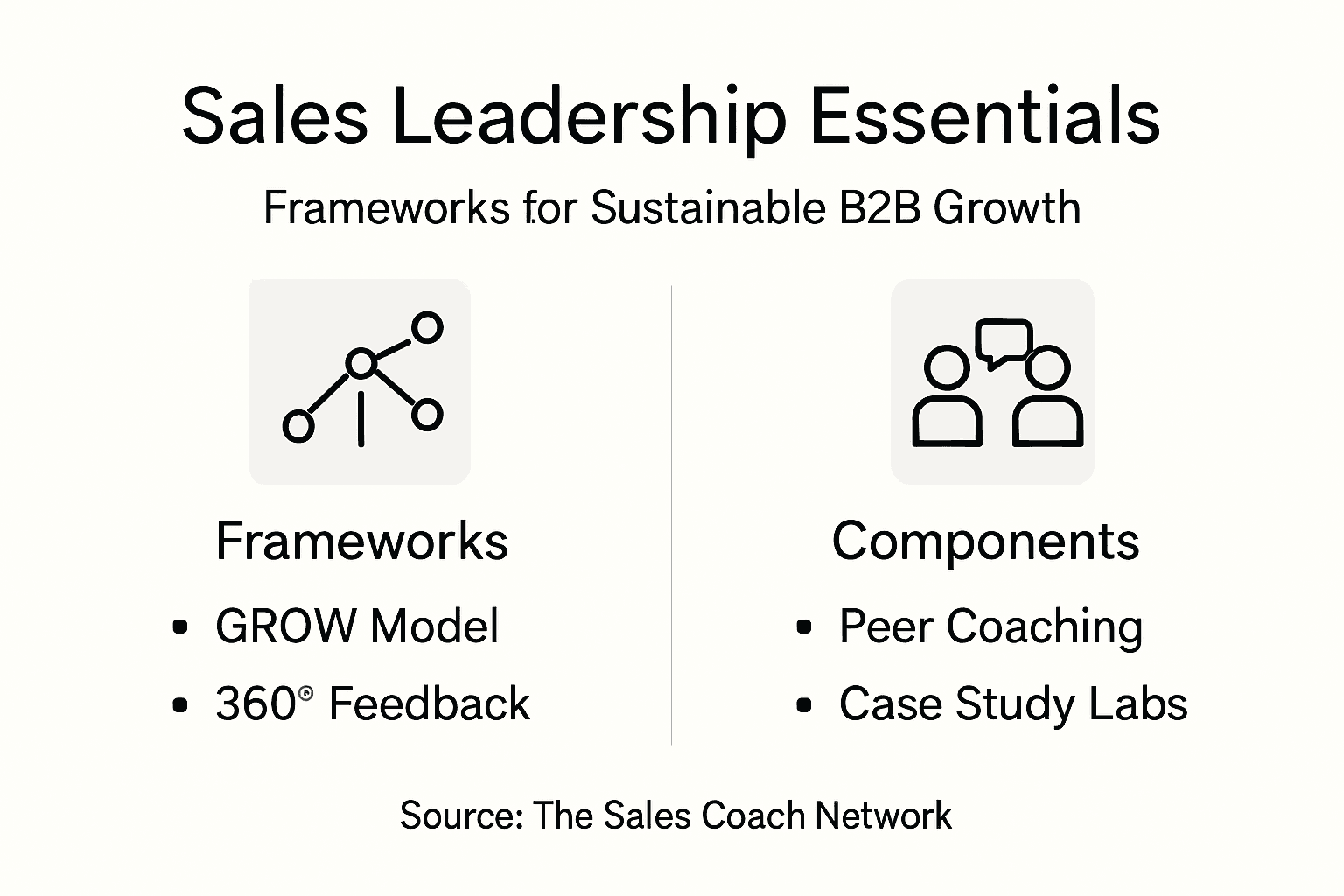
Key practical components of effective sales leadership development include immersive learning experiences such as case study analysis, leadership simulations, and strategic planning exercises. These interactive methodologies allow participants to experiment with different leadership approaches, understand their strengths and limitations, and develop nuanced problem-solving skills. Participants engage in scenarios that replicate genuine business challenges, enabling them to practise decision-making, team management, and strategic thinking in controlled yet realistic settings.
Successful leadership development frameworks also emphasise continuous personal and professional growth. They incorporate advanced diagnostic tools, 360-degree feedback mechanisms, and personalised development plans that help sales leaders understand their unique leadership styles, identify improvement areas, and create targeted strategies for enhancement. By combining structured learning with reflective practice, these programmes ensure that sales leaders can develop adaptive capabilities that transcend traditional training models and respond effectively to evolving market demands.
Expert Tip: Create a personal development portfolio documenting your leadership journey, capturing insights, challenges, and growth milestones to track your professional evolution systematically.
The following summary outlines practical components included in leading sales leadership development programmes:
Component | Description | Key Outcome |
Case Study Analysis | Real-world business scenario review | Strengthens analytical thinking |
Leadership Simulations | Interactive role-play exercises | Sharpens decision-making abilities |
360-Degree Feedback | Structured colleague evaluations | Identifies developmental priorities |
Personal Development Plan | Custom growth mapping | Sustains ongoing professional progress |
The Role of Coaching in Sustainable Change
Coaching represents a transformative approach to leadership development, moving beyond traditional management techniques towards creating sustainable organisational change. Unlike directive management styles, coaching empowers sales professionals to develop intrinsic motivation, self-awareness, and adaptive problem-solving capabilities. This approach fundamentally shifts leadership from telling employees what to do towards facilitating their personal and professional growth, creating more resilient and self-directed sales teams.
The coaching methodology employs sophisticated frameworks like the GROW model, which breaks down development into Goal, Reality, Options, and Way Forward stages. These structured approaches enable sales leaders to guide team members through complex challenges, helping them identify personal barriers, explore innovative solutions, and develop actionable strategies. By creating a supportive environment that encourages reflection and continuous learning, coaching transforms individual performance and organisational culture simultaneously.
Effective coaching transcends traditional training by embedding long-term behavioural change and psychological development. It focuses on building individual and collective capabilities, helping sales professionals develop emotional intelligence, strategic thinking, and adaptive leadership skills. This holistic approach ensures that learning is not a one-time event but a continuous journey of personal and professional evolution, ultimately driving sustainable performance improvements across sales organisations.
Expert Tip: Implement regular coaching check-ins using structured reflection questions to help your team members articulate their development goals and track meaningful progress.
Implementing and Measuring Programme Success
Successful sales leadership development programmes require strategic implementation frameworks and comprehensive measurement approaches. These programmes must transcend traditional training models by creating holistic, measurable pathways for leadership transformation. Implementation involves designing interventions that address individual learning needs while simultaneously aligning with broader organisational strategic objectives, ensuring that development efforts create tangible, sustainable performance improvements.
Measurement techniques for programme effectiveness encompass multiple dimensions, including behavioural assessments, performance metrics, and long-term organisational impact. Key evaluation methods include conducting structured leadership assessments, tracking individual and team performance indicators, analysing qualitative feedback, and monitoring business outcome improvements. These multifaceted approaches provide nuanced insights into programme effectiveness, allowing organisations to continuously refine and adapt their leadership development strategies.
The most sophisticated implementation models integrate data-driven methodologies with personalised development approaches. This involves creating adaptive learning pathways that combine theoretical knowledge, practical skills training, and ongoing coaching support. By developing comprehensive evaluation frameworks that measure both immediate skill acquisition and long-term leadership capabilities, organisations can ensure their development programmes deliver meaningful, sustainable performance enhancements across their sales teams.
Expert Tip: Develop a structured leadership development dashboard that tracks both quantitative performance metrics and qualitative behavioural changes to gain comprehensive insights into programme effectiveness.
Elevate Your Sales Leadership to Deliver Sustainable UK B2B Growth
The challenges outlined in the article highlight the need for strategic sales leadership programmes that develop adaptable leaders able to build pipeline, increase win rates, and shorten sales cycles. If you are a senior revenue leader frustrated by inconsistent team performance and complex sales environments, you need more than generic training. You require a scalable system that embeds leadership development with measurable impact across your entire sales ecosystem.
At The Sales Coach Network, we specialise in partnering with leaders exactly like you to fix systemic revenue problems through practical, holistic solutions. Our tailored sales leadership training empowers managers and directors to become effective coaches who embed new behaviours and drive accountability. By aligning strategic direction with disciplined execution, we help organisations adapt to market complexity, accelerate sales velocity, and achieve sustainable growth.
Ready to transform your sales leadership approach and break through growth barriers? Discover how we embed frameworks like the Sales Ecosystem and VALID Differentiation to create resilient, high-performing teams. Visit The Sales Coach Network to learn more about our proven leadership development programmes and begin your journey towards predictable, scalable revenue today.
Frequently Asked Questions
What is a Sales Leadership Development Programme?
Sales Leadership Development Programmes are strategic initiatives aimed at transforming sales professionals into exceptional leaders. They focus on holistic capabilities such as strategic thinking, interpersonal skills, and operational expertise, contributing to sustainable business growth.
What are the key competencies developed in these programmes?
Key competencies include advanced communication techniques, emotional intelligence, strategic planning, relationship building, and performance management. These skills help sales leaders navigate complex business environments and motivate diverse teams effectively.
How does coaching play a role in these programmes?
Coaching helps facilitate personal and professional growth by promoting intrinsic motivation and adaptive problem-solving. It shifts the focus from traditional management to empowering sales professionals, ultimately leading to more resilient and self-directed teams.
How can the success of a Sales Leadership Development Programme be measured?
Success can be measured through a combination of behavioural assessments, performance metrics, and long-term organisational impact. Structured leadership assessments and monitoring business outcome improvements provide valuable insights into programme effectiveness.
Recommended