
Team Leader in Sales: Driving UK B2B Success
- The Sales Coach Network
- Jan 13
- 8 min read


Nearly 60% of British sales directors in large B2B IT companies report challenges not only with pipeline quality but also longer sales cycles. These pressures make developing high-performing teams more vital than ever. Understanding what sets effective sales team leadership apart is the key to building robust processes and delivering predictable results across the British enterprise sector.
Table of Contents
Key Takeaways
Point | Details |
Sales Team Leaders Drive Performance | Effective sales team leaders combine strategy with coaching to enhance individual and team performance. |
Diverse Leadership Styles are Essential | Adapting leadership styles based on team dynamics fosters creativity and maintains motivation. |
Critical Skills for Success | Strong communication, analytical thinking, and emotional intelligence are vital for effective leadership in sales. |
Addressing Common Challenges | Proactively managing performance expectations and fostering open communication prevents disengagement and enhances productivity. |
Definition and core role in sales
A team leader in sales represents a pivotal management role responsible for guiding, motivating, and strategically directing a group of sales professionals towards achieving organisational revenue targets. Their core responsibility transcends traditional management by creating an environment of performance, accountability, and continuous skill development.
In the UK B2B landscape, sales team leaders must navigate complex enterprise sales ecosystems, which require sophisticated strategic oversight. Role of Sales Managers in Coaching reveals that successful leaders blend strategic thinking with hands-on coaching to drive predictable growth. These professionals are not merely supervisors but transformation agents who design sales processes, mentor individual team members, and implement systematic approaches to pipeline management and deal progression.
The fundamental responsibilities of a sales team leader include developing talent, setting performance benchmarks, creating robust sales strategies, and maintaining a disciplined approach to opportunity management. They are expected to analyse sales performance data, identify skill gaps, provide targeted training interventions, and ensure that each team member understands their individual and collective objectives. By establishing clear expectations and providing continuous feedback, team leaders create a performance-driven culture that consistently delivers results.
Top Tip: Invest at least 50% of your weekly management time in direct coaching and skill development activities with your sales team members to drive sustainable performance improvements.
Key types of sales leadership styles
Sales leadership styles significantly impact team performance, organisational culture, and ultimately revenue generation. These distinct approaches reflect a leader’s philosophy, personality, and strategic vision. Understanding types of sales leadership allows organisations to select and develop leaders who can effectively drive performance in complex B2B environments.
Five primary sales leadership styles emerge in contemporary UK business contexts. The directive leader provides clear instructions and expects precise execution, suitable for teams requiring structured guidance. The coaching leader focuses on individual skill development, investing time in mentoring and personal growth. The collaborative leader emphasises team synergy, creating environments where collective problem-solving thrives. The visionary leader communicates broader strategic objectives, inspiring teams with compelling long-term perspectives. The democratic leader encourages team input and shared decision-making, promoting engagement and innovative thinking.
Successful sales leaders often blend these styles contextually, recognising that rigid adherence to a single approach limits adaptability. High-performing sales teams require leaders who can dynamically adjust their leadership style based on individual team member capabilities, organisational goals, and specific sales challenges. This adaptive approach ensures flexibility, maintains motivation, and supports consistent performance across diverse sales scenarios.
Pro Tip: Regularly assess and rotate your leadership approach, matching your style to each team member’s developmental stage and current performance level to maximise individual and collective potential.
Here is a comparison of the five key sales leadership styles and their ideal team environments:
Leadership Style | Core Approach | Best For Team Type | Key Benefit |
Directive | Structured guidance | New or underperforming teams | Reduces ambiguity |
Coaching | Mentoring focus | Teams needing skill growth | Individual performance improves |
Collaborative | Team synergy | Diverse problem-solvers | Promotes creative solutions |
Visionary | Strategic inspiration | Teams seeking long-term goals | Enhances motivation |
Democratic | Shared decision-making | Engaged, innovative teams | Boosts team commitment |
Essential skills for effective team leaders
Sales team leadership demands a sophisticated blend of technical proficiency and interpersonal expertise. Leadership skills for sales teams represent a complex ecosystem of capabilities that extend far beyond traditional management techniques. Modern sales leaders must simultaneously navigate strategic planning, team motivation, performance management, and individual skill development.

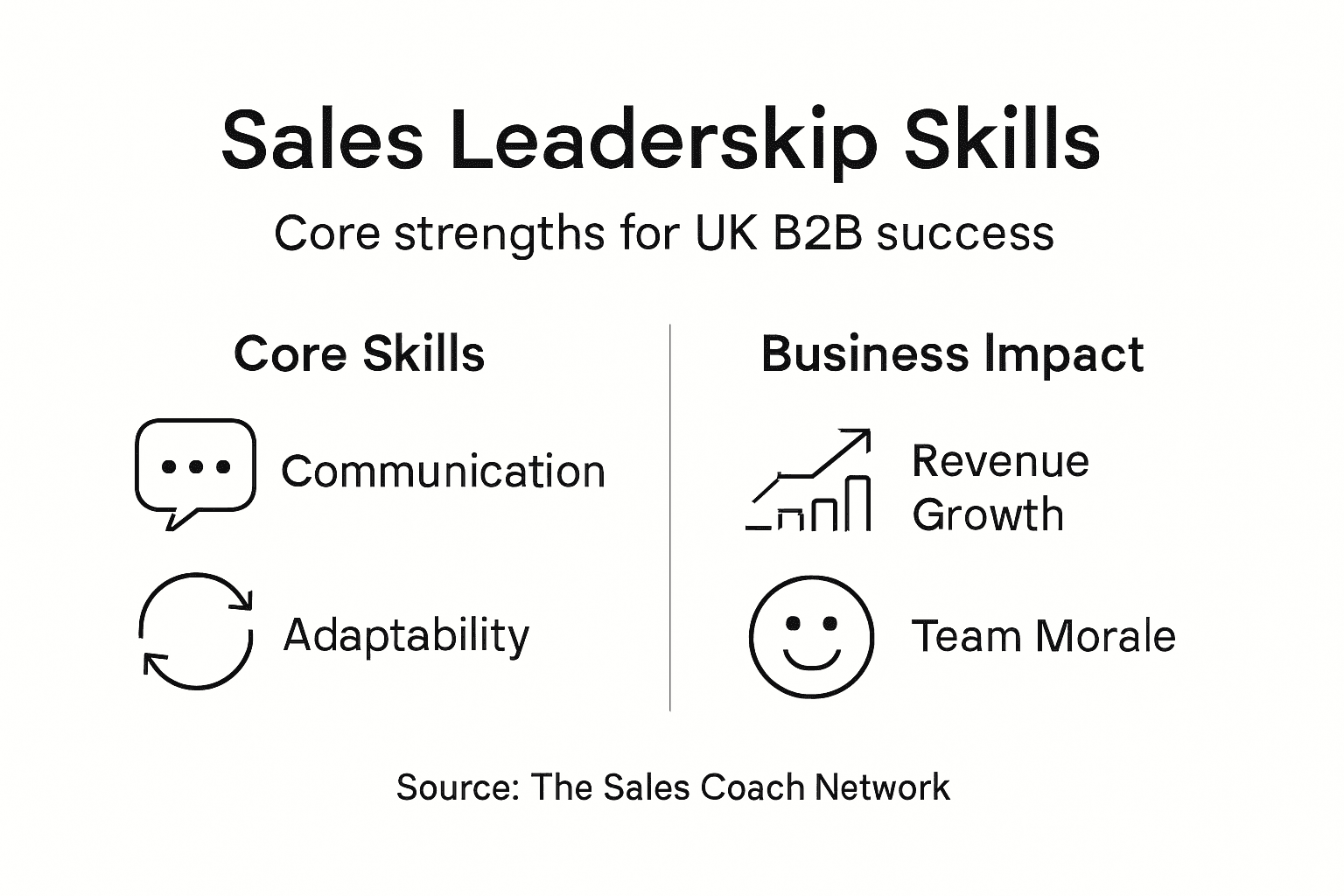
Key essential skills for effective sales team leaders include robust communication capabilities, which involve articulating clear expectations, providing constructive feedback, and creating transparent dialogue channels. Analytical thinking enables leaders to interpret sales metrics, identify performance trends, and make data-driven decisions. Emotional intelligence emerges as a critical competency, allowing leaders to understand team dynamics, manage individual motivations, and create supportive environments that encourage peak performance.
The most successful sales team leaders demonstrate exceptional adaptability, combining strategic vision with tactical execution. They possess strong coaching abilities, can develop individual team members’ potential, and maintain a holistic view of organisational objectives. Advanced problem-solving skills, resilience under pressure, and the capacity to build trust through consistent, transparent leadership behaviours differentiate outstanding sales team leaders from merely competent managers.
Pro Tip: Dedicate time each week to individual team member development, focusing on personalised coaching that addresses specific skill gaps and career aspirations.
Below is a summary of essential skills for effective sales team leaders and how each drives performance:
Leadership Skill | Description | Business Impact |
Communication | Sets expectations, feedback | Improves clarity & morale |
Analytical Thinking | Interprets sales data | Enables informed decisions |
Emotional Intelligence | Manages team dynamics | Enhances motivation |
Adaptability | Adjusts to changing needs | Sustains high performance |
Coaching Ability | Develops individual potential | Raises skill levels |
Strategic responsibilities and daily duties
Sales team leaders shoulder complex responsibilities that bridge strategic planning and operational execution. Sales team leadership duties encompass a comprehensive range of activities designed to drive organisational performance and team effectiveness. These responsibilities demand a delicate balance between high-level strategic thinking and granular operational management.
Strategic responsibilities involve developing comprehensive sales strategies aligned with organisational objectives. This includes conducting market analysis, setting ambitious yet achievable sales targets, creating detailed forecasting models, and designing performance frameworks that motivate and guide sales teams. Leaders must continuously evaluate market trends, identify emerging opportunities, and adapt strategic approaches to maintain competitive advantage. They are responsible for creating robust sales methodologies, establishing key performance indicators, and developing scalable systems that support consistent revenue generation.
Daily duties require meticulous attention to team performance and individual development. Sales team leaders spend significant time conducting performance reviews, providing targeted coaching, managing sales pipelines, and resolving complex interpersonal and operational challenges. They coordinate closely with multiple stakeholders, including senior management, marketing teams, and client-facing representatives, ensuring seamless communication and alignment of organisational goals. Reporting, data analysis, budget management, and maintaining detailed performance tracking systems form critical components of their daily operational responsibilities.
Pro Tip: Implement a structured daily routine that allocates specific time blocks for strategic planning, team coaching, performance review, and individual development to maintain consistent organisational momentum.
Common challenges and pitfalls to avoid
Sales team leaders encounter numerous systemic challenges that can significantly undermine team performance and organisational effectiveness. Common sales mistakes represent critical obstacles that require strategic intervention and proactive management. Understanding these potential pitfalls is essential for maintaining a high-performing sales ecosystem.
One primary challenge involves misaligned performance expectations, where leaders establish unrealistic targets without providing adequate support or resources. This creates demotivation and potential team disengagement. Another significant pitfall emerges through ineffective communication, where leaders fail to provide clear, consistent guidance or neglect individual team member development. Micromanagement and lack of autonomy can equally stifle creativity and reduce intrinsic motivation, causing talented sales professionals to disengage or seek opportunities elsewhere.
Additional critical challenges include inadequate performance tracking mechanisms, resistance to technological adaptation, and failure to develop a coaching culture. Sales team leaders must be vigilant about avoiding confirmation bias, where they selectively interpret data that confirms existing beliefs rather than objectively assessing team performance. Overlooking individual team member’s unique strengths, neglecting continuous learning opportunities, and maintaining rigid, outdated sales methodologies can dramatically limit team potential and organisational growth.
Pro Tip: Conduct monthly retrospective meetings that systematically analyse team performance, identifying both individual and collective challenges while collaboratively developing targeted improvement strategies.
Impact on sales performance and outcomes
Sales team leaders play a transformative role in driving organisational performance, directly influencing revenue generation and strategic outcomes. Sales team performance represents a complex ecosystem where leadership quality determines the trajectory of business success. Their impact extends far beyond traditional management, fundamentally shaping team productivity, motivation, and strategic alignment.
The quantifiable impact of effective sales leadership manifests through multiple critical performance metrics. Revenue generation becomes more predictable and consistent when leaders implement robust coaching frameworks, establish clear performance expectations, and create supportive developmental environments. Team leaders who prioritise skill enhancement, provide regular feedback, and design targeted performance improvement strategies can significantly increase average deal values, reduce sales cycle lengths, and improve overall win rates. Their ability to analyse performance data, identify skill gaps, and create personalised development plans directly translates into enhanced team capabilities.
Beyond numerical outcomes, sales team leaders profoundly influence organisational culture and team dynamics. They are responsible for creating psychological safety, fostering innovation, and building resilient sales ecosystems that can adapt to changing market conditions. By developing a coaching mindset, maintaining transparent communication channels, and promoting continuous learning, these leaders transform sales teams from transactional units into strategic growth engines. Their leadership determines not just short-term performance metrics but long-term organisational adaptability and competitive positioning.
Pro Tip: Develop a quarterly performance dashboard that tracks both quantitative metrics and qualitative team development indicators to provide comprehensive insights into team performance and growth potential.
Empower Your Sales Team Leadership for Lasting UK B2B Growth
The article highlights crucial challenges faced by sales team leaders such as aligning performance expectations, developing coaching skills, and adopting adaptive leadership styles to drive sustainable results. Many leaders struggle with inconsistent revenue and need a systematic way to embed disciplined execution while fostering individual development and team motivation. If you recognise these pain points, then addressing the unpredictable sales performance cycle and skill gaps is essential to unlocking real growth in your complex B2B environment.
At The Sales Coach Network, we specialise in transforming sales leadership capabilities through practical, scalable systems rather than generic training. Our bespoke sales leadership training and expert coaching services empower leaders to adopt proven frameworks like the Forty-20-40 Principle, which balances strategy, enablement, and execution to embed lasting behavioural change. By focusing on growing individual potential, implementing disciplined coaching practices, and improving key sales velocity drivers such as pipeline quality and win rates, we help sales leaders move beyond reactive management towards confident, data-driven leadership.
Ready to elevate your leadership impact and deliver predictable, scalable growth in the UK B2B market? Explore how our tailored sales training programmes for managers and enterprise sales coaching can help you embed a high-performance culture that consistently wins. Visit The Sales Coach Network today and start building the sales leadership foundation your organisation needs for long-term success.
Frequently Asked Questions
What is the core role of a sales team leader?
The core role of a sales team leader involves guiding and motivating sales professionals to achieve organisational revenue targets, while also focusing on performance accountability and continuous skill development.
What are the key sales leadership styles?
The key sales leadership styles include directive, coaching, collaborative, visionary, and democratic leadership, each suited to different team dynamics and performance needs.
What essential skills should an effective sales team leader possess?
Effective sales team leaders should possess strong communication skills, analytical thinking, emotional intelligence, adaptability, and coaching abilities to successfully develop their team members and drive performance.
What common challenges do sales team leaders face?
Sales team leaders commonly face challenges such as misaligned performance expectations, ineffective communication, micromanagement, inadequate performance tracking, and resistance to adopting new technologies.
Recommended