
Enterprise Sales Courses: Driving Predictable Growth
- The Sales Coach Network
- Jan 16
- 7 min read


Over 44 percent of British B2B sales leaders say their teams struggle to convert complex enterprise deals. This reality puts intense pressure on senior managers across the United Kingdom to find new ways to strengthen pipeline performance and upskill sales teams. Understanding what specialised enterprise sales courses truly offer can make the difference between stagnating results and leading a high-impact British sales force built for long-term success.
Table of Contents
Key Takeaways
Point | Details |
Specialised Training is Essential | Enterprise sales courses focus on equipping professionals with skills tailored to complex B2B sales environments. |
Diverse Training Formats Available | Programmes vary from structured methodologies to intensive workshops, addressing specific skill enhancements. |
Blended Learning Approach Recommended | A combination of delivery methods ensures both theoretical knowledge and practical application are reinforced. |
Measurable Outcomes Drive Success | Establishing a robust measurement framework connects training to tangible sales performance improvements. |
Defining Enterprise Sales Courses in B2B
Enterprise sales courses represent specialised training programmes designed to equip sales professionals with advanced skills needed to navigate complex B2B sales environments. These strategic learning interventions go beyond traditional sales training by focusing on high-value, consultative selling approaches specifically tailored for large organisational contexts.
The core objective of enterprise sales courses is to develop sophisticated capabilities that enable sales teams to manage intricate buying processes, build executive-level relationships, and drive substantial revenue growth. Strategic sales leadership programmes like those offered at Cranfield University demonstrate how these courses systematically prepare sales leaders to align sales strategies with broader business objectives.
Typical enterprise sales courses cover critical competencies such as advanced opportunity qualification, complex deal negotiation, executive engagement techniques, value proposition development, and strategic account management. These programmes often incorporate practical frameworks that help sales professionals understand nuanced client needs, construct compelling business cases, and consistently progress high-stakes sales opportunities through intricate decision-making environments.
Pro tip: When selecting an enterprise sales course, prioritise programmes that offer practical, real-world frameworks and provide ongoing coaching support to ensure skills translate into tangible performance improvements.
Types of Enterprise Sales Training Programmes
Enterprise sales training programmes encompass a diverse range of learning interventions designed to enhance the capabilities of sales professionals across different organisational contexts. Sales training methodologies in the United Kingdom demonstrate significant variation, from structured process-driven approaches to more nuanced, role-specific development strategies.
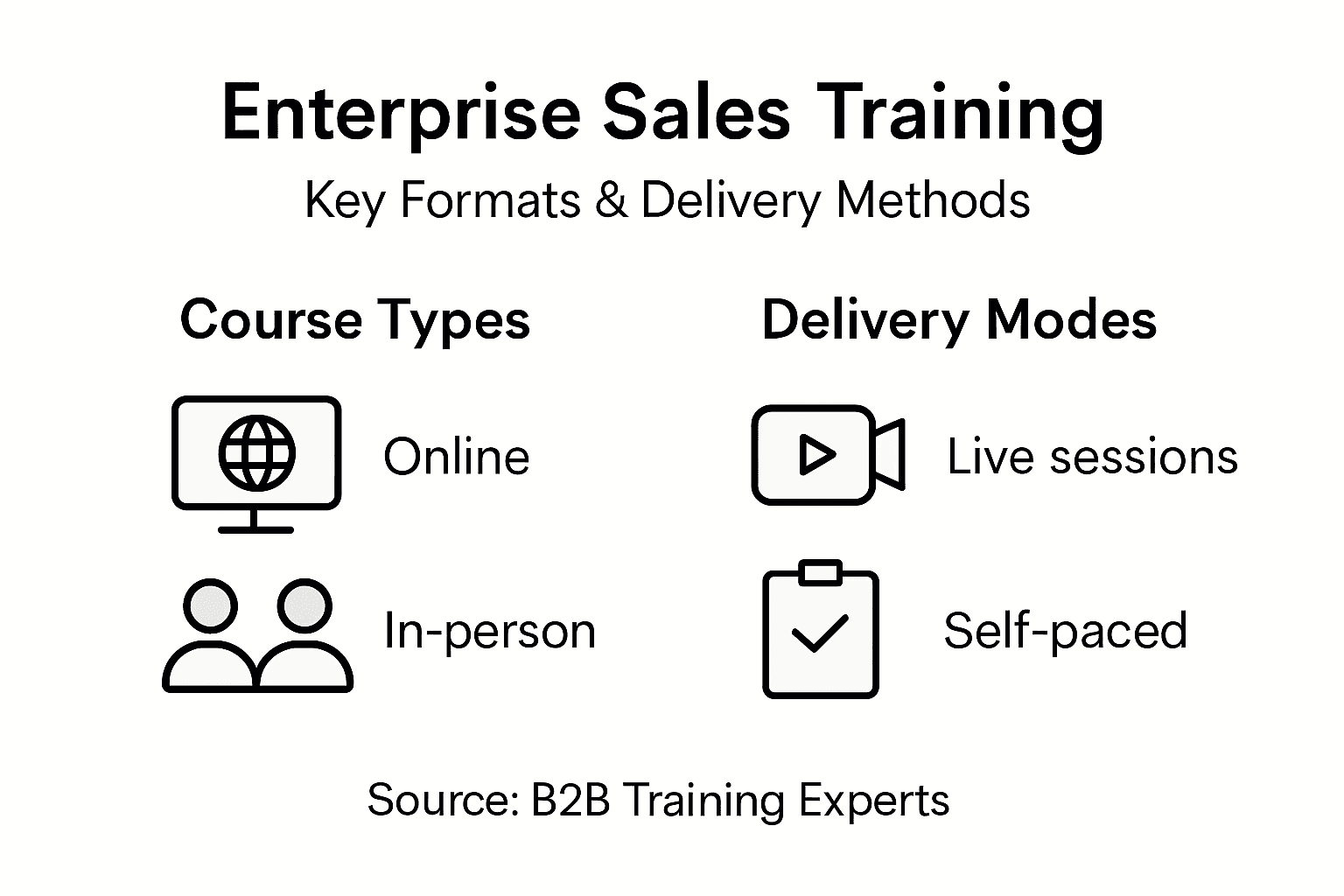
These training programmes typically fall into several critical categories. Process-driven methodologies like Sandler Training focus on establishing disciplined sales frameworks, while graduate-level programmes such as those from Pareto Law emphasise talent assessment and skill development for emerging sales professionals. Specialised training formats include intensive bootcamps, continuous learning modules, virtual workshops, and executive-level coaching programmes that target specific skill enhancements such as complex negotiation techniques, strategic account management, and executive relationship building.
Modern enterprise sales training programmes are increasingly tailored to address specific industry challenges and sales role requirements. Some programmes concentrate on technical skill development like advanced prospecting techniques, while others emphasise soft skills such as strategic communication, client engagement, and consultative selling approaches. These training interventions are designed to equip sales teams with the sophisticated capabilities required to navigate complex B2B sales landscapes, drive revenue growth, and consistently deliver high-performance outcomes.
Here’s a summary of popular enterprise sales training formats and their unique characteristics:
Training Format | Distinctive Features | Suitable For | Example Providers |
Process-driven | Structured, methodology-focused content | Large sales teams | Sandler Training |
Graduate-level | Talent assessment and foundational skills | Early-career professionals | Pareto Law |
Executive coaching | Customised for leadership, strategic skills | Sales leaders, managers | Cranfield University |
Bootcamp/workshop | Intensive, hands-on scenario simulations | Skill-specific interventions | Multiple UK consultancies |
Pro tip: When evaluating enterprise sales training programmes, assess their alignment with your specific organisational goals and select those offering flexible, practical learning formats that can be directly implemented in your sales ecosystem.
Core Components and Delivery Methods
Enterprise sales training programmes are fundamentally structured around comprehensive learning components designed to transform sales professionals’ capabilities across multiple dimensions. These core components typically encompass strategic skill development, practical application frameworks, and advanced performance enhancement techniques that address the complex requirements of modern B2B sales environments.
The delivery methods for enterprise sales training have evolved significantly, incorporating a multifaceted approach that blends traditional and innovative learning strategies. Enterprise sales training now utilises a range of modalities including immersive classroom sessions, interactive virtual workshops, digital learning platforms, simulation-based training, one-to-one executive coaching, and ongoing performance support mechanisms. These varied delivery formats enable organisations to create flexible, scalable learning experiences that can be tailored to individual and team development needs.

Key components of effective enterprise sales training programmes include advanced skill modules covering critical areas such as strategic account management, consultative selling techniques, negotiation mastery, complex solution selling, executive communication strategies, and data-driven sales intelligence. These components are typically structured to progressively build capabilities, starting with foundational skills and advancing to sophisticated, context-specific competencies that enable sales professionals to navigate intricate B2B sales landscapes with confidence and strategic insight.
Compare the business impacts of core enterprise sales competencies:
Competency | Primary Business Impact | Typical Real-World Benefit |
Advanced opportunity qualification | Improves pipeline quality | Higher conversion rates |
Executive engagement | Builds influential client relationships | Access to strategic decision-makers |
Complex negotiation | Drives favourable deal outcomes | Increased deal size and margins |
Value proposition development | Enhances client perceptions of value | Reduced price objections |
Strategic account management | Sustains long-term revenue streams | Increased customer retention |
Pro tip: Design a blended learning approach that combines multiple delivery methods, ensuring theoretical knowledge is consistently reinforced through practical application and ongoing performance support.
Real-World Impact for Revenue Leaders
Revenue leaders in contemporary B2B organisations face unprecedented challenges in driving consistent, predictable growth across complex sales ecosystems. Strategic enterprise sales courses directly address these challenges by providing targeted interventions that transform individual and collective sales team performance through sophisticated, measurable skill development approaches.
Sales performance metrics reveal that organisations investing in comprehensive enterprise sales training experience substantial improvements in key revenue generation indicators. These improvements manifest through enhanced pipeline development, more efficient qualification processes, reduced sales cycle durations, and increased average deal values. The tangible outcomes demonstrate that strategic learning interventions are not merely academic exercises but critical business transformation tools that directly influence organisational revenue trajectories.
The real-world impact extends beyond immediate performance metrics, fundamentally reshaping organisational sales capabilities. Enterprise sales courses equip revenue leaders with advanced frameworks for understanding complex buyer behaviours, developing strategic account management methodologies, and implementing data-driven sales intelligence techniques. These capabilities enable sales teams to navigate increasingly sophisticated B2B purchasing environments, build more meaningful client relationships, and consistently deliver value-driven solutions that align with strategic organisational objectives.
Pro tip: Implement a robust measurement framework that tracks both leading and lagging indicators to quantify the precise business impact of your enterprise sales training investments.
Risks, Pitfalls, and How to Avoid Them
Enterprise sales training programmes represent significant investments, and organisations must navigate potential risks with strategic foresight. The most common pitfalls emerge from misaligned expectations, inadequate implementation strategies, and a failure to integrate learning systematically into existing sales ecosystems.
Sales leadership approaches reveal that unsuccessful training interventions typically result from three fundamental challenges. First, organisations often treat training as a standalone event rather than a continuous performance improvement process. Second, they fail to secure active engagement and accountability from sales managers who are critical to embedding new skills. Third, many programmes lack robust measurement frameworks that connect learning outcomes to tangible business performance metrics.
To mitigate these risks, revenue leaders must adopt a holistic approach that extends beyond traditional training methodologies. This involves creating comprehensive change management strategies, establishing clear performance expectations, developing manager coaching capabilities, and implementing rigorous tracking mechanisms that demonstrate the direct correlation between learning interventions and sales performance improvements. Successful programmes integrate ongoing skill reinforcement, practical application opportunities, and systemic support structures that transform individual learning into collective organisational capability.
Pro tip: Design a comprehensive training evaluation framework that measures leading and lagging indicators, ensuring your enterprise sales training investment delivers measurable, sustainable performance improvements.
Unlock Predictable Growth with Expert Enterprise Sales Solutions
The article reveals a familiar challenge for revenue leaders in complex B2B organisations: how to build consistent pipeline opportunities, improve win rates, and accelerate sales cycles within intricate enterprise sales environments. When sales teams struggle with lengthy deals, stalled pipelines, and low executive engagement, it signals a need for more than generic training. Concepts like strategic account management and advanced qualification are vital but require practical, systemic change to truly drive measurable growth.
At The Sales Coach Network we specialise in exactly these challenges. Unlike conventional training programmes, we embed scalable sales operating systems focused on the critical drivers highlighted in the article. Our approach addresses the full spectrum of sales velocity by increasing qualified pipelines and win rates while reducing sales cycles through proven frameworks like the Sales Accelerator Method and the VALID Differentiation Framework. We understand that sustainable change demands a balance of strategy, enablement, and disciplined execution supported by leadership coaching.
Is your sales organisation ready to move beyond one-off events to a holistic solution that drives sustainable revenue growth? Explore how our sales training programmes and sales coaching services deliver the practical skills and accountability your teams need to thrive in complex enterprise environments. Visit our site now and start transforming your sales outcomes today.
Frequently Asked Questions
What are enterprise sales courses?
Enterprise sales courses are specialised training programmes aimed at equipping sales professionals with advanced skills for navigating complex B2B sales environments, focusing on high-value, consultative selling approaches.
What skills do enterprise sales courses typically cover?
These courses usually cover competencies such as advanced opportunity qualification, complex deal negotiation, executive engagement techniques, value proposition development, and strategic account management.
How have delivery methods for enterprise sales training evolved?
Delivery methods now include a blend of traditional and innovative strategies, such as immersive classroom sessions, interactive virtual workshops, digital learning platforms, simulation-based training, and one-to-one executive coaching.
What are the risks associated with enterprise sales training programmes?
Common risks include misaligned expectations, inadequate implementation strategies, and failure to integrate learning into existing sales ecosystems. It’s crucial to treat training as a continuous process and ensure active engagement from sales managers.
Recommended