
Inside Sales Management: Driving UK B2B Growth
- The Sales Coach Network
- Jan 19
- 7 min read


Driving consistent growth across complex B2B sales environments can feel like a constant test of both team structure and strategy. Many senior sales leaders in the United Kingdom are finding that traditional field sales often fall short when it comes to predictable pipeline and win rate improvement. By investing in well-structured inside sales teams, supported by robust digital tools and strong management, you gain visibility, better performance tracking, and greater agility—all crucial for addressing today’s demanding revenue targets.
Table of Contents
Key Takeaways
Point | Details |
Inside Sales Management | Focuses on remote sales, building client relationships through digital communication technologies. |
Team Structure | A well-defined organisational structure enhances team collaboration and sales process efficiency. |
Pipeline Success | Effective pipeline management relies on strategic drivers like market intelligence and robust qualification methodologies. |
Risk Management | Identifying and addressing operational risks and compliance challenges is crucial for sustained sales performance. |
Inside sales management explained for B2B
Inside sales management represents a sophisticated strategic approach to driving business growth through professional remote sales teams. Unlike traditional field sales, inside sales focuses on building client relationships and closing deals using digital communication technologies. Sales managers play a critical role in orchestrating these teams, ensuring they consistently meet performance targets and deliver exceptional customer experiences.
The core responsibilities of B2B inside sales managers involve comprehensive team development, performance tracking, and strategic pipeline management. Sales managers monitor team performance through detailed metrics, coaching interventions, and systematic performance reviews. Key activities include recruitment, training, motivation, target setting, and creating robust sales processes that enable predictable revenue generation.
Successful inside sales management requires a robust skill set combining technical knowledge, interpersonal capabilities, and strategic thinking. Managers must understand complex B2B sales ecosystems, leverage advanced sales technologies, and develop adaptive leadership approaches. This involves creating structured sales methodologies, implementing effective qualification processes, and building team capabilities that can navigate increasingly complex buying environments.
Insider Tip: Invest in continuous skills development for your inside sales team, focusing on consultative selling techniques and technological proficiency to maintain competitive advantage.
Distinct types and operative models
B2B sales management encompasses multiple operative models, each tailored to specific business environments and strategic objectives. Sales models vary across industries with distinct approaches designed to optimise revenue generation and customer engagement. The primary models include inside sales, field sales, and hybrid sales management, each presenting unique characteristics and operational strategies.
Inside sales teams predominantly operate remotely, utilising digital communication technologies to manage customer relationships and drive sales processes. These teams typically work from centralised offices or home environments, focusing on telephone, email, and video conference interactions. By contrast, field sales models involve direct, face-to-face client engagement, with sales professionals travelling to client locations to build relationships and negotiate complex deals.
Hybrid sales management represents an increasingly sophisticated approach, blending digital and in-person interaction strategies. This model allows organisations to leverage the cost-effectiveness of inside sales with the relationship-building potential of field sales. Modern hybrid approaches incorporate advanced customer relationship management technologies, enabling seamless communication and tracking across multiple engagement channels.
The following table highlights the main differences between inside sales, field sales, and hybrid models:
Model Type | Communication Approach | Cost Efficiency | Relationship Depth |
Inside Sales | Digital channels only | High due to remote work | Moderate, mostly virtual |
Field Sales | In-person client meetings | Low, travel required | High, face-to-face value |
Hybrid | Mix of digital and in-person | Balanced, flexible use | High, adaptable methods |
Insider Tip: Develop flexible sales models that can dynamically adapt to changing customer preferences and technological capabilities, ensuring your sales approach remains agile and responsive.
Critical roles and team structure
B2B inside sales teams require a sophisticated and strategically designed organisational structure to drive consistent performance and revenue generation. Effective team structures define clear roles that align individual responsibilities with overarching business objectives. Typically, these teams comprise multiple interconnected roles that work collaboratively to manage complex sales processes and customer relationships.
The core structure of a high-performing inside sales team usually includes key roles such as sales representatives, sales administrators, account managers, and sales managers. Sales representatives are responsible for direct client engagement, identifying potential opportunities, and driving initial sales conversations. Sales administrators provide critical operational support, managing order processing, customer documentation, and maintaining essential administrative functions that enable smooth sales workflows.

At the leadership level, sales managers play a pivotal role in orchestrating team performance, setting strategic targets, and providing comprehensive coaching and development. Their responsibilities extend beyond traditional management, encompassing performance monitoring, pipeline management, skills development, and creating a culture of continuous improvement. Advanced inside sales teams may also incorporate specialised roles such as sales enablement professionals, who develop training materials, create sales collateral, and design strategic frameworks to enhance team capabilities.
Below is a summary of critical roles within a B2B inside sales team and their core contributions:
Role | Main Contribution | Impact on Sales Process |
Sales Representative | Engages prospects; initiates conversations | Drives lead generation and outreach |
Sales Administrator | Manages sales documentation; supports operations | Ensures process efficiency |
Account Manager | Maintains client relationships; monitors accounts | Promotes client retention |
Sales Manager | Sets team strategy; conducts coaching | Improves team performance |
Sales Enablement Lead | Develops resources; enhances sales skills | Increases team effectiveness |
Insider Tip: Design your sales team structure with flexibility and clear role definitions, ensuring each team member understands their specific responsibilities and how they contribute to overall revenue generation.
Strategic drivers of pipeline and success
Successful B2B sales pipeline management demands a multifaceted strategic approach that transcends traditional sales methodologies. Strategic pipeline management underpins business growth by creating a systematic framework for identifying, qualifying, and advancing potential business opportunities. This holistic approach requires sales leaders to develop sophisticated mechanisms for opportunity assessment, risk management, and resource allocation.
The core strategic drivers of pipeline success revolve around four critical dimensions: market intelligence, targeted prospecting, robust qualification methodologies, and adaptive engagement strategies. Effective market intelligence involves continuous analysis of industry trends, client behaviours, and competitive landscapes. This enables sales teams to anticipate market shifts, identify emerging opportunities, and proactively develop tailored engagement approaches that resonate with potential clients’ specific needs and challenges.
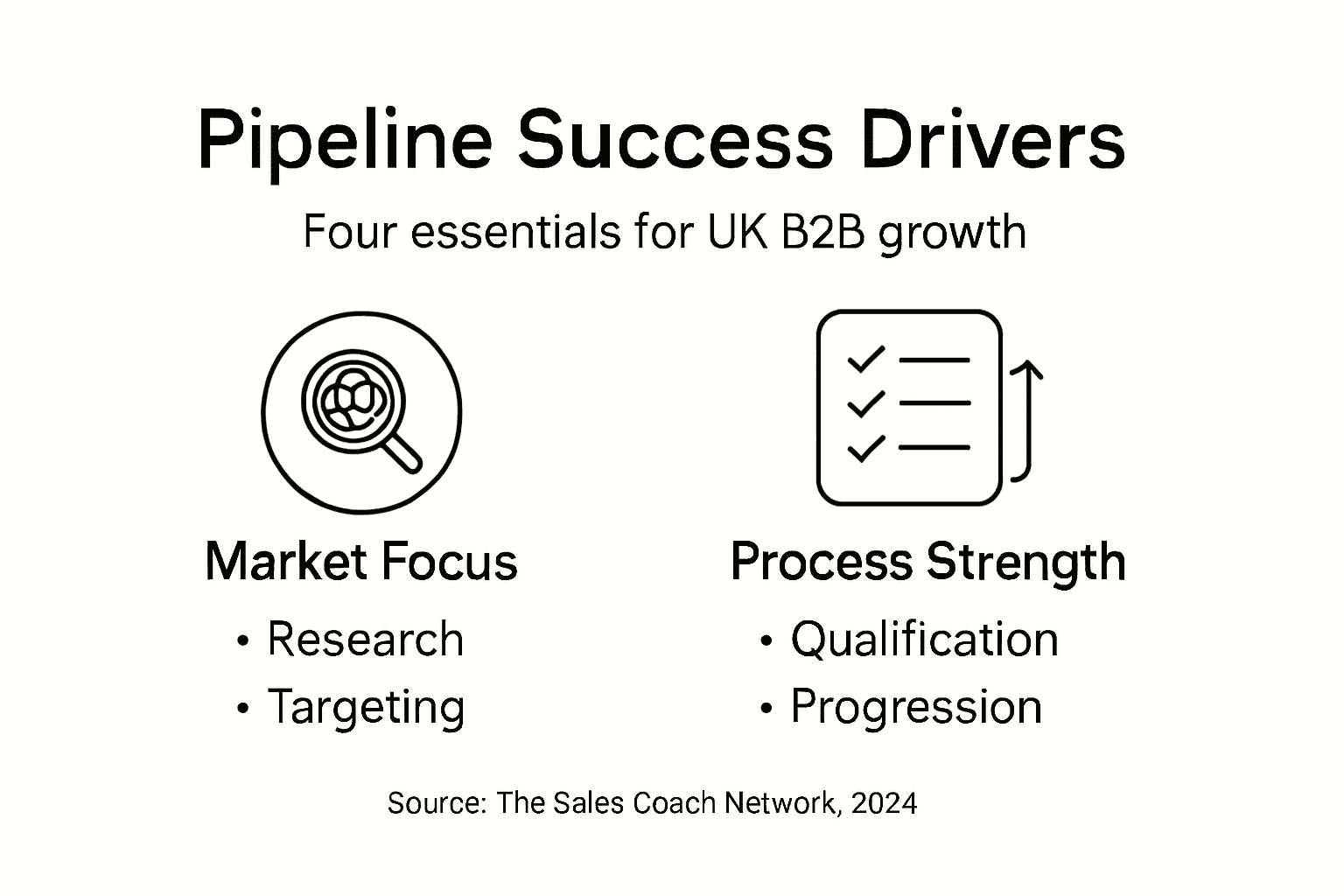
Advanced pipeline development also necessitates a disciplined approach to opportunity qualification and progression. This involves implementing rigorous assessment frameworks that evaluate potential deals based on multiple dimensions, including strategic alignment, financial viability, resource requirements, and probability of successful conversion. Successful B2B sales organisations create sophisticated scoring mechanisms that enable sales teams to prioritise opportunities, allocate resources efficiently, and maintain a high-quality, predictable pipeline that supports sustainable revenue generation.
Insider Tip: Develop a dynamic pipeline management system that combines data-driven insights with strategic flexibility, allowing your sales team to adapt quickly to changing market conditions and client expectations.
Risks, challenges and common mistakes
B2B inside sales management confronts numerous strategic risks that can undermine organisational performance and growth potential. Identifying operational risks remains critical for maintaining sustainable sales strategies. These risks encompass multiple dimensions, including compliance challenges, performance inconsistencies, and potential regulatory vulnerabilities that can significantly impact business outcomes.
Common mistakes in inside sales management often stem from inadequate risk assessment and insufficient performance monitoring. These typically include poor lead qualification processes, inconsistent sales methodologies, and failure to implement robust performance tracking mechanisms. Sales teams frequently struggle with over-optimistic pipeline projections, insufficient customer segmentation, and a lack of disciplined opportunity evaluation, which can lead to resource misallocation and reduced overall sales effectiveness.
Regulatory compliance represents another critical risk area for B2B sales organisations. Market practice guidelines highlight significant compliance challenges that demand proactive management. Potential pitfalls include misleading sales representations, inadequate documentation, insufficient transparency in client communications, and failure to maintain proper records. These compliance risks can result in substantial financial penalties, reputational damage, and potential legal consequences that extend far beyond immediate sales performance implications.
Insider Tip: Implement a comprehensive risk management framework that combines regular training, systematic performance reviews, and continuous compliance monitoring to mitigate potential sales management vulnerabilities.
Boost Your Inside Sales Management for B2B Growth in the UK
If you are facing challenges with unpredictable revenue, stalled deals, or inconsistent team performance in your inside sales operations, you are not alone. Inside sales management demands more than just traditional training – it requires a scalable sales operating system that aligns strategy, enablement, and disciplined execution. The article highlights key pain points such as the need for sophisticated team structures, robust pipeline management, and stringent risk mitigation strategies. These are the very challenges The Sales Coach Network specialises in solving.
Our expert practitioners understand the complexities of UK B2B sales environments and provide targeted solutions that increase pipeline opportunities, boost average deal size, improve win rates, and shorten sales cycles. By embedding practical methodologies like the Sales Accelerator Method and applying consultative sales techniques, your team will engage prospects more effectively and drive measurable growth. Don’t settle for generic training that fails to address your systemic issues.
Explore how partnering with us can transform your inside sales management today. Visit The Sales Coach Network to discover bespoke sales leadership training and performance coaching services designed specifically for complex B2B teams. Take control of your sales pipeline and build a disciplined sales culture that delivers results now.
Frequently Asked Questions
What is inside sales management in B2B?
Inside sales management in B2B refers to the strategic coordination of remote sales teams that use digital communication tools to build relationships and close deals, as opposed to traditional field sales.
What are the key responsibilities of a B2B inside sales manager?
The key responsibilities include team development, performance tracking, recruitment, training, setting targets, and establishing sales processes to ensure revenue generation and exceptional customer experiences.
What are the main differences between inside sales and field sales?
Inside sales primarily utilise digital channels and operate remotely, while field sales involve in-person meetings and direct client engagements. Inside sales are generally more cost-effective due to reduced travel.
How can effective pipeline management enhance B2B sales success?
Effective pipeline management improves sales success by systematically identifying, qualifying, and advancing business opportunities through thorough market analysis, structured qualification processes, and adaptive engagement strategies.
Recommended


