
Sales Team Leader Roles – Driving UK B2B Growth
- The Sales Coach Network
- Jan 20
- 8 min read


Pipeline challenges weigh heavily on many UK sales directors, especially in the demanding world of enterprise IT. When revenue goals depend on coordinated efforts rather than isolated wins, effective leadership strategies can be the deciding factor between stagnation and growth. This article offers a clear view of what defines an exceptional Sales Team Leader, detailing the leadership skills, approaches, and operational insights needed to transform team capability and drive consistent pipeline generation.
Table of Contents
Key Takeaways
Point | Details |
Sales Team Leader Role | A Sales Team Leader in UK B2B is crucial for transforming individual performance into a cohesive, high-performing unit through strategic guidance and coaching. |
Leadership Styles | Adaptability in leadership styles—such as Transformational and Consultative—is essential for fostering team dynamics and driving consistent revenue growth. |
Essential Skills | Key skills for effective leadership include strategic intelligence, emotional competence, and technological adaptability, enabling leaders to navigate complex sales environments successfully. |
Avoiding Common Pitfalls | Leaders should avoid micromanagement and inconsistent performance management to ensure team motivation and effectiveness; embracing technology is also critical for modern sales leadership. |
Defining the Sales Team Leader Role
A Sales Team Leader in the UK B2B environment is a strategic professional responsible for guiding, developing, and driving sales performance across complex enterprise landscapes. These leaders are not merely managers but performance architects who transform individual sales capabilities into coordinated, high-performing units. Team dynamics in sales leadership require nuanced understanding of both human potential and commercial objectives.
The core responsibilities of a Sales Team Leader encompass multiple critical dimensions. They must simultaneously manage individual performance, cultivate team culture, design strategic approaches, and interface with senior leadership. Key accountabilities include setting sales targets, implementing performance management frameworks, coaching team members, monitoring sales pipelines, and creating scalable processes that drive consistent revenue generation.
Successful Sales Team Leaders in UK B2B sectors understand that their role transcends traditional management. They are change agents who must balance data-driven decision making with emotional intelligence. This means developing robust qualification methodologies, installing disciplined cadences for deal progression, and building trust across complex buying committees. Their ability to translate strategic vision into actionable team performance is what distinguishes exceptional leaders from average managers.
Pro tip: Invest at least 40% of your leadership time in direct coaching and skill development, focusing on individual team member growth trajectories rather than purely numerical performance metrics.
Types of Sales Leadership Styles
Sales leadership styles in UK B2B environments are dynamic frameworks that profoundly influence team performance and organisational success. Understanding these approaches is critical for creating adaptive, high-performing sales units. Sales leadership approaches reveal nuanced strategies for driving consistent revenue growth.
Five primary leadership styles emerge in contemporary sales management: the Transformational Leader, the Consultative Coach, the Strategic Orchestrator, the Performance Driver, and the Collaborative Enabler. Each style represents a unique approach to team development and performance management. The Transformational Leader inspires through vision and personal charisma, creating an environment of continuous improvement. The Consultative Coach focuses on individual skill development, providing personalised guidance and structured learning opportunities. The Strategic Orchestrator designs comprehensive sales ecosystems, aligning team efforts with broader organisational objectives.
The Performance Driver maintains rigorous accountability through data-driven metrics and clear performance expectations. This approach emphasises quantitative outcomes and systematic process improvement. Conversely, the Collaborative Enabler prioritises team dynamics, fostering an environment of mutual support, knowledge sharing, and collective problem solving. These leaders create interconnected teams where individual strengths are leveraged for collective success, breaking down traditional hierarchical barriers and promoting a more holistic approach to sales performance.
Here is a comparison of prominent sales leadership styles and their typical team impact:
Leadership Style | Key Focus | Typical Team Outcome |
Transformational Leader | Inspiring vision | Heightened innovation and motivation |
Consultative Coach | Individual skill growth | Improved team competencies |
Strategic Orchestrator | Process and alignment | Harmonised efforts and efficiency |
Performance Driver | Targets and accountability | Consistent results, fast corrections |
Collaborative Enabler | Team collaboration | Enhanced support and knowledge sharing |
Pro tip: Regularly assess and adapt your leadership style to match your team’s evolving capabilities and organisational challenges, recognising that flexibility is key to sustained sales excellence.
Essential Skills for UK Sales Team Leaders
UK B2B sales leadership demands a sophisticated blend of strategic, interpersonal, and technical competencies that extend far beyond traditional management approaches. Sales leadership development requires mastery of complex skills that drive organisational performance and individual team member growth.
The essential skills for contemporary sales team leaders can be categorised into three critical domains: strategic intelligence, emotional competence, and technological adaptability. Strategic intelligence encompasses the ability to analyse market dynamics, design robust sales frameworks, and translate organisational objectives into actionable team strategies. This involves advanced skills in data interpretation, predictive analytics, and strategic planning. Emotional competence represents the leader’s capacity to understand, motivate, and develop individual team members through nuanced communication, empathetic coaching, and personalised performance management.

Technological adaptability has become a paramount skill in modern sales leadership. UK sales team leaders must demonstrate proficiency in digital sales technologies, customer relationship management systems, and advanced analytics platforms. They need to create technology-enabled sales ecosystems that enhance team productivity, provide real-time performance insights, and support data-driven decision making. This requires continuous learning, technological curiosity, and the ability to integrate emerging digital tools seamlessly into existing sales processes.
The following table summarises key skills required for effective UK B2B sales team leadership:
Skill Domain | Example Skills | Business Advantage |
Strategic Intelligence | Market analysis, forecasting | Aligns team with long-term objectives |
Emotional Competence | Empathetic coaching, motivation | Boosts morale and retention |
Technological Adaptability | CRM proficiency, analytics | Increases efficiency and insight |
Pro tip: Invest in your own continuous learning by dedicating at least two hours weekly to understanding emerging sales technologies and leadership methodologies, ensuring you remain at the forefront of sales performance innovation.
Strategic and Operational Responsibilities
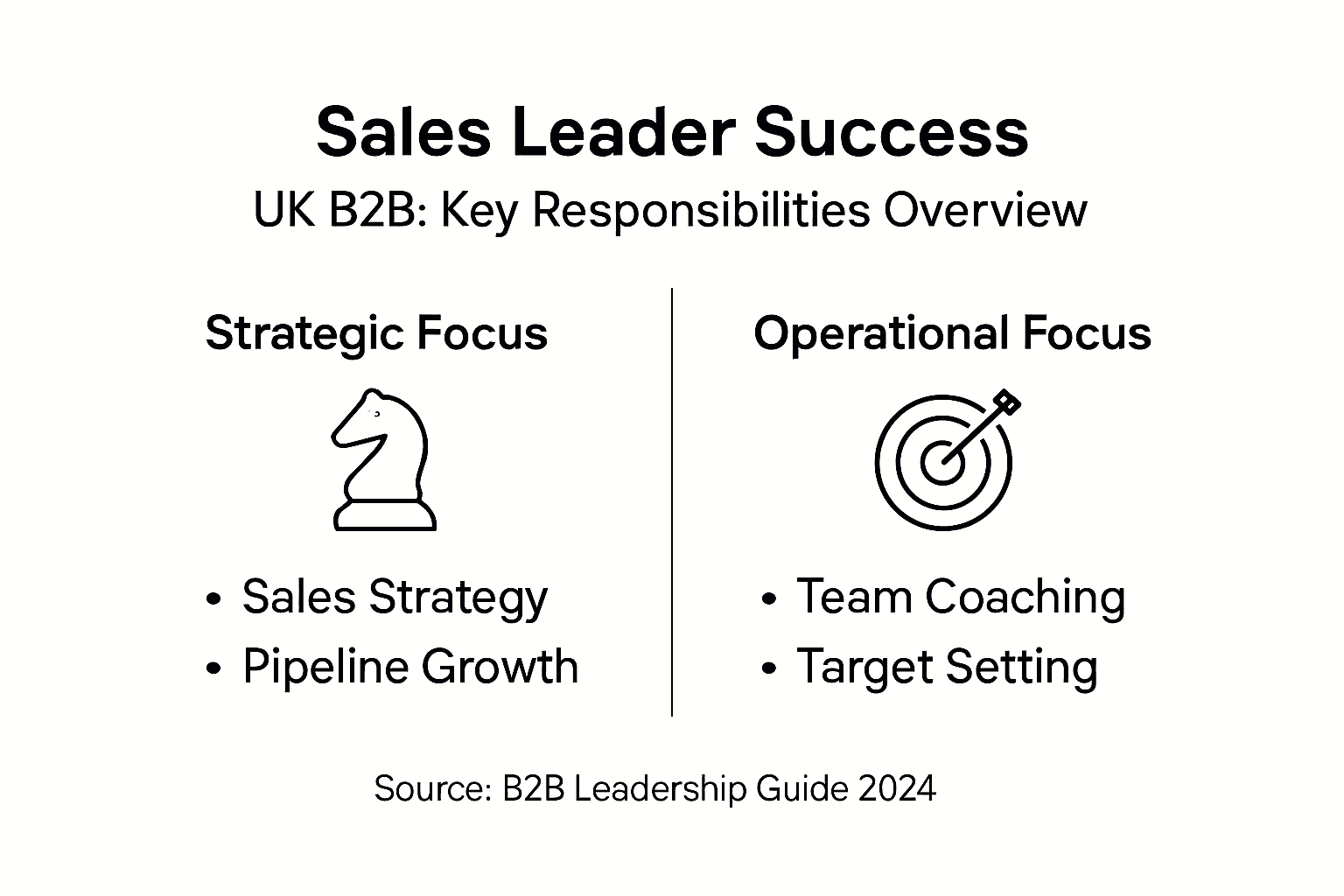
Sales team leaders in UK B2B environments shoulder multifaceted responsibilities that bridge strategic vision and tactical execution. Sales team manager responsibilities encompass a comprehensive approach to driving organisational performance through intricate leadership mechanisms.
Strategically, these leaders must develop comprehensive sales frameworks that align with broader organisational objectives. This involves creating detailed sales strategies, establishing clear performance metrics, and designing robust qualification methodologies. They are responsible for analysing market dynamics, identifying emerging opportunities, and crafting nuanced approaches that differentiate their teams in competitive landscapes. Operationally, this translates into developing precise sales pipelines, implementing systematic lead generation processes, and creating scalable revenue generation models that can adapt to rapidly changing business environments.
The operational dimension of sales leadership demands meticulous attention to performance management, talent development, and continuous improvement processes. Sales team leaders must design and implement comprehensive coaching programmes, establish performance tracking systems, and create accountability frameworks that motivate individual team members while maintaining collective team momentum. This requires a delicate balance between data-driven performance management and empathetic leadership, ensuring that each team member receives personalised guidance while maintaining overall team effectiveness.
Pro tip: Develop a quarterly strategic review process that critically examines your sales approach, allowing for rapid adaptation and continuous refinement of your team’s performance methodology.
Impact on Pipeline and Revenue Performance
Sales team leaders fundamentally transform organisational revenue potential through strategic pipeline management and performance optimisation. Pipeline management strategies represent the critical mechanism through which sales leaders drive predictable and sustainable revenue growth in complex UK B2B environments.
The impact of effective sales leadership extends far beyond traditional performance metrics. These leaders create comprehensive ecosystems that enhance pipeline quality, accelerate deal velocity, and systematically reduce sales cycle complexity. By implementing advanced qualification methodologies, they ensure teams focus exclusively on high-probability opportunities, dramatically improving conversion rates and average deal values. This involves developing rigorous lead assessment frameworks, creating targeted engagement strategies, and installing disciplined processes that filter out low-potential prospects while nurturing high-value potential customers.
Moreover, sales team leaders directly influence revenue performance through sophisticated performance management techniques. They design granular tracking systems that provide real-time insights into individual and collective sales team performance, enabling rapid interventions and continuous skill development. By integrating data-driven coaching, personalised development programmes, and transparent accountability mechanisms, these leaders transform sales teams from reactive units into proactive revenue generation engines that consistently exceed organisational targets.
Pro tip: Implement a weekly pipeline review process that critically examines opportunity quality, deal progression rates, and potential blockages, ensuring your team maintains a dynamic and high-performing sales ecosystem.
Common Pitfalls and What to Avoid
Sales team leaders in UK B2B environments must navigate a complex landscape of potential leadership challenges that can undermine team performance and organisational growth. Role of leadership strategies reveals critical insights into avoiding systemic leadership failures that compromise sales effectiveness.
One significant pitfall is the tendency to micromanage, which paradoxically reduces team performance and individual motivation. Ineffective leaders often become trapped in detailed operational tasks, neglecting strategic oversight and team development. This approach stifles individual creativity, reduces accountability, and creates dependency structures that prevent sales professionals from developing critical problem solving skills. Another common mistake involves inconsistent performance management, where leaders fail to establish clear, measurable expectations and provide structured, ongoing feedback mechanisms.
Technological disconnection represents another substantial risk for contemporary sales leaders. Many struggle to integrate advanced analytics, customer relationship management systems, and performance tracking technologies effectively. This technological resistance creates significant blind spots in understanding team dynamics, individual performance trajectories, and emerging market opportunities. Leaders who fail to embrace data driven insights and continuously upgrade their technological capabilities risk becoming obsolete in an increasingly complex and rapidly evolving sales environment.
Pro tip: Conduct quarterly self assessments of your leadership approach, actively seeking feedback from team members and critically examining your own potential blind spots and areas for improvement.
Elevate Your Sales Team Leadership to Drive UK B2B Growth
The article highlights the complex role of Sales Team Leaders in orchestrating team performance, pipeline quality, and revenue outcomes within UK B2B environments. If you are facing challenges such as inconsistent team results, prolonged sales cycles, or difficulty managing pipeline quality through strategic qualification and coaching, you are not alone. These pain points are exactly what the Sales Coach Network specialises in resolving by embedding scalable sales operating systems that transform teams and embed disciplined execution.
By applying concepts like the Forty-20-40 Principle and focusing on both strategic intelligence and emotional competence, our tailored sales training programmes and sales coaching services enable sales leaders to shift from micromanagement pitfalls toward empowering leadership that drives measurable revenue growth. If you want to accelerate your team’s ability to build qualified pipeline, increase deal values, and improve win rates while shortening sales cycles, then now is the time to act.
Explore how partnering with a practitioner-led firm can embed real, sustainable change across your sales ecosystem. Visit The Sales Coach Network to discover how our proven frameworks and expert coaching turn sales team leaders into true performance architects. Take the first step toward predictable, scalable growth today.
Frequently Asked Questions
What are the core responsibilities of a Sales Team Leader?
Sales Team Leaders are responsible for managing individual performance, cultivating team culture, setting sales targets, implementing performance management frameworks, coaching team members, monitoring sales pipelines, and creating scalable processes for consistent revenue generation.
What leadership styles are effective for leading sales teams?
Effective leadership styles include Transformational Leaders who inspire through vision, Consultative Coaches who focus on individual development, Strategic Orchestrators who align team efforts with organisational objectives, Performance Drivers who emphasis data-driven accountability, and Collaborative Enablers who foster team support and knowledge sharing.
What essential skills should Sales Team Leaders possess?
Sales Team Leaders should possess strategic intelligence, emotional competence, and technological adaptability. This includes skills in market analysis, empathetic coaching, and proficiency in digital sales technologies and analytics platforms.
How can Sales Team Leaders impact pipeline and revenue performance?
Sales Team Leaders can enhance pipeline quality, accelerate deal velocity, and improve conversion rates by implementing advanced qualification methodologies, creating detailed performance tracking systems, and providing data-driven coaching to maintain a high-performing sales ecosystem.
Recommended


